Mosquito receptor for human-sweat odorant (original) (raw)
- Brief Communication
- Published: 15 January 2004
Olfaction
Nature volume 427, pages 212–213 (2004) Cite this article
- 3669 Accesses
- 190 Citations
- 13 Altmetric
- Metrics details
Abstract
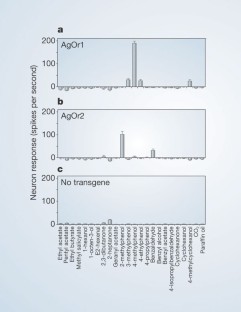
Female Anopheles mosquitoes, the world's most important vector of Plasmodium falciparum malaria, locate their human hosts primarily through olfactory cues1, but the molecular mechanisms that underlie this recognition are a mystery. Here we show that the Anopheles gambiae protein AgOr1, a female-specific member of a family of putative odorant receptors2,3, responds to a component of human sweat. Compounds designed to activate or block receptors of this type could function as attractants for trapping mosquitoes or as insect repellents in helping to control Anopheles and other insect pests.
This is a preview of subscription content, access via your institution
Access options
Subscribe to this journal
Receive 52 print issues and online access
$199.00 per year
only $3.83 per issue
Buy this article
- Purchase on SpringerLink
- Instant access to the full article PDF.
USD 39.95
Prices may be subject to local taxes which are calculated during checkout
Additional access options:
Figure 1: Identification of a mosquito odorant receptor that responds to a component of human sweat by expression in a Drosophila olfactory receptor neuron.
References
- Takken, W. in Olfaction in Mosquito–Host Interactions (eds Bock, G. R. & Cardew, G.) 302–312 (Wiley, New York, 1996).
Google Scholar - Fox, A., Pitts, R., Robertson, H., Carlson, J. R. & Zwiebel, L. Proc. Natl Acad. Sci. USA 98, 14693–14697 (2001).
Article ADS CAS PubMed Google Scholar - Hill, C. A. et al. Science 298, 176–178 (2002).
Article ADS CAS PubMed Google Scholar - Dobritsa, A. A., van der Goes van Naters, W., Warr, C. G., Steinbrecht, R. A. & Carlson, J. R. Neuron 37, 827–841 (2003).
Article CAS PubMed Google Scholar - Cork, A. & Park, K. C. Med. Vet. Entomol. 10, 269–276 (1996).
Article CAS PubMed Google Scholar - Takken, W., van Loon, J. J. & Adam, W. J. Insect Physiol. 47, 303–310 (2001).
Article CAS PubMed Google Scholar - Vale, G. A., Hall, D. R. & Gouch, A. J. E. Bull. Entomol. Res. 78, 293–300 (1988).
Article CAS Google Scholar - Gross, S. P., Guo, Y., Martinez, J. E. & Welte, M. A. Curr. Biol. 13, 1660–1668 (2003).
Article CAS PubMed Google Scholar
Author information
Author notes
- A. Nicole Fox
Present address: Division of Biology, California Institute of Technology, Pasadena, California, 91125, USA
Authors and Affiliations
- Department of Molecular, Cellular and Developmental Biology, Yale University, New Haven, 06520, Connecticut, USA
Elissa A. Hallem & John R. Carlson - Department of Biological Sciences, Program in Developmental Biology and Center for Molecular Neuroscience, Vanderbilt University, Nashville, 37235, Tennessee, USA
A. Nicole Fox & Laurence J. Zwiebel
Authors
- Elissa A. Hallem
- A. Nicole Fox
- Laurence J. Zwiebel
- John R. Carlson
Corresponding author
Correspondence toJohn R. Carlson.
Ethics declarations
Competing interests
The authors declare no competing financial interests.
Rights and permissions
About this article
Cite this article
Hallem, E., Nicole Fox, A., Zwiebel, L. et al. Mosquito receptor for human-sweat odorant.Nature 427, 212–213 (2004). https://doi.org/10.1038/427212a
- Issue date: 15 January 2004
- DOI: https://doi.org/10.1038/427212a