Unidirectional rotary motion in a molecular system (original) (raw)
- Letter
- Published: 09 September 1999
Nature volume 401, pages 150–152 (1999) Cite this article
- 9341 Accesses
- 763 Citations
- 13 Altmetric
- Metrics details
Abstract
The conversion of energy into controlled motion plays an important role in both man-made devices and biological systems. The principles of operation of conventional motors are well established, but the molecular processes used by ‘biological motors’ such as muscle fibres, flagella and cilia1,2,3,4,5,6,7,8,9 to convert chemical energy into co-ordinated movement remain poorly understood10,11,12. Although ‘brownian ratchets’13,14,15,16 are known to permit thermally activated motion in one direction only, the concept of channelling random thermal energy into controlled motion has not yet been extended to the molecular level. Here we describe a molecule that uses chemical energy to activate and bias a thermally induced isomerization reaction, and thereby achieve unidirectional intramolecular rotary motion. The motion consists of a 120° rotation around a single bond connecting a three-bladed subunit to the bulky remainder of the molecule, and unidirectional motion is achieved by reversibly introducing a tether between the two units to energetically favour one of the two possible rotation directions. Although our system does not achieve continuous and fast rotation, the design principles that we have used may prove relevant for a better understanding of biological and synthetic molecular motors producing unidirectional rotary motion.
This is a preview of subscription content, access via your institution
Access options
Subscribe to this journal
Receive 51 print issues and online access
$199.00 per year
only $3.90 per issue
Buy this article
- Purchase on SpringerLink
- Instant access to the full article PDF.
USD 39.95
Prices may be subject to local taxes which are calculated during checkout
Additional access options:
Figure 1: Compound 1, a triptycyl[4]helicene.
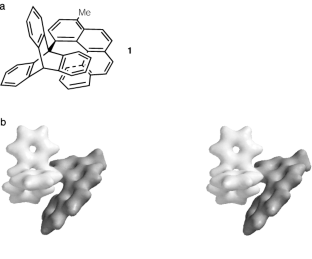
The alternative text for this image may have been generated using AI.
Figure 2: Schematic representation of the concepts underlying the design of the system.
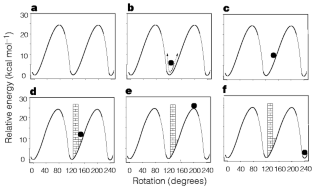
The alternative text for this image may have been generated using AI.
Figure 3: Sequence of events in the chemically powered rotation of 2 to 7.
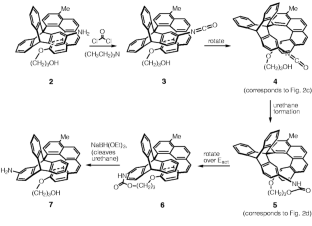
The alternative text for this image may have been generated using AI.
Figure 4
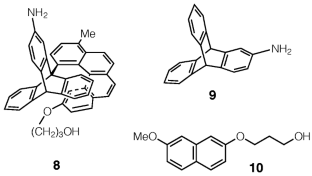
The alternative text for this image may have been generated using AI.
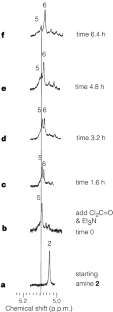
Figure 5: Spectroscopic evidence that carbonyl dichloride fuels the unidirectional rotation of 2.
The alternative text for this image may have been generated using AI.
An electric molecular motor
Article Open access 11 January 2023
References
- Rayment,I. et al. Structure of the actin-myosin complex and its implications for muscle contraction. Science 261, 58–65 (1993).
Article ADS CAS PubMed Google Scholar - Abrahams,J. P., Leslie,A. G. W., Lutter,R. & Walker,J. E. Structure at 2.8 Å resolution of F1-ATPase from bovine heart mitochondria. Nature 370, 621–628 (1994).
Article ADS CAS PubMed Google Scholar - Dominguez,R., Freyzon,Y., Trybus,K. M. & Cohen,C. Crystal structure of a vertebrate smooth muscle myosin motor domain and its complex with the essential light chain: visualization of the pre-power stroke state. Cell 94, 559–571 (1998).
Article CAS PubMed Google Scholar - Block,S. M. Real engines of creation. Nature 386, 217–219 (1997).
Article ADS CAS PubMed Google Scholar - Noji,H., Yasuda,R., Yoshida,M. & Kinoshita, K. Jr Direct observation of the rotation of F1-ATPase. Nature 386, 299–302 (1997).
Article ADS CAS PubMed Google Scholar - Boyer,P. D. The ATP synthase—a splendid molecular machine. Annu. Rev. Biochem. 66, 717–749 (1997).
Article CAS PubMed Google Scholar - Shingyoji,C., Higuchi,H., Yoshimura,M., Katayama,E. & Yanagida,T. Dynein arms are oscillating force generators. Nature 393, 711–714 (1998).
Article ADS CAS PubMed Google Scholar - Berg,H. C. Keeping up with F1-ATPase. Nature 394, 324–325 (1998).
Article ADS CAS PubMed Google Scholar - Vale,R. D. & Oosawa,F. Protein motors and Maxwell's demons: does mechanochemical transduction involve a thermal ratchet? Adv. Biophys. 26, 97–134 (1990).
Article CAS PubMed Google Scholar - Stryer,L. in Biochemistry Ch. 15, 4th edn (W. H. Freeman, New York, 1995).
Google Scholar - Howard,J. Molecular motors: structural adaptations to cellular functions. Nature 389, 561–567 (1997).
Article ADS CAS PubMed Google Scholar - Huxley,A. How molecular motors work in muscle. Nature 391, 239–240 (1998).
Article ADS CAS PubMed Google Scholar - Faucheux,L. P., Bourdieu,L. S., Kaplan,P. D. & Libchaber,A. J. Optical thermal ratchet. Phys. Rev. Lett. 74, 1504–1507 (1995).
Article ADS CAS PubMed Google Scholar - Travis,J. Making light work of Brownian motion. Science 267, 1593–1594 (1995).
Article ADS CAS PubMed Google Scholar - Astumian,R. D. Thermodynamics and kinetics of Brownian motion. Science 276, 917–922 (1997).
Article CAS PubMed Google Scholar - Rousselet,J., Salome,L., Ajdari,k A. & Prost,J. Directed motion of brownian particles induced by a periodic asymmetric potential. Nature 370, 446–448 (1994).
Article ADS CAS PubMed Google Scholar - Mislow,K. Molecular machinery in organic chemistry. Chemtracts—Org. Chem. 2, 151–174 (1989).
Google Scholar - Bedard,T. C. & Moore,J. S. Design and synthesis of molecular turnstiles. J. Am. Chem. Soc. 117, 10662–10671 (1995).
Article CAS Google Scholar - Balzani,V., Gomez-Lopez,M. & Stoddard,J. F. Molecular machines. Acc. Chem. Res. 31, 405–414 (1998).
Article CAS Google Scholar - Sauvage, J.-P. Transition metal-containing rotaxanes and catenanes in motion: toward molecular machines and motors. Acc. Chem. Res. 31, 611–619 (1998).
Article Google Scholar - Bissell,R. A., Cordova,E., Kaifer,A. & Stoddart,J. F. A chemically and electrochemically switchable molecular shuttle. Nature 369, 133–137 (1994).
Article ADS CAS Google Scholar - Benniston,A. C. & Harriman,A. A light-induced molecular shuttle based on a [2]rotaxane-derived triad. Angew. Chem. Int. Edn. Engl. 32, 1459–1461 (1993).
Article Google Scholar - Mao,C., Sun,W., Shen,Z. & Seeman,N. C. A nanomechanical device based on the B-Z transition of DNA. Nature 397, 144–146 (1999).
Article ADS CAS PubMed Google Scholar - Kelly,T. R., Tellitu,I. & Sestelo,J. P. In search of molecular ratchets. Angew. Chem. Int. Edn. Engl. 36, 1866–1868 (1997).
Article CAS Google Scholar - Kelly,T. R., Sestelo,J. P. & Tellitu,I. New molecular devices: in search of a molecular ratchet. J. Org. Chem. 63, 3655–3665 (1998).
Article CAS Google Scholar - Davis,A. P. Tilting at windmills? The second law survives. Angew. Chem. Int. Edn. Engl. 37, 909–910 (1998).
Article ADS CAS Google Scholar - Musser,G. Taming Maxwell's demon. Sci. Am. 280, 24 (1999).
Google Scholar - Kelly,T. R. et al. A molecular brake. J. Am. Chem. Soc. 116, 3657–3658 (1994).
Article CAS Google Scholar
Acknowledgements
We thank S. Jasmin and Y. Zhao for contributions to the preparation of necessary quantities of 2, and J. Sieglen and B. Wang for technical assistance. This work was supported by the NIH.
Author information
Authors and Affiliations
- Department of Chemistry, E. F. Merkert Chemistry Center, Boston College, Chestnut Hill, 02467, Massachusetts, USA
T. Ross Kelly, Harshani De Silva & Richard A. Silva
Authors
- T. Ross Kelly
- Harshani De Silva
- Richard A. Silva
Corresponding author
Correspondence toT. Ross Kelly.
Rights and permissions
About this article
Cite this article
Kelly, T., De Silva, H. & Silva, R. Unidirectional rotary motion in a molecular system.Nature 401, 150–152 (1999). https://doi.org/10.1038/43639
- Received: 11 March 1999
- Accepted: 16 July 1999
- Issue date: 09 September 1999
- DOI: https://doi.org/10.1038/43639