Coupled ocean–atmosphere dynamics in the Indian Ocean during 1997–98 (original) (raw)
- Letter
- Published: 23 September 1999
Nature volume 401, pages 356–360 (1999) Cite this article
- 6971 Accesses
- 1917 Citations
- 23 Altmetric
- Metrics details
Abstract
Climate variability in the Indian Ocean region seems to be, in some aspects, independent of forcing by external phenomena such as the El Niño/Southern Oscillation1,2,3,4. But the extent to which, and how, internal coupled ocean–atmosphere dynamics determine the state of the Indian Ocean system have not been resolved. Here we present a detailed analysis of the strong seasonal anomalies in sea surface temperatures, sea surface heights, precipitation and winds that occurred in the Indian Ocean region in 1997–98, and compare the results with the record of Indian Ocean climate variability over the past 40 years. We conclude that the 1997–98 anomalies—in spite of the coincidence with the strong El Niño/Southern Oscillation event—may primarily be an expression of internal dynamics, rather than a direct response to external influences. We propose a mechanism of ocean–atmosphere interaction governing the 1997–98 event that may represent a characteristic internal mode of the Indian Ocean climate system. In the Pacific Ocean, the identification of such a mode has led to successful predictions of El Niño5; if the proposed Indian Ocean internal mode proves to be robust, there may be a similar potential for predictability of climate in the Indian Ocean region.
This is a preview of subscription content, access via your institution
Access options
Subscribe to this journal
Receive 52 print issues and online access
$199.00 per year
only $3.83 per issue
Buy this article
- Purchase on SpringerLink
- Instant access to the full article PDF.
USD 39.95
Prices may be subject to local taxes which are calculated during checkout
Additional access options:
Figure 1: Evolution of the state of the Indian Ocean, 1997–98.
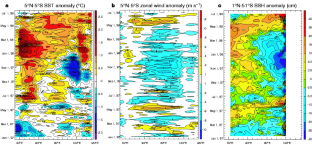
The alternative text for this image may have been generated using AI.
Figure 2: State of the Indian Ocean in November 1997.
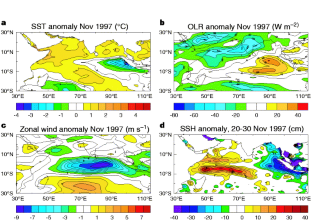
The alternative text for this image may have been generated using AI.
Figure 3: The evolving sea surface height (SSH) field.
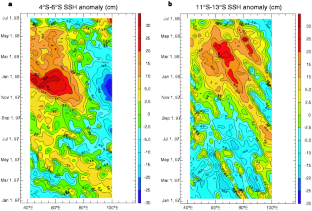
The alternative text for this image may have been generated using AI.
Figure 4: Diagram of the sequence of events in 1997–98.
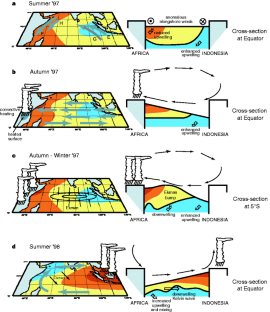
The alternative text for this image may have been generated using AI.
References
- Nicholls,N. Air-sea interaction and the quasi-biennial oscillation. Mon. Weath. Rev. 106, 1505–1508 (1983).
Article ADS Google Scholar - Nicholls,N. All-India summer monsoon rainfall and sea surface temperature around northern Australia and Indonesia. J. Clim. 8, 1463–1467 (1995).
Article ADS Google Scholar - Meehl,G. A. Coupled ocean-atmosphere-land processes and south Asian monsoon variability. Science 265, 263–267 (1994).
Article ADS Google Scholar - Meehl,G. A. The south Asian monsoon and the tropospheric biennial oscillation. J. Clim. 10, 1921–1943 (1997).
Article ADS Google Scholar - Webster,P. J. & Palmer,T. N. The past and future of El Niño. Nature 390, 562–564 (1997).
Article ADS Google Scholar - Reynolds,R. & Marisco,D. An improved real-time global sea surface temperature analysis. J. Clim. 6, 114–119 (1993).
Article ADS Google Scholar - Kalnay,E. et al. The NCEP/NCAR 40-year reanalysis project. Bull. Am. Meteorol. Soc. 77, 437–471 (1996).
Article ADS Google Scholar - Hendricks,J. R., Leben,R. R., Born,G. H. & Koblinsky,C. J. Empirical orthogonal function analysis of global TOPEX/POSEIDON altimeter data and implications for detection of global sea level rise. J. Geophys. Res. 101, 14131–14145 (1996).
Article ADS Google Scholar - Yu,L. & Rienecker, M. M. Mechanisms for the Indian Ocean warming during the 1997–1998 El Niño. Geophys. Res. Lett. 26, 735–738 (1999).
Article ADS Google Scholar - Barnett,T. P. Interaction of the monsoon and Pacific Ocean trade wind systems at interannual time scales. Part I: the equatorial zone. Mon. Weath. Rev. 111, 756–773 (1983).
Article ADS Google Scholar - Arkin,P. & Meisner,B. The relationship between large-scale convective rainfall and cloud cover over the western hemisphere during 1982–1984. Mon. Weath. Rev. 115, 51–74 (1987).
Article ADS Google Scholar - Webster,P. J. Response of the tropical atmosphere to local steady forcing. Mon. Weath. Rev. 100, 518–541 (1972).
Article ADS Google Scholar - Gill,A. E. Some simple solutions for heat-induced tropical circulation. Q. J. R. Meteorol. Soc. 106, 447–462 (1981).
Article ADS Google Scholar - Near Real-Time Analysis of the Ocean and Atmosphere Fig T 29, p. 36 (Climate Diagnostics Bull. NO. 97/11, Climate Diagnostics Center, National Center of Environmental Prediction, NOAA, Washington DC, 1997).
- Gill,A. Atmosphere-Ocean Dynamics (Academic, London, 1982).
Google Scholar - Webster,P. J. et al. Monsoons: processes, predictability and the prospects for prediction. J. Geophys. Res. 103, 14451–14510 (1998).
Article ADS Google Scholar - Nicholson,S. E. & Kim,J. The relationship of the El-Niño Southern Oscillation to African rainfall. Int. J. Climatol. 17, 117–135 (1997).
Article Google Scholar - Nicholson,S. E. An analysis of the ENSO signal in the tropical Atlantic and western Indian Oceans. Int. J. Climatol. 17, 345–375 (1997).
Article Google Scholar - Reverdin,G., Cadet,D. & Gutzler,D. Interannual displacements of convection and surface circulation over the equatorial Indian Ocean. Q. J. R. Meteorol. Soc. 122, 43–67 (1986).
Article ADS Google Scholar - Kapala,A., Born,K. & Flohn,H. in Proc. Int. Conf. on Monsoon Variability and Prediction (ed. Newson, R.) 119–126 (Tech. Doc. 619, World Meteorological Organization, Geneva, Switzerland, 1994).
Google Scholar - Rao,K. G. & Goswami,B. N. Interannual variations of the sea-surface temperature over the Arabian Sea and the Indian Monsoon: A new perspective. Mon. Weath. Rev. 116, 558–568 (1988).
Article ADS Google Scholar - Shukla,J. & Mooley,D. A. Empirical prediction of the summer monsoon over India. Mon. Weath. Rev. 115, 695–703 (1987).
Article ADS Google Scholar
Acknowledgements
This work was supported by the Office of Global Programs, NOAA, and the NSF (P.J.W., A.M.M., J.P.L.), and by NASA (R.R.L.).
Author information
Authors and Affiliations
- Program in Atmospheric and Oceanic Sciences, Campus Box 311, University of Colorado, Boulder, 80309-311, Colorado, USA
Peter J. Webster, Andrew M. Moore & Johannes P. Loschnigg - Department of Aerospace Engineering Sciences, Colorado Center for Astrodynamics Research, University of Colorado, Boulder, 80309-311, Colorado, USA
Robert R. Leben
Authors
- Peter J. Webster
- Andrew M. Moore
- Johannes P. Loschnigg
- Robert R. Leben
Corresponding author
Correspondence toPeter J. Webster.
Supplementary information
Rights and permissions
About this article
Cite this article
Webster, P., Moore, A., Loschnigg, J. et al. Coupled ocean–atmosphere dynamics in the Indian Ocean during 1997–98.Nature 401, 356–360 (1999). https://doi.org/10.1038/43848
- Received: 06 July 1998
- Accepted: 09 July 1999
- Issue date: 23 September 1999
- DOI: https://doi.org/10.1038/43848