Kin preference in a social microbe (original) (raw)
- Brief Communication
- Published: 23 August 2006
Social evolution
- Chandra N. Jack1,
- Tiffany Talley Farnham1,
- Thomas G. Platt1 nAff3,
- Sara E. Kalla1,
- Gad Shaulsky2,
- David C. Queller1 &
- …
- Joan E. Strassmann1
Nature volume 442, pages 881–882 (2006)Cite this article
- 2220 Accesses
- 187 Citations
- 15 Altmetric
- Metrics details
Given the right circumstances, even an amoeba chooses to be altruistic towards its relatives.
Abstract
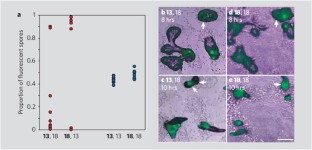
Kin recognition helps cooperation to evolve in many animals1, but it is uncertain whether microorganisms can also use it to focus altruistic behaviour on relatives. Here we show that the social amoeba Dictyostelium purpureum prefers to form groups with its own kin in situations where some individuals die to assist others. By directing altruism towards kin, D. purpureum should generally avoid the costs of chimaerism2,3 experienced by the related D. discoideum.
This is a preview of subscription content, access via your institution
Access options
Subscribe to this journal
Receive 51 print issues and online access
$199.00 per year
only $3.90 per issue
Buy this article
- Purchase on SpringerLink
- Instant access to the full article PDF.
USD 39.95
Prices may be subject to local taxes which are calculated during checkout
Additional access options:
Figure 1: Kin discrimination during social development in the amoeba Dictyostelium purpureum.
The alternative text for this image may have been generated using AI.
References
- Fletcher, D. J. C. & Michener, C. D. Kin Recognition in Animals (Wiley, Chichester, 1987).
Google Scholar - Strassmann, J. E., Zhu, Y. & Queller, D. C. Nature 408, 965–967 (2000).
Article ADS CAS Google Scholar - Foster, K. R., Fortunato, A., Strassmann, J. E. & Queller, D. C. Proc. R. Soc. Lond. B 269, 2357–2362 (2004).
Article Google Scholar - Kessin, R. H. Dictyostelium — Evolution, Cell Biology, and the Development of Multicellularity (Cambridge Univ. Press, Cambridge, 2001).
Book Google Scholar - Bonner, J. T. The Cellular Slime Molds 3rd edn (Princeton Univ. Press, Princeton, 1967).
Book Google Scholar - Buss, L. W. Proc. Natl Acad. Sci. USA 79, 5337–5341 (1982).
Article ADS CAS Google Scholar - Bonner, J. T. & Adams, M. S. J. Embryol. Exp. Morphol. 6, 346–356 (1958).
CAS PubMed Google Scholar - Kaushik, S., Katoch, B. & Nanjundiah, V. Behav. Ecol. Sociobiol. 59, 521–530 (2006).
Article Google Scholar - Reeve, H. K. Am. Nat. 133, 407–435 (1989).
Article Google Scholar - Crespi, B. J. Trends Ecol. Evol. 16, 178–183 (2001).
Article Google Scholar
Author information
Author notes
- Thomas G. Platt
Present address: Department of Biology, Indiana University, Bloomington, Indiana, 47405, USA
Authors and Affiliations
- Department of Ecology and Evolutionary Biology, Rice University, Houston, 77005, Texas, USA
Natasha J. Mehdiabadi, Chandra N. Jack, Tiffany Talley Farnham, Thomas G. Platt, Sara E. Kalla, David C. Queller & Joan E. Strassmann - Department of Molecular and Human Genetics, Baylor College of Medicine, Houston, 77030, Texas, USA
Gad Shaulsky
Authors
- Natasha J. Mehdiabadi
- Chandra N. Jack
- Tiffany Talley Farnham
- Thomas G. Platt
- Sara E. Kalla
- Gad Shaulsky
- David C. Queller
- Joan E. Strassmann
Corresponding author
Correspondence toNatasha J. Mehdiabadi.
Ethics declarations
Competing interests
The authors declare no competing financial interests.
Supplementary information
Rights and permissions
About this article
Cite this article
Mehdiabadi, N., Jack, C., Farnham, T. et al. Kin preference in a social microbe.Nature 442, 881–882 (2006). https://doi.org/10.1038/442881a
- Received: 16 January 2006
- Accepted: 29 June 2006
- Published: 23 August 2006
- Issue date: 24 August 2006
- DOI: https://doi.org/10.1038/442881a
This article is cited by
Multiple social encounters can eliminate Crozier’s paradox and stabilise genetic kin recognition
- Thomas W. Scott
- Alan Grafen
- Stuart A. West
Nature Communications (2022)
Ten recent insights for our understanding of cooperation
- Stuart A. West
- Guy A. Cooper
- Ashleigh S. Griffin
Nature Ecology & Evolution (2021)
Kin discrimination allows plants to modify investment towards pollinator attraction
- Rubén Torices
- José M. Gómez
- John R. Pannell
Nature Communications (2018)
Complex interactions underpin social behaviour in Dictyostelium giganteum
- Santosh Sathe
- Vidyanand Nanjundiah
Behavioral Ecology and Sociobiology (2018)
Species recognition in social amoebae
- Ikumi Shibano Hayakawa
- Kei Inouye
Journal of Biosciences (2018)
Editorial Summary
Relatives valued
Kin recognition helps cooperation to evolve in many animals — even in microorganisms it seems. An experiment in the social amoeba Dictyostelium purpureum shows that it prefers to form groups with its own kin. In these groups some individuals die to assist others. By directing altruism towards kin, D. purpureum may avoid the costs of participating in chimaeric groups, as experienced by the related D. discoideum.