Policing of oncogene activity by p53 (original) (raw)
- Brief Communication
- Published: 13 September 2006
Tumour biology
Nature volume 443, page 159 (2006)Cite this article
- 2094 Accesses
- 104 Citations
- Metrics details
Oncogenes, rather than DNA damage, may provide the key signal to p53 to trigger tumour suppression.
Abstract
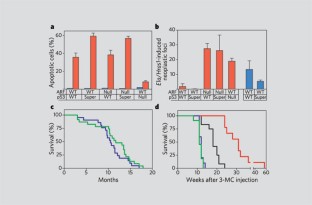
The tumour-suppressor protein p53 provides the most important genetic defence against cancer1 and is activated in response to DNA damage and to oncogenic signalling, both of which occur almost universally in malignant tumours. But the relative contribution of these two pathways in inducing p53-dependent protection against cancer is unclear. Here we show that p53-dependent protection against cancer is lost in mice that have been genetically manipulated so that their p53 is activated in response to DNA damage but not to oncogenic signalling. We conclude that oncogenic signalling is the critical event that elicits p53-dependent protection and that the DNA-damage stimulus is less important.
This is a preview of subscription content, access via your institution
Access options
Subscribe to this journal
Receive 51 print issues and online access
$199.00 per year
only $3.90 per issue
Buy this article
- Purchase on SpringerLink
- Instant access to the full article PDF.
USD 39.95
Prices may be subject to local taxes which are calculated during checkout
Additional access options:
Figure 1: ARF is necessary for tumour suppression by p53.
TP53: the unluckiest of genes?
Article Open access 23 October 2024
References
- Harris, S. L. & Levine, A. J. Oncogene 24, 2899–2908 (2005).
Article CAS Google Scholar - Kamijo, T. et al. Cell 91, 649–659 (1997).
Article CAS Google Scholar - Garcia-Cao, I. et al. EMBO J. 21, 6225–6235 (2002).
Article CAS Google Scholar - Stott, F. J. et al. EMBO J. 17, 5001–5014 (1998).
Article CAS Google Scholar - Kamijo, T. et al. Cancer Res. 59, 2464–2469 (1999).
CAS PubMed Google Scholar - Palmero, I., Pantoja, C. & Serrano, M. Nature 395, 125–126 (1998).
Article ADS CAS Google Scholar - Zindy, F. et al. Genes Dev. 12, 2424–2433 (1998).
Article CAS Google Scholar - de Stanchina, E. et al. Genes Dev. 12, 2434–2442 (1998).
Article CAS Google Scholar - Sharpless, N. E. Mutat. Res. 576, 22–38 (2005).
Article CAS Google Scholar - Bartek, J. & Lukas, J. Cancer Cell 3, 421–429 (2003).
Article CAS Google Scholar
Author information
Authors and Affiliations
- Spanish National Cancer Centre (CNIO), Madrid, 28029, Spain
Alejo Efeyan, Isabel Garcia-Cao, Daniel Herranz, Susana Velasco-Miguel & Manuel Serrano
Authors
- Alejo Efeyan
- Isabel Garcia-Cao
- Daniel Herranz
- Susana Velasco-Miguel
- Manuel Serrano
Corresponding author
Correspondence toManuel Serrano.
Ethics declarations
Competing interests
The authors declare no competing financial interests.
Supplementary information
Rights and permissions
About this article
Cite this article
Efeyan, A., Garcia-Cao, I., Herranz, D. et al. Policing of oncogene activity by p53.Nature 443, 159 (2006). https://doi.org/10.1038/443159a
- Received: 01 August 2006
- Accepted: 22 August 2006
- Published: 13 September 2006
- Issue date: 14 September 2006
- DOI: https://doi.org/10.1038/443159a
This article is cited by
Editorial Summary
The two sides of p53
The protein p53 is an important mediator of the DNA damage response and tumour suppression in vertebrates. In general, these two attributes are thought to be causally linked: p53 suppresses tumours by responding to DNA damage or genome abnormalities in tumour cells and triggering growth arrest or apoptosis. Now using a reversibly switchable endogenous p53 mouse model, Christophorou et al. show that the pathological p53-induced response to irradiation is irrelevant to p53-mediated suppression of tumours induced by that irradiation. Conversely, restoring p53 at later times avoids the pathological effects of irradiation but provides much of the tumour suppression. These data suggest that the DNA damage response and tumour suppression are unlinked activities of p53, each induced by distinct signals. A similar conclusion is drawn from a separate experiment, the absence of the tumour suppressor protein ARF was found to abolish the extra cancer-protective activity of an additional copy of p53 in mice. Again, this suggests that oncogenic signalling is critical for triggering protection by p53, whereas activation of p53 as a result of DNA damage has a lesser impact on the final development of tumours. In News and Views, Anton Berns looks at the implications of these findings for models of p53 activity.