Glia — more than just brain glue (original) (raw)
- News and Views Q&A
- Published: 04 February 2009
Neuroscience
Nature volume 457, pages 675–677 (2009)Cite this article
- 36k Accesses
- 765 Citations
- 78 Altmetric
- Metrics details
Glia make up most of the cells in the brain, yet until recently they were believed to have only a passive, supporting role. It is now becoming increasingly clear that these cells have other functions: they make crucial contributions to the formation, operation and adaptation of neural circuitry.
This is a preview of subscription content, access via your institution
Relevant articles
Open Access articles citing this article.
Astrocytic ALKBH5 in stress response contributes to depressive-like behaviors in mice
- Fang Guo
- , Jun Fan
- … Xiong Cao
Nature Communications Open Access 21 May 2024
Astrocytes in the adult dentate gyrus—balance between adult and developmental tasks
- Nicholas Chalmers
- , Evangelia Masouti
- & Ruth Beckervordersandforth
Molecular Psychiatry Open Access 04 January 2024
The effect of nanomaterials on embryonic stem cell neural differentiation: a systematic review
- Ramyar Rahimi Darehbagh
- , Mozaffar Mahmoodi
- … Yousef Moradi
European Journal of Medical Research Open Access 09 December 2023
Access options
Subscribe to this journal
Receive 51 print issues and online access
$199.00 per year
only $3.90 per issue
Buy this article
- Purchase on SpringerLink
- Instant access to the full article PDF.
USD 39.95
Prices may be subject to local taxes which are calculated during checkout
Additional access options:
Figure 1: Glia–neuron interactions.

The alternative text for this image may have been generated using AI.
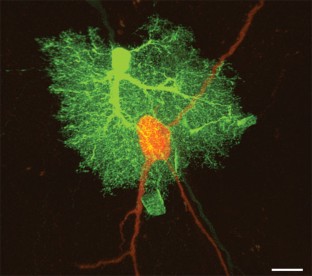
Figure 2: An astrocyte in action.
The alternative text for this image may have been generated using AI.
Figure 3: A tripartite synapse.

The alternative text for this image may have been generated using AI.
Further reading
- Allen, N. J. & Barres, B. A. Signaling between glia and neurons: focus on synaptic plasticity. Curr. Opin. Neurobiol. 15, 542–548 (2005).
Article CAS PubMed Google Scholar - Barres, B. A. The mystery and magic of glia: a perspective on their roles in health and disease. Neuron 60, 430–440 (2008).
Article CAS PubMed Google Scholar - Freeman, M. R. & Doherty, J. Glial cell biology in Drosophila and vertebrates. Trends Neurosci. 29, 82–90 (2006).
Article CAS PubMed Google Scholar - Haydon, P. G. & Carmignoto, G. Astrocyte control of synaptic transmission and neurovascular coupling. Physiol. Rev. 86, 1009–1031 (2006).
Article CAS PubMed Google Scholar - Kettenmann, H. & Ransom, B. R. (eds) Neuroglia 2nd edn (Oxford Univ. Press, 2005).
- Nave, K.-A. & Trapp, B. D. Axon–glial signaling and the glial support of axon function. Annu. Rev. Neurosci. 31, 535–561 (2008).
Article CAS PubMed Google Scholar - Wang, D. D. & Bordey, A. The astrocyte odyssey. Prog. Neurobiol. 86, 342–367 (2008).
CAS PubMed PubMed Central Google Scholar
Author information
Authors and Affiliations
- Nicola J. Allen and Ben A. Barres are in the Department of Neurobiology, Stanford University School of Medicine, Stanford, California 94305-5125, USA. njallen@stanford.edu barres@stanford.edu,
Nicola J. Allen & Ben A. Barres
Authors
- Nicola J. Allen
- Ben A. Barres
Rights and permissions
About this article
Cite this article
Allen, N., Barres, B. Glia — more than just brain glue.Nature 457, 675–677 (2009). https://doi.org/10.1038/457675a
- Published: 04 February 2009
- Issue date: 05 February 2009
- DOI: https://doi.org/10.1038/457675a