Faint young Sun redux (original) (raw)
- News & Views
- Published: 31 March 2010
Early Earth
Nature volume 464, pages 687–689 (2010)Cite this article
- 2766 Accesses
- 76 Citations
- 16 Altmetric
- Metrics details
Subjects
Given that the Sun was dimmer in its youth, our planet should have been frozen over for much of its early history. That it evidently wasn't is a puzzle that continues to engage the attention of Earth scientists.
This is a preview of subscription content, access via your institution
Relevant articles
Open Access articles citing this article.
Chance played a role in determining whether Earth stayed habitable
- Toby Tyrrell
Communications Earth & Environment Open Access 11 December 2020
- Toby Tyrrell
Carbon isotope evidence for large methane emissions to the Proterozoic atmosphere
- Pierre Cadeau
- , Didier Jézéquel
- … Magali Ader
Scientific Reports Open Access 23 October 2020
The Chemical Likelihood of Ribonucleotide-α-Amino acid Copolymers as Players for Early Stages of Evolution
- Ziwei Liu
- , Ghinwa Ajram
- … Robert Pascal
Journal of Molecular Evolution Open Access 20 February 2019
Access options
Subscribe to this journal
Receive 51 print issues and online access
$199.00 per year
only $3.90 per issue
Buy this article
- Purchase on SpringerLink
- Instant access to the full article PDF.
USD 39.95
Prices may be subject to local taxes which are calculated during checkout
Additional access options:
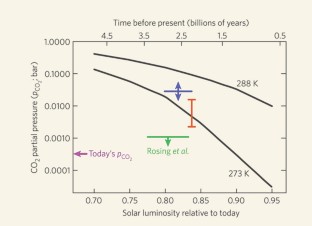
Figure 1: Possible variation in atmospheric CO2 partial pressure (_p_CO2) during Earth's history.
The alternative text for this image may have been generated using AI.
References
- Sagan, C. & Mullen, G. Science 177, 52–56 (1972).
Article CAS ADS Google Scholar - Rosing, M. T., Bird, D. K., Sleep, N. H. & Bjerrum, C. J. Nature 464, 744–747 (2010).
Article CAS ADS Google Scholar - Holland, H. D. Phil. Trans. R. Soc. B 361, 903–915 (2006).
Article CAS Google Scholar - Kuhn, W. R. & Atreya, S. K. Icarus 37, 207–213 (1979).
Article CAS ADS Google Scholar - Owen, T., Cess, R. D. & Ramanathan, V. Nature 277, 640–642 (1979).
Article CAS ADS Google Scholar - Walker, J. C. G., Hays, P. B. & Kasting, J. F. J. Geophys. Res. 86, 9776–9782 (1981).
Article CAS ADS Google Scholar - von Paris, P. et al. Planet. Space Sci. 56, 1244–1259 (2008).
Article CAS ADS Google Scholar - Haqq-Misra, J. D., Domagal-Goldman, S. D., Kasting, P. J. & Kasting, J. F. Astrobiology 8, 1127–1137 (2008).
Article CAS ADS Google Scholar - Kiehl, J. T. & Dickinson, R. E. J. Geophys. Res. 92, 2991–2998 (1987).
Article CAS ADS Google Scholar - Rondanelli, R. & Lindzen, R. S. J. Geophys. Res. 115, doi:10.1029/2009JD012050 (2010).
- Goldblatt, C. et al. Nature Geosci. 2, 891–896 (2009).
Article CAS ADS Google Scholar - Knauth, L. P. Palaeogeogr. Palaeoclimatol. Palaeoecol. 219, 53–69 (2005).
Article Google Scholar - Ohmoto, H., Watanabe, Y. & Kumazawa, K. Nature 429, 395–399 (2004).
Article CAS ADS Google Scholar - Rye, R., Kuo, P. H. & Holland, H. D. Nature 378, 603–605 (1995).
Article CAS ADS Google Scholar - Sheldon, N. D. Precambrian Res. 147, 148–155 (2006).
Article CAS ADS Google Scholar - Gough, D. O. Solar Phys. 74, 21–34 (1981).
Article CAS ADS Google Scholar
Author information
Authors and Affiliations
- James F. Kasting is in the Department of Geosciences, The Pennsylvania State University, University Park, Pennsylvania 16802, USA. jfk4@psu.edu,
James F. Kasting
Rights and permissions
About this article
Cite this article
Kasting, J. Faint young Sun redux.Nature 464, 687–689 (2010). https://doi.org/10.1038/464687a
- Published: 31 March 2010
- Issue date: 01 April 2010
- DOI: https://doi.org/10.1038/464687a