Insulin resistance and obesity (original) (raw)
- News & Views
- Published: 23 December 1999
Diabetes
Nature volume 402, pages 860–861 (1999)Cite this article
- 1629 Accesses
- 38 Citations
- Metrics details
Type 2 diabetes mellitus is a serious health problem in the Western world. It arises when resistance to the glucose-lowering effects of insulin combines with impaired insulin secretion to raise the levels of glucose in the blood beyond the normal range. Studies into the molecular basis of insulin resistance have focused on the peroxisome proliferator-activated receptor gamma (PPARγ). This molecule, a member of the nuclear-hormone-receptor family, is the cellular target of thiazolidinedione drugs, which are used to treat diabetes by increasing sensitivity to insulin.
What are the endogenous ligands for PPARγ? How does it promote the insulin-stimulated uptake of glucose? And is this effect essential for the normal action of insulin? The answer to the last of these questions may be nearer thanks to a study by Barroso et al.1 on page 880 of this issue. They report the identification of two loss-of-function mutations of PPARγ that are associated with severe insulin resistance and type 2 diabetes mellitus in humans. Although such mutations are rare — detected in just three of 85 insulin-resistant people, and none of 314 controls — the implication that PPARγ is required for normal insulin sensitivity in humans is an important advance.
This is a preview of subscription content, access via your institution
Relevant articles
Open Access articles citing this article.
Access options
Subscribe to this journal
Receive 51 print issues and online access
$199.00 per year
only $3.90 per issue
Buy this article
- Purchase on SpringerLink
- Instant access to the full article PDF.
USD 39.95
Prices may be subject to local taxes which are calculated during checkout
Additional access options:
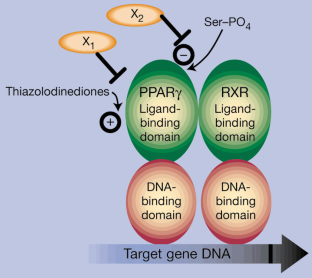
Figure 1: Molecular complex formed by dimerization of PPARγ and the retinoid X receptor (RXR).
References
- Barroso, I. et al. Nature 402, 880–883 (1999).
Article ADS CAS Google Scholar - Auwerx, J. Diabetologia 42, 1033–1049 (1999).
Article CAS Google Scholar - Satoh, H. et al. Biochem. Biophys. Res. Commun. 254, 757–763 (1999).
Article CAS Google Scholar - Spiegelman, B. M. Cell 93, 153–155 (1998).
Article CAS Google Scholar - Sarraf, P. et al. Mol. Cell 3, 799–804 (1999).
Article CAS Google Scholar - Ristow, M., Müller-Wieland, D., Pfeiffer, A., Krone, W. & Kahn, C. N. Engl. J. Med. 339, 953–959 (1998).
Article CAS Google Scholar - Deeb, S. S. et al. Nature Genet. 20, 284–287 (1998).
Article CAS Google Scholar - Valve, R. et al. J. Clin. Endocrinol. Metab. 84, 3708–3712 (1999).
CAS PubMed Google Scholar - Hu, E., Kim, J. B., Sarraf, P. & Spiegelman, B. M. Science 274, 2100–2103 (1996).
Article ADS CAS Google Scholar - Kahn, S. E. et al. Diabetes 42, 1663–1672 (1993).
Article CAS Google Scholar
Author information
Authors and Affiliations
- the Department of Medicine, University of Washington, Harborview Medical Center and VA Puget Sound Health Care System, Seattle, 98108, Washington, USA
Michael W. Schwartz & Steven E. Kahn
Authors
- Michael W. Schwartz
- Steven E. Kahn
Corresponding author
Correspondence toMichael W. Schwartz.
Rights and permissions
About this article
Cite this article
Schwartz, M., Kahn, S. Insulin resistance and obesity.Nature 402, 860–861 (1999). https://doi.org/10.1038/47209
- Issue date: 23 December 1999
- DOI: https://doi.org/10.1038/47209