Is there biological research beyond Systems Biology? A comparative analysis of terms (original) (raw)
When a term comes into vogue as quickly as ‘Systems Biology’ (Figure 1), one asks why and wonders how it will continue. A major prerequisite for Systems Biology was certainly the introduction of robotics and engineering into biology, a process that began at the end of the 1980s, mainly in the field of genomics. As a consequence of the subsequent massive scale of data generation, bioinformatics was, although with a considerable delay due to the lack of experts, booming by the mid‐1990s and led to a widespread knowledge of data management. High‐throughput approaches to collect all kinds of parts lists (genes, expression levels, binary interactions, etc.) expanded from the transcription level to the protein world, leading to a data flood in cell biology in the late 1990s. The new large‐scale data and the advances in their handling also affected the modelling and simulation community, as sparse and often incompatible data were not necessarily a bottleneck to proving models anymore. At the beginning of this decade, biological journals became much more open to simulation approaches and the first modelling studies using large‐scale data sets could be published in visible places and, consequently, spread well. Taken together, all the rational prerequisites to overcome the classical reductionist thinking in biology were in place.
Figure 1
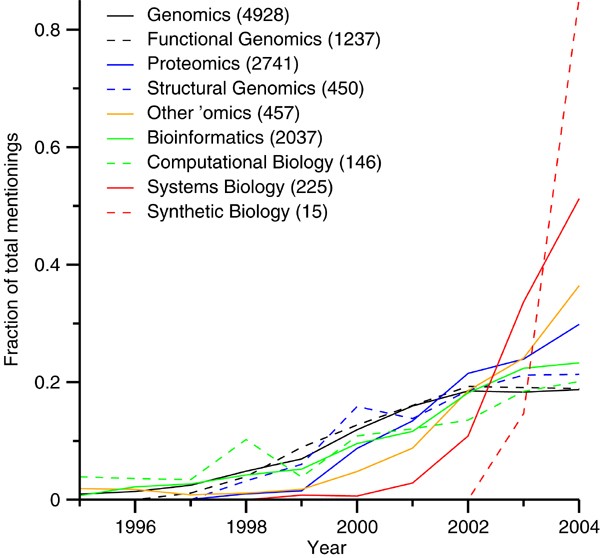
Acceptance of research fields that are driven by the generation of massive amounts of molecular data. Occurrences of selected terms in MEDLINE titles and abstracts over the last 10 years were measured. To compare tendencies, the number of occurrences in each year divided by the total number of occurrences over 10 years is shown. In 2004, ‘Systems Biology’ was mentioned 124 times. In comparison, Genomics occurred 1188 times, Proteomics 958, Bioinformatics 243, other relevant ‘omics’ 194, ‘Computational Biology’ 39 and ‘Synthetic Biology’ 13. This should be seen in the context of classical disciplines such as Biology 4343 (of which ‘Cell Biology’ 510), Genetics 2118 and Biochemistry 783. Although this simplistic counting implies lots of biases, it clearly shows that ‘Systems Biology’ has had a sharp increase in awareness (most of the articles are reviews, not all of them using this term are sympathetic). This awareness is also supported by a comparison with Bioinformatics/‘Computational Biology’ in respect to conference attendance. It took the currently largest (still growing) bioinformatics conference (ISMB with 2200 participants in 2004) 7 years to grow to 650 attendees, but the currently largest systems biology conference (ICSB) attained 780 participants in only 5 years. (Both conferences were in Heidelberg and were oversubscribed.) Note that a successful discipline with fuzzy borders always leads to spin‐offs (subterms such as ‘Functional Genomics’). Some of these took off despite being unfortunate, like ‘Structural Genomics’, which is really about proteomics.
Not everything is entirely rational though, as it would have been sufficient to revive the existing term ‘Physiology’ (which tries to understand the function of biological systems), and adding the novel quantitative molecular measures. But after all, it was a new generation of scientists that enabled all the progress, and a new term always creates hope and stimulates visions. There have been a number of definitions of Systems Biology but, as with almost all terms in biology, it remains fuzzy, although everybody concerned roughly knows what it is about and this is indeed justification for a term. However, as with other terms that promise fame and funding, there will likely be a further broadening of its meaning both in scale (from molecules to environments) and in scope (e.g. to include simple data collections or abstract simulations).
The tendency to become more inclusive is perhaps one of the reasons why the occurrence of ‘Systems Biology’ in print is increasing more steeply than many other successful disciplines, such as bioinformatics when it was in the limelight in the early‐mid‐1990s (Figure 1). For bioinformatics, the immediate need and feasibility was much more obvious, another indication that the hope for a quantum jump in understanding and a wide range of possible avenues might contribute to the success of the term ‘Systems Biology’.
Given the fact that the borders between classical biological research disciplines are falling apart, and given the exhaustiveness of the term, can there be biological research beyond Systems Biology? The evolution of terms and research will certainly continue and the duration of the success of the term will strongly depend on the deliveries (in the end, not only systemic descriptions and visions but predictive power counts) and on the context of other disciplines.
The analysis in Figure 1 indicates the fate of other successful terms, and the emergence of subdisciplines that sometimes create goals in their own right. An example is the term ‘Synthetic Biology’, which is growing out of a small part of what Systems Biology encompasses: the understanding and prediction not only of systemic properties but also of their design. With new approaches towards the chemical synthesis of biomolecules and an increasing understanding of the modularity of biological systems, it will certainly attract a large community that works explicitly towards design goals. There are various other possibilities for specialization, as seen from previously successful terms; for example, genomics spun off a number of subterms such as ‘Functional Genomics’, and the philosophy of ‘omics’ created numerous novel terms with this ending (Figure 1). In the case of ‘Systems Biology’ and its current and extrapolated success, we should therefore expect to see subterms emerging very soon. One easy separator is a limit on the scale of a system; I predict that ‘Molecular Systems Biology’ is also a trendsetter in this respect. Although the journal emphasizes the molecular data that are expected to enhance data‐driven modelling and simulation, it does not exclude emerging fields such as Synthetic Biology and even work on ecosystems as long as a connection to molecular and cellular data can be made. In fact, I look forward to enjoying ‘Molecular Systems Biology’ as a forum that will reveal emerging trends at an early stage before they spread over journals and become apparent (Figure 1).