Ecosystem carbon loss with woody plant invasion of grasslands (original) (raw)
- Letter
- Published: 08 August 2002
- Jay L. Banner2,
- Esteban G. Jobbágy1,
- William T. Pockman1 nAff3 &
- …
- Diana H. Wall nAff4
Nature volume 418, pages 623–626 (2002) Cite this article
- 7765 Accesses
- 886 Citations
- 17 Altmetric
- Metrics details
Abstract
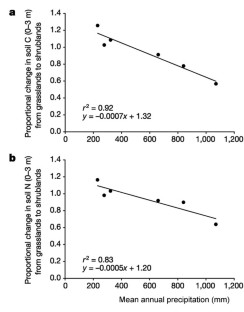
The invasion of woody vegetation into deserts, grasslands and savannas is generally thought to lead to an increase in the amount of carbon stored in those ecosystems. For this reason, shrub and forest expansion (for example, into grasslands) is also suggested to be a substantial, if uncertain, component of the terrestrial carbon sink1,2,3,4,5,6,7,8,9,10,11,12,13,14. Here we investigate woody plant invasion along a precipitation gradient (200 to 1,100 mm yr-1) by comparing carbon and nitrogen budgets and soil δ13C profiles between six pairs of adjacent grasslands, in which one of each pair was invaded by woody species 30 to 100 years ago. We found a clear negative relationship between precipitation and changes in soil organic carbon and nitrogen content when grasslands were invaded by woody vegetation, with drier sites gaining, and wetter sites losing, soil organic carbon. Losses of soil organic carbon at the wetter sites were substantial enough to offset increases in plant biomass carbon, suggesting that current land-based assessments may overestimate carbon sinks. Assessments relying on carbon stored from woody plant invasions to balance emissions may therefore be incorrect.
This is a preview of subscription content, access via your institution
Access options
Subscribe to this journal
Receive 51 print issues and online access
$199.00 per year
only $3.90 per issue
Buy this article
- Purchase on SpringerLink
- Instant access to the full article PDF.
USD 39.95
Prices may be subject to local taxes which are calculated during checkout
Additional access options:
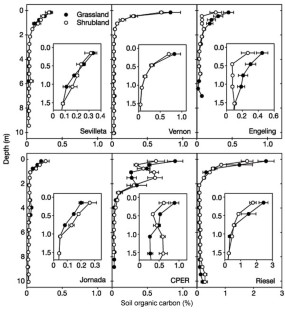
Figure 1: Concentrations of total soil organic carbon with depth.
The alternative text for this image may have been generated using AI.
Figure 2: The proportional change in total soil organic carbon (a) and nitrogen (b) to 3 m depth with woody plant invasion of native grasslands.
The alternative text for this image may have been generated using AI.
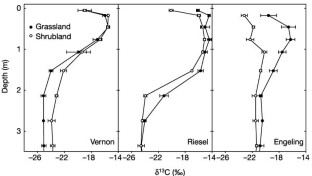
Figure 3: δ13C values of soil organic carbon for the three wettest sites—Vernon, Riesel and Engeling.
The alternative text for this image may have been generated using AI.
References
- Schlesinger, W. H. et al. Biological feedbacks in global desertification. Science 247, 1043–1048 (1990)
Article ADS CAS Google Scholar - Vitousek, P. M., Mooney, H. A., Lubchenco, J. & Melillo, J. M. Human domination of Earth's ecosystems. Science 277, 494–499 (1997)
Article CAS Google Scholar - Schimel, D. S. et al. Recent patterns and mechanisms of carbon exchange by terrestrial ecosystems. Nature 414, 169–172 (2001)
Article ADS CAS Google Scholar - Turner, B. L. II et al. (eds) in The Earth as Transformed by Human Action (Cambridge Univ. Press, Cambridge, 1990)
Google Scholar - Tucker, C. J., Dregne, H. E. & Newcomb, W. W. Expansion and contraction of the Sahara Desert from 1980 to 1990. Science 253, 299–301 (1991)
Article ADS CAS Google Scholar - Scholes, R. J. & Archer, S. R. Tree-grass interactions in savannas. Annu. Rev. Ecol. Syst. 28, 517–544 (1997)
Article Google Scholar - Brown, J. H., Valone, T. J. & Curtin, C. G. Reorganization of an arid ecosystem in response to recent climate change. Proc. Natl Acad. Sci. USA 94, 9729–9733 (1997)
Article ADS CAS Google Scholar - Allen, C. D. & Breshears, D. D. Drought-induced shift of a forest-woodland ecotone: rapid landscape response to climate variation. Proc. Natl Acad. Sci. USA 95, 14839–14842 (1998)
Article ADS CAS Google Scholar - Casper, B. B. & Jackson, R. B. Plant competition underground. Annu. Rev. Ecol. Syst. 28, 545–570 (1997)
Article Google Scholar - Amundson, R. The carbon budget in soils. Annu. Rev. Earth Planet. Sci. 29, 535–562 (2001)
Article ADS CAS Google Scholar - Pacala, S. W. et al. Consistent land- and atmosphere-based U.S. carbon sink estimates. Science 292, 2316–2320 (2001)
Article ADS CAS Google Scholar - Houghton, R. A., Hackler, J. L. & Lawrence, K. T. The U. S. carbon budget: contributions from land-use change. Science 285, 574–578 (1999)
Article CAS Google Scholar - Guo, L. B. & Gifford, R. M. Soil carbon stocks and land use change: a meta analysis. Glob. Change Biol. 8, 345–360 (2002)
Article ADS Google Scholar - Fang, J. Y., Chen, A. P., Peng, C. H., Zhao, S. Q. & Longjun, C. Changes in forest biomass carbon storage in China between 1949 and 1998. Science 292, 2320–2322 (2001)
Article CAS Google Scholar - Nepstad, D. C. et al. The role of deep roots in the hydrological and carbon cycles of Amazonian forests and pastures. Nature 372, 666–669 (1994)
Article ADS CAS Google Scholar - Van Auken, O. W. Shrub invasions of North American semiarid grasslands. Annu. Rev. Ecol. Syst. 31, 197–215 (2000)
Article Google Scholar - Boutton, T. W. et al. Delta C-13 values of soil organic carbon and their use in documenting vegetation change in a subtropical savanna ecosystem. Geoderma 82, 5–41 (1998)
Article ADS Google Scholar - Jackson, R. B. et al. Belowground consequences of vegetation change and their treatment in models. Ecol. Appl. 10, 470–483 (2000)
Article Google Scholar - Trumbore, S. E. Potential responses of soil organic carbon to global environmental change. Proc. Natl Acad. Sci. USA 94, 8284–8291 (1997)
Article ADS CAS Google Scholar - Jobbágy, E. G. & Jackson, R. B. The vertical distribution of soil organic carbon and its relation to climate and vegetation. Ecol. Appl. 10, 423–436 (2000)
Article Google Scholar - Post, W. M., Emanuel, W. R., Zinke, P. J. & Stangenberger, A. G. Soil carbon pools and world life zones. Nature 298, 156–159 (1982)
Article ADS CAS Google Scholar - Batjes, N. H. Total carbon and nitrogen in the soils of the world. Eur. J. Soil Sci. 47, 151–163 (1996)
Article CAS Google Scholar - Neill, C. & Davidson, E. A. in Global Climate Change and Tropical Ecosystems (eds Lal, R., Kimble, J. M. & Stewart, B. A.) 197–211 (CRC, Boca Raton, 2000)
Google Scholar - Wall, D. H., Adams, G. A. & Parsons, A. N. in Global Biodiversity in a Changing Environment (eds Chapin, F. S., Sala, O. E. & Huber-Sannwald, E.) 47–82 (Springer, New York, 2001)
Book Google Scholar - Vitousek, P. M., Kennedy, M. J., Derry, L. A. & Chadwick, O. A. Weathering versus atmospheric sources of strontium in ecosystems on young volcanic soils. Oecologia 121, 255–259 (1999)
Article ADS Google Scholar - Burke, I. C. et al. Texture, climate, and cultivation effects on soil organic matter content in U.S. grassland soils. Soil Sci. Soc. Am. J. 53, 800–805 (1989)
Article ADS Google Scholar - Tilman, D. et al. Fire suppression and ecosystem carbon storage. Ecology 81, 2680–2685 (2000)
Article Google Scholar - Archer, S., Boutton, T. W. & Hibbard, K. A. in Global Biogeochemical Cycles in the Climate System (eds Schulze, E.-D. et al.) 115–137 (Academic, San Diego, 2001)
Book Google Scholar - Conant, R. T., Paustian, K. & Elliott, E. T. Grassland management and conversion to grassland: effects on soil carbon. Ecol. Appl. 11, 343–355 (2001)
Article Google Scholar - Gill, R. A. et al. Nonlinear grassland responses to past and future atmospheric CO2 . Nature 417, 279–282 (2002)
Article ADS CAS Google Scholar
Acknowledgements
We thank W. Cook, L. Giles, J. Karr, L. Mack, A. Parsons and S. Rainey for laboratory analyses, and W. H. Schlesinger, A. T. Austin, O. E. Sala and E. A. Davidson for manuscript suggestions. We also thank R. J. Ansley, H. W. Polley and many others who helped us locate sites and provide their history. This work was supported by the US National Science Foundation, NIGEC/DOE, the Inter-American Institute for Global Change Research, the Andrew W. Mellon Foundation, and the Geology Foundation of the University of Texas at Austin. This paper is a contribution to the Global Change and Terrestrial Ecosystems core project of the International Geosphere Biosphere Programme.
Author information
Author notes
- Diana H. Wall
Present address: Natural Resource Ecology Laboratory, Colorado State University, Fort Collins, Colorado, 80523, USA - William T. Pockman
Present address: Department of Biology, University of New Mexico, Albuquerque, New Mexico, 87131-1091, USA
Authors and Affiliations
- Department of Biology and Nicholas School of the Environment and Earth Sciences, Duke University, Durham, North Carolina, 27708-0340, USA
Robert B. Jackson, Esteban G. Jobbágy & William T. Pockman - Department of Geological Sciences, University of Texas at Austin, Austin, Texas, 78712, USA
Jay L. Banner
Authors
- Robert B. Jackson
- Esteban G. Jobbágy
- William T. Pockman
- Diana H. Wall
Corresponding author
Correspondence toRobert B. Jackson.
Ethics declarations
Competing interests
The authors declare that they have no competing financial interests.
Supplementary information
Rights and permissions
About this article
Cite this article
Jackson, R., Banner, J., Jobbágy, E. et al. Ecosystem carbon loss with woody plant invasion of grasslands.Nature 418, 623–626 (2002). https://doi.org/10.1038/nature00910
- Received: 14 January 2002
- Accepted: 14 June 2002
- Issue date: 08 August 2002
- DOI: https://doi.org/10.1038/nature00910