Coherent properties of a two-level system based on a quantum-dot photodiode (original) (raw)
- Letter
- Published: 08 August 2002
Nature volume 418, pages 612–614 (2002)Cite this article
- 7967 Accesses
- 735 Citations
- 13 Altmetric
- Metrics details
Abstract
Present-day information technology is based mainly on incoherent processes in conventional semiconductor devices1. To realize concepts for future quantum information technologies, which are based on coherent phenomena, a new type of ‘hardware’ is required2. Semiconductor quantum dots are promising candidates for the basic device units for quantum information processing. One approach is to exploit optical excitations (excitons) in quantum dots. It has already been demonstrated that coherent manipulation between two excitonic energy levels—via so-called Rabi oscillations—can be achieved in single quantum dots by applying electromagnetic fields3,4,5,6,7. Here we make use of this effect by placing an InGaAs quantum dot in a photodiode, which essentially connects it to an electric circuit. We demonstrate that coherent optical excitations in the quantum-dot two-level system can be converted into deterministic photocurrents. For optical excitation with so-called π-pulses, which completely invert the two-level system, the current is given by I = fe, where f is the repetition frequency of the experiment and e is the elementary charge. We find that this device can function as an optically triggered single-electron turnstile.
This is a preview of subscription content, access via your institution
Access options
Subscribe to this journal
Receive 51 print issues and online access
$199.00 per year
only $3.90 per issue
Buy this article
- Purchase on SpringerLink
- Instant access to the full article PDF.
USD 39.95
Prices may be subject to local taxes which are calculated during checkout
Additional access options:
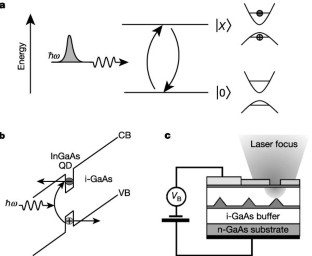
Figure 1: The two-level system in a quantum dot, and the single-quantum-dot photodiode.
The alternative text for this image may have been generated using AI.
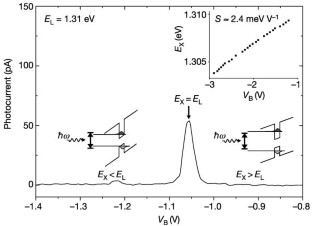
Figure 2: Photocurrent spectrum of a single QD in the region of the excitonic ground state energy _E_X.
The alternative text for this image may have been generated using AI.
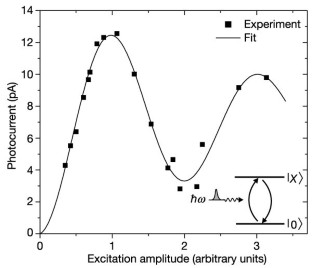
Figure 3: Rabi oscillations of the photocurrent at resonance for increasing excitation amplitude _A_exc.
The alternative text for this image may have been generated using AI.
Exciton-polariton photodiodes
Article Open access 17 January 2026
References
- Alferov, Z. I. Nobel Lecture: The double heterostructure concept and its applications in physics, electronics, and technology. Rev. Mod. Phys. 73, 767–782 (2001)
Article ADS CAS Google Scholar - Bouwmeester, D., Ekert, A. & Zeilinger, A. (eds) The Physics of Quantum Information (Springer, Berlin, 2000)
- Stievater, T. H. et al. Rabi oscillations of excitons in single quantum dots. Phys. Rev. Lett. 87, 133603-1–133603-4 (2001)
Article ADS Google Scholar - Kamada, H. et al. Exciton Rabi oscillation in a single quantum dot. Phys. Rev. Lett. 87, 247401-1–247401-4 (2001)
Article Google Scholar - Htoon, H. et al. Interplay of Rabi oscillations and quantum interference in semiconductor quantum dots. Phys. Rev. Lett. 88, 087401-1–087401-4 (2002)
Article ADS Google Scholar - Rabi, I. I. Space quantization in a gyrating magnetic field. Phys. Rev. 51, 652–654 (1937)
Article ADS CAS Google Scholar - Allen, L. & Eberly, J. H. Optical Resonance and Two-Level Atoms (Wiley, New York, 1975)
Google Scholar - Borri, P. et al. Ultralong dephasing time in InGaAs quantum dots. Phys. Rev. Lett. 87, 157401-1–157401-4 (2001)
Article ADS Google Scholar - Bayer, M. & Forchel, A. Temperature dependence of the exciton homogeneous linewidth in In0.60Ga0.40As/GaAs self-assembled quantum dots. Phys. Rev. B 65, 041308-1–041308-4 (2002)
ADS Google Scholar - Zrenner, A. German patent DE 100 06 909 C1 (4 April 2001).
- Findeis, F. et al. Photocurrent and photoluminescence of a single self-assembled quantum dot in electric fields. Appl. Phys. Lett. 78, 2958–2960 (2001)
Article ADS CAS Google Scholar - Beham, E. et al. Nonlinear ground-state absorption observed in a single quantum dot. Appl. Phys. Lett. 79, 2808–2810 (2001)
Article ADS CAS Google Scholar - Brunner, K. et al. Sharp-line photoluminescence and two-photon absorption of zero-dimensional biexcitons in a GaAs/AlGaAs structure. Phys. Rev. Lett. 73, 1138–1141 (1994)
Article ADS CAS Google Scholar - Pothier, H. et al. Single-electron pump based on charging effects. Europhys. Lett. 17, 249–254 (1992)
Article ADS Google Scholar
Acknowledgements
This work was supported by the BMBF and by the Deutsche Forschungsgemeinschaft.
Author information
Author notes
- A. Zrenner & S. Stufler
Present address: Universität Paderborn, Warburger Strasse 100, D-33098, Paderborn, Germany
Authors and Affiliations
- Walter Schottky Institut, Technische Universität München, Am Coulombwall, D-85748, Garching, Germany
A. Zrenner, E. Beham, S. Stufler, F. Findeis, M. Bichler & G. Abstreiter
Authors
- A. Zrenner
- E. Beham
- S. Stufler
- F. Findeis
- M. Bichler
- G. Abstreiter
Corresponding author
Correspondence toA. Zrenner.
Ethics declarations
Competing interests
The authors declare that they have no competing financial interests.
Rights and permissions
About this article
Cite this article
Zrenner, A., Beham, E., Stufler, S. et al. Coherent properties of a two-level system based on a quantum-dot photodiode.Nature 418, 612–614 (2002). https://doi.org/10.1038/nature00912
- Received: 10 April 2002
- Accepted: 17 June 2002
- Issue date: 08 August 2002
- DOI: https://doi.org/10.1038/nature00912