Multiplicative computation in a visual neuron sensitive to looming (original) (raw)
- Letter
- Published: 21 November 2002
Nature volume 420, pages 320–324 (2002)Cite this article
- 4130 Accesses
- 382 Citations
- 13 Altmetric
- Metrics details
Abstract
Multiplicative operations are important in sensory processing1,2,3,4,5, but their biophysical implementation remains largely unknown5,6,7,8,9,10. We investigated an identified neuron (the lobula giant movement detector, LGMD, of locusts) whose output firing rate in response to looming visual stimuli has been described by two models, one of which involves a multiplication. In this model, the LGMD multiplies postsynaptically two inputs (one excitatory, one inhibitory) that converge onto its dendritic tree11,12; in the other model, inhibition is presynaptic to the LGMD13,14. By using selective activation and inactivation of pre- and postsynaptic inhibition, we show that postsynaptic inhibition has a predominant role, suggesting that multiplication is implemented within the neuron itself. Our pharmacological experiments and measurements of firing rate versus membrane potential also reveal that sodium channels act both to advance the response of the LGMD in time and to map membrane potential to firing rate in a nearly exponential manner. These results are consistent with an implementation of multiplication based on dendritic subtraction of two converging inputs encoded logarithmically, followed by exponentiation through active membrane conductances.
This is a preview of subscription content, access via your institution
Access options
Subscribe to this journal
Receive 51 print issues and online access
$199.00 per year
only $3.90 per issue
Buy this article
- Purchase on SpringerLink
- Instant access to the full article PDF.
USD 39.95
Prices may be subject to local taxes which are calculated during checkout
Additional access options:
Figure 1: Properties of a neuronal circuit involved in locust escape behaviour and obstacle avoidance.

The alternative text for this image may have been generated using AI.
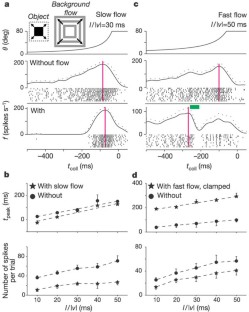
Figure 2: Effect of activating lateral or feedforward inhibition on peak firing time (magenta lines).
The alternative text for this image may have been generated using AI.
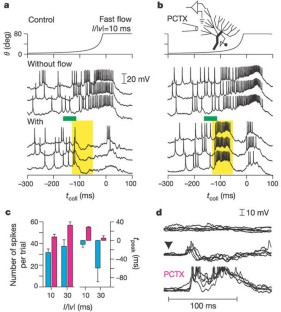
Figure 3: Effect of picrotoxin (PCTX) on the LGMD's responses to approaching stimuli.
The alternative text for this image may have been generated using AI.
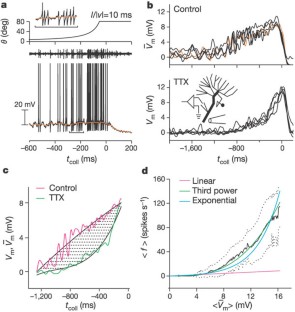
Figure 4: Transformation between membrane potential (_V_m) and firing rate at the spike initiation zone.
The alternative text for this image may have been generated using AI.
References
- Reichardt, W. Autokorrelations-Auswertung als Funktionsprinzip des Zentralnervensystems. Z. Naturforsch. 12, 448–457 (1957)
Article Google Scholar - Barlow, H. B. & Levick, W. R. The mechanisms of directionally selective units in rabbit's retina. J. Physiol. (Lond.) 178, 477–504 (1965)
Article CAS Google Scholar - McAdams, C. J. & Maunsell, J. H. R. Effects of attention on orientation-tuning functions of single neurons in macaque cortical area V4. J. Neurosci. 19, 431–441 (1999)
Article CAS Google Scholar - Sun, H. & Frost, B. J. Computation of different optical variables of looming objects in pigeon nucleus rotundus neurons. Nature Neurosci. 1, 296–303 (1998)
Article CAS Google Scholar - Pena, J. L. & Konishi, M. Auditory spatial receptive fields created by multiplication. Science 292, 249–252 (2001)
Article ADS CAS Google Scholar - Torre, V. & Poggio, T. A synaptic mechanism possibly underlying directional selectivity to motion. Proc. R. Soc. Lond. B 202, 409–416 (1978)
Article ADS Google Scholar - Andersen, R. A., Essick, G. K. & Siegel, R. M. Encoding of spatial location by posterior parietal neurons. Science 23, 456–458 (1985)
Article ADS Google Scholar - Yuste, R. & Tank, D. Dendritic integration in mammalian neurons, a century after Cajal. Neuron 16, 701–716 (1996)
Article CAS Google Scholar - Koch, C. Biophysics of Computation: Information Processing in Single Neurons (Oxford Univ. Press, Oxford, 1998)
Google Scholar - Chance, F. S., Abbott, L. F. & Reyes, A. D. Gain modulation from background synaptic input. Neuron 35, 773–782 (2002)
Article CAS Google Scholar - Hatsopoulos, N., Gabbiani, F. & Laurent, G. Elementary computation of object approach by a wide-field visual neuron. Science 270, 1000–1003 (1995)
Article ADS CAS Google Scholar - Gabbiani, F., Krapp, H. G. & Laurent, G. Computation of object approach by a wide-field, motion-sensitive neuron. J. Neurosci. 19, 1122–1141 (1999)
Article CAS Google Scholar - Rind, F. C. & Bramwell, D. I. Neural network based on the input organization of an identified neuron signaling impending collision. J. Neurophysiol. 75, 967–985 (1996)
Article CAS Google Scholar - Rind, F. C. Intracellular characterization of neurons in the locust brain signaling impending collision. J. Neurophysiol. 75, 986–995 (1996)
Article CAS Google Scholar - Wagner, H. Flow field variables trigger landing in flies. Nature 297, 147–148 (1982)
Article ADS Google Scholar - Wicklein, M. & Strausfeld, N. J. Organization and significance of neurons that detect change of visual depth in the hawk moth Manduca sexta. J. Comp. Neurol. 424, 356–376 (2000)
Article CAS Google Scholar - Schlotterer, G. R. Response of the locust descending movement detector neuron to rapidly approaching and withdrawing visual stimuli. Can. J. Zool. 55, 1372–1376 (1977)
Article Google Scholar - Rind, F. C. & Simmons, P. J. Orthopteran DCMD neuron: a reevaluation of responses to moving objects. I. Selective responses to approaching objects. J. Neurophysiol. 68, 1654–1666 (1992)
Article CAS Google Scholar - Robertson, R. M. & Johnson, A. G. Retinal image size triggers obstacle avoidance in flying locusts. Naturwissenschaften 80, 176–178 (1993)
Article ADS Google Scholar - Gabbiani, F., Mo, C. & Laurent, G. Invariance of angular threshold computation in a wide-field looming-sensitive neuron. J. Neurosci. 21, 314–329 (2001)
Article CAS Google Scholar - O'Shea, M. & Rowell, C. H. F. Protection from habituation by lateral inhibition. Nature 254, 53–55 (1975)
Article ADS CAS Google Scholar - Rowell, C. H. F., O'Shea, M. & Williams, J. L. D. The neuronal basis of a sensory analyser, the acridid movement detector system. IV. The preference for small field stimuli. J. Exp. Biol. 68, 157–185 (1977)
Google Scholar - Rind, F. C. & Simmons, P. J. Local circuits for the computation of object approach by an identified visual neuron in the locust. J. Comp. Neurol. 395, 405–415 (1998)
Article CAS Google Scholar - Rauh, J. J., Lummis, S. C. R. & Sattelle, D. B. Pharmacological and biochemical properties of insect GABA receptors. Trends Pharmacol. 11, 325–329 (1990)
Article CAS Google Scholar - Warzecha, A. K., Egelhaaf, M. & Borst, A. Neural circuit tuning fly visual interneurons to motion of small objects. 1. Dissection of the circuit by pharmacological and photoinactivation techniques. J. Neurophysiol. 69, 329–339 (1993)
Article CAS Google Scholar - Zanker, J. M., Srinivasan, M. V. & Egelhaaf, M. Speed tuning in elementary motion detectors of the correlation type. Biol. Cybern. 80, 109–116 (1999)
Article CAS Google Scholar - Mead, C. Analog VLSI and Neural Systems (Addison-Wesley, Boston, 1989)
MATH Google Scholar - Koch, C., Bernander, O. & Douglas, R. J. Do neurons have a voltage or a current threshold for action potential initiation? J. Comput. Neurosci. 2, 63–82 (1995)
Article CAS Google Scholar - Rowell, C. H. F. in Experimental Analysis of Insect Behavior (ed. Browne, L. B.) 87–99 (Springer, New York, 1974)
Book Google Scholar - Galant, A. R. Non-linear Statistical Models (Wiley & Sons, New York, 1987)
Book Google Scholar
Acknowledgements
We thank C. Mo for technical assistance with the experiments presented in Fig. 2, S. Potter for help with two-photon confocal microscopy, and J. Maunsell for comments. This work was supported by the Sloan Foundation, the National Institute of Mental Health (F.G., C.K.), the National Institute for Deafness and Communication Disorders (G.L.), the McKnight Foundation (G.L.) and the Center for Neuromorphic Engineering as part of the NSF Engineering Research Center programme. H.G.K. was supported by a travel grant of the Deutsche Forschungsgemeinschaft. F.G. is an Alfred P. Sloan research fellow.
Author information
Authors and Affiliations
- Division of Biology, California Institute of Technology, California, 91125, Pasadena, USA
Fabrizio Gabbiani, Holger G. Krapp, Christof Koch & Gilles Laurent - Division of Neuroscience, Baylor College of Medicine, One Baylor Plaza, Texas, 77030, Houston, USA
Fabrizio Gabbiani - Department of Zoology, University of Cambridge, Downing Street, CB2 3EJ, Cambridge, UK
Holger G. Krapp
Authors
- Fabrizio Gabbiani
- Holger G. Krapp
- Christof Koch
- Gilles Laurent
Corresponding author
Correspondence toFabrizio Gabbiani.
Ethics declarations
Competing interests
The authors declare that they have no competing financial interests.
Supplementary information
Rights and permissions
About this article
Cite this article
Gabbiani, F., Krapp, H., Koch, C. et al. Multiplicative computation in a visual neuron sensitive to looming.Nature 420, 320–324 (2002). https://doi.org/10.1038/nature01190
- Received: 01 August 2002
- Accepted: 20 September 2002
- Issue date: 21 November 2002
- DOI: https://doi.org/10.1038/nature01190