Productivity–biodiversity relationships depend on the history of community assembly (original) (raw)
- Letter
- Published: 24 July 2003
Nature volume 424, pages 423–426 (2003)Cite this article
- 3303 Accesses
- 249 Citations
- 1 Altmetric
- Metrics details
Abstract
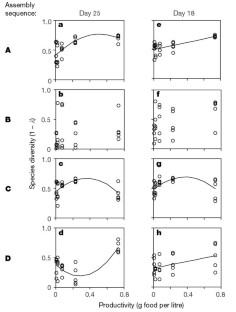
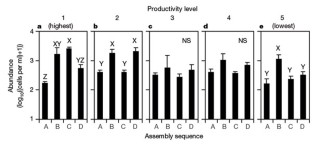
Identification of the causes of productivity–species diversity relationships remains a central topic of ecological research1,2. Different relations have been attributed to the influence of disturbance3,4, consumers5,6, niche specialization7 and spatial scale8,9,10,11,12,13,14. One unexplored cause is the history of community assembly, the partly stochastic sequential arrival of species from a regional pool of potential community members. The sequence of species arrival can greatly affect community structure15,16,17,18,19. If assembly sequence interacts with productivity to influence diversity, different sequences can contribute to variation in productivity–diversity relationships. Here we report a test of this hypothesis by assembling aquatic microbial communities at five productivity levels using four assembly sequences. About 30 generations after assembly, productivity–diversity relationships took various forms, including a positive, a hump-shaped, a U-shaped and a non-significant pattern, depending on assembly sequence. This variation resulted from idiosyncratic joint effects of assembly sequence, productivity and species identity on species abundances. We suggest that the history of community assembly should be added to the growing list of factors that influence productivity–biodiversity patterns.
This is a preview of subscription content, access via your institution
Access options
Subscribe to this journal
Receive 51 print issues and online access
$199.00 per year
only $3.90 per issue
Buy this article
- Purchase on SpringerLink
- Instant access to the full article PDF.
USD 39.95
Prices may be subject to local taxes which are calculated during checkout
Additional access options:
Figure 1: Response of species diversity to productivity.
The alternative text for this image may have been generated using AI.
Figure 2: Response of the abundance of Uronema sp. to productivity and assembly sequence on day 25.
The alternative text for this image may have been generated using AI.
References
- Waide, R. B. et al. The relationship between productivity and species richness. Annu. Rev. Ecol. Syst. 30, 257–300 (1999)
Article Google Scholar - Morin, P. J. Biodiversity's ups and downs. Nature 406, 463–464 (2000)
Article CAS Google Scholar - Huston, M. A. Biological Diversity: The Coexistence of Species on Changing Landscapes (Cambridge Univ. Press, 1994)
Google Scholar - Kondoh, M. Unifying the relationships of species richness to productivity and disturbance. Proc. R. Soc. Lond. B 268, 269–271 (2001)
Article CAS Google Scholar - Worm, B. et al. Consumer versus resource control of species diversity and ecosystem functioning. Nature 417, 848–851 (2002)
Article ADS CAS Google Scholar - Leibold, M. A. et al. Species turnover and the regulation of trophic structure. Annu. Rev. Ecol. Syst. 28, 467–494 (1997)
Article Google Scholar - Kassen, R. et al. Diversity peaks at intermediate productivity in a laboratory microcosm. Nature 406, 508–512 (2000)
Article ADS CAS Google Scholar - Currie, D. J. Energy and large-scale patterns of animal- and plant-species richness. Am. Nat. 137, 27–49 (1991)
Article Google Scholar - Wright, D. H., Currie, D. J. & Maurer, B. A. in Species Diversity in Ecological Communities: Historical and Geographical Perspectives (eds Ricklefs, R. & Schluter, D.) 66–74 (Univ. Chicago Press, 1993)
Google Scholar - Abrams, P. A. Monotonic or unimodal diversity–productivity gradients: What does competition theory predict? Ecology 76, 2019–2027 (1995)
Article Google Scholar - Gross, K. L. et al. Patterns of species density and productivity at different spatial scales in herbaceous plant communities. Oikos 89, 417–427 (2000)
Article Google Scholar - Scheiner, S. M. et al. Species richness, species–area curves and Simpson's paradox. Evol. Ecol. Res. 2, 791–802 (2000)
Google Scholar - Mittelbach, G. G. et al. What is the observed relationship between productivity and diversity? Ecology 82, 2381–2396 (2001)
Article Google Scholar - Chase, J. M. & Leibold, M. A. Spatial scale dictates the productivity–biodiversity relationship. Nature 416, 427–430 (2002)
Article ADS CAS Google Scholar - Gilpin, M. E. & Case, T. J. Multiple domains of attraction in competition-communities. Nature 261, 40–42 (1976)
Article ADS CAS Google Scholar - Post, W. M. & Pimm, S. L. Community assembly and food web stability. Math. Biosci. 64, 169–192 (1983)
Article Google Scholar - Drake, J. A. Community–assembly mechanics and the structure of experimental species ensemble. Am. Nat. 137, 1–26 (1991)
Article Google Scholar - Wilson, D. S. Complex interactions in metacommunities, with implications for biodiversity and higher levels of selection. Ecology 73, 1984–2000 (1992)
Article Google Scholar - Law, R. & Morton, R. D. Alternative permanent states of ecological communities. Ecology 74, 1347–1361 (1993)
Article Google Scholar - Connell, J. H. & Orias, E. The ecological regulation of species diversity. Am. Nat. 98, 399–414 (1964)
Article Google Scholar - Leigh, E. G. Jr On the relationship between productivity, biomass, diversity and stability of a community. Proc. Natl Acad. Sci. USA 53, 777–783 (1965)
Article ADS CAS Google Scholar - Pianka, E. R. Latitudinal gradients in species diversity: a review of concepts. Am. Nat. 100, 33–46 (1966)
Article Google Scholar - Rosenzweig, M. L. Species diversity gradients: We know more and less than we thought. J. Mammal. 73, 715–730 (1992)
Article Google Scholar - Rosenzweig, M. L. Species Diversity in Space and Time (Cambridge Univ. Press, 1995)
Book Google Scholar - Tilman, D. & Pacala, S. in Species Diversity in Ecological Communities: Historical and Geographical Perspectives (eds Ricklefs, R. & Schluter, D.) 13–25 (Univ. Chicago Press, 1993)
Google Scholar - Van de Koppel, J. et al. Patterns of herbivory along a productivity gradient: An empirical and theoretical investigation. Ecology 77, 736–745 (1996)
Article Google Scholar - Holt, R. D. & Polis, G. A. A theoretical framework for intraguild predation. Am. Nat. 149, 745–764 (1997)
Article Google Scholar - Chase, J. M. Food web effects of prey size refugia: Variable interactions and alternative stable equilibria. Am. Nat. 154, 559–570 (1999)
Article Google Scholar - Simpson, E. H. Measurement of diversity. Nature 163, 688 (1949)
Article ADS Google Scholar - Mitchell-Olds, T. & Shaw, R. E. Regression analysis of natural selection: Statistical inference and biological interpretation. Evolution 41, 1149–1161 (1987)
Article Google Scholar
Acknowledgements
We thank members of the Morin laboratory for discussion, and J. A. Drake, C. M. K. Kaunzinger, M. A. Leibold, Z. T. Long, P. B. Rainey and D. Simberloff for comments. The National Science Foundation and the Department of Ecology and Evolutionary Biology at the University of Tennessee supported this research.
Author information
Authors and Affiliations
- Department of Ecology and Evolutionary Biology, University of Tennessee, Knoxville, Tennessee, 37996-1610, USA
Tadashi Fukami - Department of Ecology, Evolution, and Natural Resources, Rutgers University, 14 College Farm Road, New Brunswick, New Jersey, 08901-8551, USA
Peter J. Morin
Authors
- Tadashi Fukami
- Peter J. Morin
Corresponding author
Correspondence toTadashi Fukami.
Ethics declarations
Competing interests
The authors declare that they have no competing financial interests.
Supplementary information
41586_2003_BFnature01785_MOESM1_ESM.doc (download DOC )
Supplementary Information: This file contains supplementary information on the following: regression analysis, MOS test, species richness, population dynamics, comparison of assembly in our study and assembly in nature, and local and regional diversity. (DOC 220 kb)
Rights and permissions
About this article
Cite this article
Fukami, T., Morin, P. Productivity–biodiversity relationships depend on the history of community assembly.Nature 424, 423–426 (2003). https://doi.org/10.1038/nature01785
- Received: 18 March 2003
- Accepted: 08 May 2003
- Issue date: 24 July 2003
- DOI: https://doi.org/10.1038/nature01785