An asymptotic-giant-branch star in the progenitor system of a type Ia supernova (original) (raw)
- Letter
- Published: 07 August 2003
- M. M. Phillips2,
- Nicholas B. Suntzeff3,
- José Maza4,
- L. E. González4,
- Miguel Roth2,
- Kevin Krisciunas2,
- Nidia Morrell2,
- E. M. Green5,
- S. E. Persson1 &
- …
- P. J. McCarthy1
Nature volume 424, pages 651–654 (2003) Cite this article
- 832 Accesses
- 377 Citations
- 11 Altmetric
- Metrics details
Abstract
Stars that explode as supernovae come in two main classes. A type Ia supernova is recognized by the absence of hydrogen and the presence of elements such as silicon and sulphur in its spectrum; this class of supernova is thought to produce the majority of iron-peak elements in the Universe. They are also used as precise ‘standard candles’ to measure the distances to galaxies. While there is general agreement that a type Ia supernova is produced by an exploding white dwarf star1, no progenitor system has ever been directly observed. Significant effort has gone into searching for circumstellar material to help discriminate between the possible kinds of progenitor systems2, but no such material has hitherto been found associated with a type Ia supernova3. Here we report the presence of strong hydrogen emission associated with the type Ia supernova SN2002ic, indicating the presence of large amounts of circumstellar material. We infer from this that the progenitor system contained a massive asymptotic-giant-branch star that lost several solar masses of hydrogen-rich gas before the supernova explosion.
This is a preview of subscription content, access via your institution
Access options
Subscribe to this journal
Receive 51 print issues and online access
$199.00 per year
only $3.90 per issue
Buy this article
- Purchase on SpringerLink
- Instant access to the full article PDF.
USD 39.95
Prices may be subject to local taxes which are calculated during checkout
Additional access options:
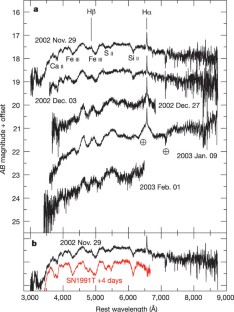
Figure 1: Spectroscopic evolution of SN2002ic.
The alternative text for this image may have been generated using AI.
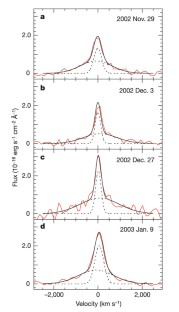
Figure 2: Decomposition and evolution of the Hα profiles.
The alternative text for this image may have been generated using AI.
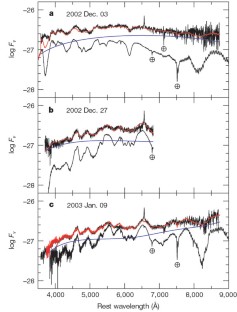
Figure 3: Spectral analysis of SN2002ic.
The alternative text for this image may have been generated using AI.
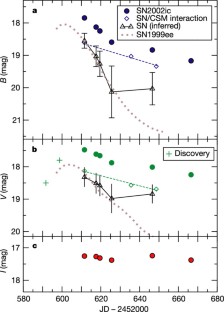
Figure 4: Photometric analysis of SN2002ic.
The alternative text for this image may have been generated using AI.
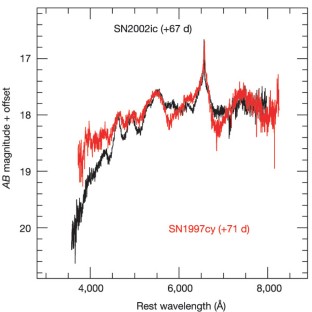
Figure 5: Spectroscopic comparison between SN2002ic and SN1997cy.
The alternative text for this image may have been generated using AI.
References
- Livio, M. in Supernovae and Gamma-Ray Bursts (eds Livio, M., Panagia, N. & Sahu, K.) 334–335 (STScI Symp. Vol. 13, Cambridge Univ. Press, Cambridge, 2001)
Google Scholar - Lentz, E. J., Baron, E., Hauschildt, P. H. & Branch, D. Detectability of hydrogen mixing in type Ia supernova premaximum spectra. Astrophys. J. 580, 374–379 (2002)
Article ADS CAS Google Scholar - Cumming, R. J., Lundqvist, P., Smith, L. J., Pettini, M. & King, D. Circumstellar Hα from SN 1994D and future type Ia supernovae: an observational test of progenitor models. Mon. Not. R. Astron. Soc. 283, 1355–1360 (1996)
Article ADS CAS Google Scholar - Wood-Vasey, W. M. et al. Supernova 2002ic. IAU Circ. No. 8019 (2002)
- Phillips, M. M. et al. SN 1991T: Further evidence of the heterogeneous nature of type Ia supernovae. Astron. J. 103, 1632–1637 (1992)
Article ADS CAS Google Scholar - Li, W. et al. A high intrinsic peculiarity rate among type Ia supernovae. Astrophys. J. 546, 734–743 (2001)
Article ADS CAS Google Scholar - Schlegel, E. M. A new subclass of type II supernovae? Mon. Not. R. Astron. Soc. 244, 269–271 (1990)
ADS CAS Google Scholar - Chugai, N. N. The origin of supernovae with dense winds. Astron. Rep. 41, 672–681 (1997a)
ADS Google Scholar - Chugai, N. N. Supernovae in dense winds. Astrophys. Space Sci. 252, 225–236 (1997b)
Article ADS CAS Google Scholar - Hamuy, M. in Core Collapse of Massive Stars (ed. Fryer, C. L.) (Kluwer, Dordrecht, in the press); preprint at 〈http://xxx.lanl.gov/astro-ph/0301006〉 (2003)
Google Scholar - Hamuy, M. et al. Optical and infrared spectroscopy of SN 1999ee and SN 1999ex. Astron. J. 124, 417–429 (2002)
Article ADS CAS Google Scholar - Germany, L. M., Reiss, D. J., Sadler, E. M., Schmidt, B. P. & Stubbs, C. W. SN 1997cy/GRB 970514: A new piece in the gamma-ray burst puzzle? Astrophys. J. 533, 320–328 (2000)
Article ADS CAS Google Scholar - Turatto, M. et al. The properties of supernova 1997cy associated with GRB 970514. Astrophys. J. 534, L57–L61 (2000)
Article ADS CAS Google Scholar - Turatto, M. et al. The type II supernova 1988Z in MCG + 03-28-022: Increasing evidence of interaction of supernova ejecta with a circumstellar ring. Mon. Not. R. Astron. Soc. 262, 128–140 (1993)
Article ADS CAS Google Scholar - Arnett, D. Supernovae and Nucleosynthesis (Princeton Univ. Press, Princeton, 1996)
Google Scholar - Aretxaga, I. et al. SN 1988Z: Spectro-photometric catalogue and energy estimates. Mon. Not. R. Astron. Soc. 309, 343–354 (1999)
Article ADS CAS Google Scholar - Suntzeff, N. B. in Supernovae and Supernova Remnants (eds McCray, R. & Wang, Z.) 41 (IAU Colloq. 145, Cambridge Univ. Press, Cambridge, 1996)
Book Google Scholar - Strolger, L.-G. et al. The type Ia supernova 1999aw: A probable SN 1999aa-like event in a low luminosity host galaxy. Astron. J. 124, 2905–2919 (2002)
Article ADS Google Scholar - Weidemann, V. Revision of the initial-to-final mass relation. Astron. Astrophys. 363, 647–656 (2000)
ADS CAS Google Scholar - Iben, I. & Renzini, A. Asymptotic giant branch evolution and beyond. Annu. Rev. Astron. Astrophys. 21, 271–342 (1983)
Article ADS CAS Google Scholar - Henry, R. B. C. & Worthey, G. The distribution of heavy elements in spiral and elliptical galaxies. Publ. Astron. Soc. Pacif. 111, 919–945 (1999)
Article ADS Google Scholar - Schlegel, D. J., Finkbeiner, D. P. & Davis, M. Maps of dust infrared emission for use in estimation of reddening and cosmic microwave background radiation foregrounds. Astrophys. J. 500, 525–553 (1998)
Article ADS Google Scholar - Hamuy, M., Phillips, M. M., Wells, L. A. & Maza, J. K corrections for type Ia supernovae. Publ. Astron. Soc. Pacif. 105, 787–793 (1993)
Article ADS Google Scholar - Phillips, M. M. et al. The reddening-free decline rate versus luminosity relationship for type Ia supernovae. Astron. J. 118, 1766–1776 (1999)
Article ADS Google Scholar - Stritzinger, M. et al. Optical photometry of the type Ia SN 1999ee and the type Ib/c SN 1999ex in IC 5179. Astron. J. 124, 2100–2117 (2002)
Article ADS Google Scholar - Hamuy, M. et al. The morphology of type Ia supernovae light curves. Astron. J. 112, 2438–2447 (1996)
Article ADS Google Scholar
Acknowledgements
All the co-authors participated in gathering the observations of the supernova. M.H. noticed the presence of hydrogen emission. M.M.P. noticed spectroscopic and photometric peculiarities and put forward the idea that these could be understood as due to SN/CSM interaction. N.B.S. provided the arguments about the progenitor types. M.H., M.M.P. and N.B.S. co-wrote this Letter. M.H. is a Hubble Fellow.
Author information
Authors and Affiliations
- Carnegie Observatories, 813 Santa Barbara Street, Pasadena, California, 91101, USA
Mario Hamuy, S. E. Persson & P. J. McCarthy - Las Campanas Observatory, Carnegie Observatories, La Serena, Casilla, 601, Chile
M. M. Phillips, Miguel Roth, Kevin Krisciunas & Nidia Morrell - Cerro Tololo Inter-American Observatory, National Optical Astronomy Observatories, La Serena, Casilla, 603, Chile
Nicholas B. Suntzeff - Departamento de Astronomía, Universidad de Chile, Santiago, Casilla, 36-D, Chile
José Maza & L. E. González - University of Arizona, Steward Observatory, Tucson, Arizona, 85721, USA
E. M. Green
Authors
- Mario Hamuy
- M. M. Phillips
- Nicholas B. Suntzeff
- José Maza
- L. E. González
- Miguel Roth
- Kevin Krisciunas
- Nidia Morrell
- E. M. Green
- P. J. McCarthy
Corresponding author
Correspondence toMario Hamuy.
Ethics declarations
Competing interests
The authors declare that they have no competing financial interests.
Supplementary information
41586_2003_BFnature01854_MOESM1_ESM.jpg (download JPG )
Supplementary Figure 1: Direct image of SN 2002ic. V-band CCD image of SN 2002ic taken on 2002 Dec. 9 UT with the Las Campanas Observatory Swope 1-m telescope. The horizontal bar corresponds to 1 arc min. North is up and East to the left. (JPG 9 kb)
Rights and permissions
About this article
Cite this article
Hamuy, M., Phillips, M., Suntzeff, N. et al. An asymptotic-giant-branch star in the progenitor system of a type Ia supernova.Nature 424, 651–654 (2003). https://doi.org/10.1038/nature01854
- Received: 02 April 2003
- Accepted: 16 June 2003
- Issue date: 07 August 2003
- DOI: https://doi.org/10.1038/nature01854