Dependence of the duration of geomagnetic polarity reversals on site latitude (original) (raw)
- Letter
- Published: 08 April 2004
Nature volume 428, pages 637–640 (2004) Cite this article
- 1492 Accesses
- 185 Citations
- 36 Altmetric
- Metrics details
Abstract
An important constraint on the processes governing the geodynamo—the flow in the outer core responsible for generating Earth's magnetic field—is the duration of geomagnetic polarity reversals; that is, how long it takes for Earth's magnetic field to reverse1. It is generally accepted that Earth's magnetic field strength drops to low levels during polarity reversals, and the field direction progresses through a 180° change while the field is weak1. The time it takes for this process to happen, however, remains uncertain, with estimates ranging from a few thousand up to 28,000 years. Here I present an analysis of the available sediment records of the four most recent polarity reversals. These records yield an average estimate of about 7,000 years for the time it takes for the directional change to occur. The variation about this mean duration is not random, but instead varies with site latitude, with shorter durations observed at low-latitude sites, and longer durations observed at mid- to high-latitude sites. Such variation of duration with site latitude is predicted by simple geometrical reversal models, in which non-dipole fields are allowed to persist while the axial dipole decays through zero and then builds in the opposite direction, and provides a constraint on numerical dynamo models.
This is a preview of subscription content, access via your institution
Access options
Subscribe to this journal
Receive 51 print issues and online access
$199.00 per year
only $3.90 per issue
Buy this article
- Purchase on SpringerLink
- Instant access to the full article PDF.
USD 39.95
Prices may be subject to local taxes which are calculated during checkout
Additional access options:
Figure 1: Comparison of the transition-zone thickness in the lower Jaramillo record from ODP Hole 758A (ref.
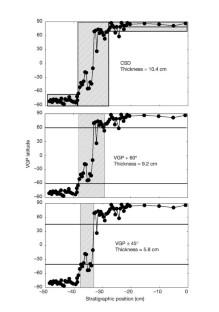
The alternative text for this image may have been generated using AI.
Figure 2: The duration of the directional changes during polarity transitions varies as a function of site latitude.

The alternative text for this image may have been generated using AI.
Figure 3: The durations do not correlate with sedimentation rates.
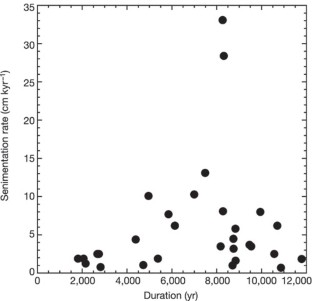
The alternative text for this image may have been generated using AI.
Figure 4: Simple geometrical models in which standing non-dipole fields are allowed to persist while the axial dipole field decays to zero and then builds up in the opposite direction produce transition durations that vary systematically with latitude.
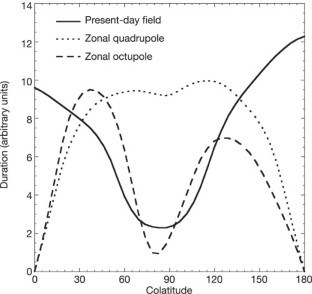
The alternative text for this image may have been generated using AI.
References
- Merrill, R. T. & McFadden, P. L. Geomagnetic polarity transitions. Rev. Geophys. 37, 201–226 (1999)
Article ADS Google Scholar - Singer, B. S. & Pringle, M. S. Age and duration of the Matuyama-Brunhes geomagnetic polarity reversal from 40Ar/39Ar incremental heating analyses of lavas. Earth Planet. Sci. Lett. 139, 47–61 (1996)
Article ADS CAS Google Scholar - McElhinny, M. W. & Lock, J. IAGA paleomagnetic databases with access. Surv. Geophys. 17, 575–591 (1996)
Article ADS Google Scholar - Channell, J. E. T. & Lehman, B. The last two geomagnetic polarity reversals recorded in high-deposition-rate sediment drifts. Nature 389, 712–715 (1997)
Article ADS CAS Google Scholar - Yamazaki, T. & Oda, H. Orbital influence on Earth's magnetic field; 100,000-year periodicity in inclination. Science 295, 2435–2438 (2002)
Article ADS CAS Google Scholar - Oda, H., Shibuya, H. & Hsu, V. Palaeomagnetic records of the Brunhes/Matuyama polarity transition from ODP Leg 124 (Celebes and Sulu seas). Geophys. J. Int. 142, 319–338 (2000)
Article ADS Google Scholar - Fisher, R. A. Dispersion on a sphere. Proc. R. Astron. Soc. A 217, 295–305 (1953)
Article ADS MathSciNet Google Scholar - Channell, J. E. T., Hodell, D. A. & Lehman, B. Relative geomagnetic paleointensity and δ18O at ODP Site 983 (Gardar Drift, North Atlantic) since 350 ka. Earth Planet. Sci. Lett. 153, 103–118 (1997)
Article ADS CAS Google Scholar - Cande, S. C. & Kent, D. V. Revised calibration of the geomagnetic polarity time scale for the Late Cretacous and Cenozoic. J. Geophys. Res. 100, 6093–6095 (1995)
Article ADS Google Scholar - Holt, J. W. & Kirschvink, J. L. The upper Olduvai geomagnetic field reversal from Death Valley, California; a fold test of transitional directions. Earth Planet. Sci. Lett. 133, 475–491 (1995)
Article ADS CAS Google Scholar - Clement, B. M. & Kent, D. V. Latitudinal dependency of geomagnetic polarity transition durations. Nature 310, 488–491 (1984)
Article ADS Google Scholar - Dormy, E., Valet, J.-P. & Courtillot, V. Numerical models of the geodynamo and observational constraints. Geochem. Geophys. Geosyst. 1, doi:2000GC000062 (2000)
- McMillan, D. G., Constable, C. G., Parker, R. L. & Glatzmaier, G. A. A statistical analysis of magnetic fields from some geodynamo simulations. _Geochem. Geophys. Geosyst._[online] 28, doi:2000GC000130 (2001)
- Coe, R. S., Hongre, L. & Glatzmaier, G. A. An examination of simulated geomagnetic reversals from a palaeomagnetic perspective. Phil. Trans. R. Soc. 358, 1141–1170 (2000)
Article ADS Google Scholar - Clement, B. M. & Kent, D. V. A southern hemisphere record of the Matuyama-Brunhes polarity reversal. Geophys. Res. Lett. 18, 81–84 (1991)
Article ADS Google Scholar - Theyer, F., Herrero-Bervera, E., Hsu, V. & Hammond, S. R. The zonal harmonic model of polarity transitions; a test using successive reversals. J. Geophys. Res. B 90, 1963–1982 (1985)
Article ADS Google Scholar - Valet, J.-P., Tauxe, L. & Clement, B. Equatorial and mid-latitude records of the last geomagnetic reversal from the Atlantic Ocean. Earth Planet. Sci. Lett. 94, 371–384 (1989)
Article ADS Google Scholar - Clement, B. M., Kent, D. V. & Opdyke, N. D. Brunhes-Matuyama polarity transition in three deep-sea sediment cores. Phil. Trans. R. Soc. Lond. 306, 113–119 (1982)
Article ADS Google Scholar - Cisowski, S. M. et al. Detailed record of the Brunhes/Matuyama polarity reversal in high sedimentation rate marine sediments from the Isu-Bonin Arc. Proc. ODP Sci. Res. 126, 341–352 (1992)
Google Scholar - Zhu, R., Laj, C. & Mazuad, A. The Matuyama-Brunhes and upper Jaramillo transitions recorded in a loess section at Weinan, north-central China. Earth Planet. Sci. Lett. 125, 143–158 (1994)
Article ADS Google Scholar - Okada, M. & Niitsuma, N. Detailed paleomagnetic records during the Brunhes-Matuyama geomagnetic reversal, and a direct determination of depth lag for magnetization in marine sediments. Phys. Earth Planet. Inter. 56, 133–150 (1989)
Article ADS Google Scholar - Valet, J.-P., Tauxe, L. & Clark, C. R. The Brunhes-Matuyama transition recorded from Lake Tecopa sediments (California). Earth Planet. Sci. Lett. 87, 463–472 (1988)
Article ADS CAS Google Scholar - Clement, B. M., Kent, D. V. Geomagnetic polarity transition records from five hydraulic piston core sites in the North Atlantic. in Init. Rep. Deep Sea Drilling Project (ed. Ruddiman, W. F. et al.) 94, 831–852 (US Government Printing Office, Washington, 1987)
Google Scholar - Athanossopolous, J. A Matuyama-Brunhes Polarity Reversal Record; Comparison Between Thermal and Alternating Field Demagnetization of Ocean Sediments from the North Pacific Transect. PhD thesis, Univ. California, Santa Barbara, 225 (1993)
Google Scholar - Herrero-Bervera, E. & Theyer, F. Non-axisymmetric behaviour of Olduvai and Jaramillo polarity transitions recorded in north-central Pacific deep-sea sediments. Nature 322, 159–162 (1986)
Article ADS Google Scholar - Clement, B. M. & Kent, D. V. A detailed record of the lower Jaramillo polarity transition from a southern hemisphere, deep-sea sediment core. J. Geophys. Res. 89, 1049–1058 (1984)
Article ADS Google Scholar - Gee, J. S. et al. Lower Jaramillo polarity transition records from the equatorial Atlantic and Indian oceans. Proc. ODP Sci. Res. 121, 377–391 (1991)
Google Scholar - Clement, B. M. & Kent, D. V. A comparison of two sequential geomagnetic polarity transitions (upper Olduvai and lower Jaramillo) from the Southern Hemisphere. Phys. Earth Planet. Inter. 39, 301–313 (1985)
Article ADS Google Scholar - Herrero-Bervera, E. & Khan, M. A. Olduvai termination; detailed palaeomagnetic analysis of a north central Pacific core. Geophys. J. Int. 108, 535–545 (1992)
Article ADS Google Scholar
Acknowledgements
R. Coe, D. V. Kent, J. Dauphin & B. Midson provided comments that improved the manuscript. J. E. T. Channell and T. Yamazaki provided their data for this work.
Author information
Authors and Affiliations
- Department of Earth Sciences, Florida International University, SW 8th Street & 107th Avenue, Miami, Florida, 33199, USA
Bradford M. Clement
Authors
- Bradford M. Clement
Corresponding author
Correspondence toBradford M. Clement.
Ethics declarations
Competing interests
The authors declare that they have no competing financial interests.
Rights and permissions
About this article
Cite this article
Clement, B. Dependence of the duration of geomagnetic polarity reversals on site latitude.Nature 428, 637–640 (2004). https://doi.org/10.1038/nature02459
- Received: 07 November 2003
- Accepted: 02 March 2004
- Issue date: 08 April 2004
- DOI: https://doi.org/10.1038/nature02459