Zinc transporter LIVI controls epithelial-mesenchymal transition in zebrafish gastrula organizer (original) (raw)
- Letter
- Published: 05 May 2004
- Chiemi Miyagi2 na1,
- Toshiyuki Fukada2,3,
- Naofumi Kagara2,
- Yong-Suk Che1 &
- …
- Toshio Hirano1,2,3
Nature volume 429, pages 298–302 (2004)Cite this article
- 3261 Accesses
- 336 Citations
- 12 Altmetric
- Metrics details
Abstract
Vertebrate gastrulation is a critical step in the establishment of body plan. During gastrulation, epithelial-mesenchymal transition (EMT) occurs1. EMT is one of the central events of embryonic development, organ and tissue regeneration, and cancer metastasis1,2. Signal transducers and activators of transcription (STATs) mediate biological actions such as cell proliferation, differentiation and survival in response to cytokines and growth factors, in a variety of biological processes3,4,5,6. STATs are also important in EMT during gastrulation, organogenesis, wound healing and cancer progression7,8,9. We previously showed that STAT3 is activated in the organizer during zebrafish gastrulation and its activity is essential for gastrulation movements. The requirement for STAT3 is cell-autonomous for the anterior migration of gastrula organizer cells, and non-cell-autonomous for the convergence of neighbouring cells10. The molecular mechanisms of STAT's action in EMT, however, are unknown. Here we identify LIV1, a breast-cancer-associated zinc transporter protein11,12,13, as a downstream target of STAT3 that is essential and sufficient for STAT3's cell-autonomous role in the EMT of zebrafish gastrula organizer cells. Furthermore, we demonstrate that LIV1 is essential for the nuclear localization of zinc-finger protein Snail, a master regulator of EMT1,2,14,15. These results establish a molecular link between STAT3, LIV1 and Snail in EMT.
This is a preview of subscription content, access via your institution
Access options
Subscribe to this journal
Receive 51 print issues and online access
$199.00 per year
only $3.90 per issue
Buy this article
- Purchase on SpringerLink
- Instant access to the full article PDF.
USD 39.95
Prices may be subject to local taxes which are calculated during checkout
Additional access options:
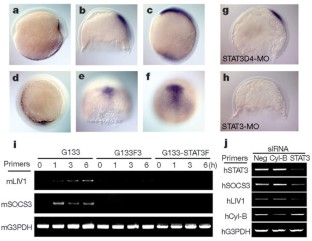
Figure 1: Zinc transporter LIV1 is a target of STAT3 in zebrafish gastrula organizer cells.
The alternative text for this image may have been generated using AI.
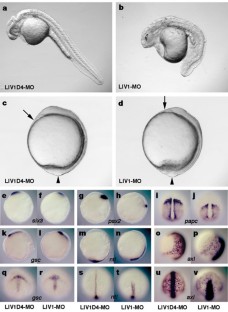
Figure 2: Disruption of gastrulation movement in LIV1 morphants.
The alternative text for this image may have been generated using AI.
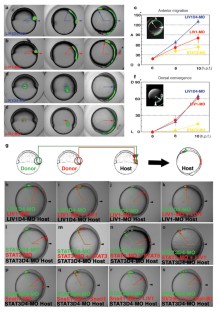
Figure 3: Dependence of cell-autonomous role of STAT3 in gastrulation movements on LIV1 activity.
The alternative text for this image may have been generated using AI.
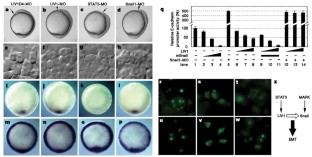
Figure 4: LIV1, STAT3 and Snail are essential for EMT of zebrafish gastrula organizer cells.
The alternative text for this image may have been generated using AI.
References
- Thiery, J. P. Epithelial-mesenchymal transitions in tumour progression. Nature Rev. Cancer 2, 442–454 (2002)
Article CAS Google Scholar - Savagner, P. Leaving the neighborhood: molecular mechanisms involved during epithelial-mesenchymal transition. Bioessays 23, 912–923 (2001)
Article CAS Google Scholar - Darnell, J. E. Jr. STATs and gene regulation. Science 277, 1630–1635 (1997)
Article ADS CAS Google Scholar - Bromberg, J. & Darnell, J. E. Jr The role of STATs in transcriptional control and their impact on cellular function. Oncogene 19, 2468–2473 (2000)
Article CAS Google Scholar - Hirano, T., Ishihara, K. & Hibi, M. Roles of STAT3 in mediating the cell growth, differentiation and survival signals relayed through the IL-6 family of cytokine receptors. Oncogene 19, 2548–2556 (2000)
Article CAS Google Scholar - Kamimura, D. & Hirano, T. in Signal Transducers and Activators of Transcription (STATs): Activation and Biology (eds Sehgal, P. B., Levy, D. E. & Hirano, T.) 155–175 (Kluwer Academic, Dordrecht, 2003)
Book Google Scholar - Sano, S. et al. Keratinocyte-specific ablation of Stat3 exhibits impaired skin remodeling, but does not affect skin morphogenesis. EMBO J. 18, 4657–4668 (1999)
Article CAS Google Scholar - Silver, D. L. & Montell, D. J. Paracrine signaling through the JAK/STAT pathway activates invasive behavior of ovarian epithelial cells in Drosophila. Cell 107, 831–841 (2001)
Article CAS Google Scholar - Yamashita, S. & Hirano, T. in Signal Transducers and Activators of Transcription (STATs): Activation and Biology (eds Sehgal, P. B., Levy, D. E. & Hirano, T.) 595–607 (Kluwer Academic, Dordrecht, 2003)
Book Google Scholar - Yamashita, S. et al. Stat3 controls cell movements during zebrafish gastrulation. Dev. Cell 2, 363–375 (2002)
Article CAS Google Scholar - Manning, D. L., Daly, R. J., Lord, P. G., Kelly, K. F. & Green, C. D. Effects of oestrogen on the expression of a 4.4 kb mRNA in the ZR-75-1 human breast cancer cell line. Mol. Cell. Endocrinol. 59, 205–212 (1988)
Article CAS Google Scholar - Manning, D. L. et al. Oestrogen-regulated genes in breast cancer: association of pLIV1 with lymph node involvement. Eur. J. Cancer 30A, 675–678 (1994)
Article CAS Google Scholar - Taylor, K. M., Morgan, H. E., Johnson, A., Hadley, L. J. & Nicholson, R. I. Structure-function analysis of LIV-1, the breast cancer-associated protein that belongs to a new subfamily of zinc transporters. Biochem. J. 375, 51–59 (2003)
Article CAS Google Scholar - Batlle, E. et al. The transcription factor snail is a repressor of E-cadherin gene expression in epithelial tumour cells. Nature Cell Biol. 2, 84–89 (2000)
Article CAS Google Scholar - Cano, A. et al. The transcription factor snail controls epithelial-mesenchymal transitions by repressing E-cadherin expression. Nature Cell Biol. 2, 76–83 (2000)
Article ADS CAS Google Scholar - Taylor, K. M. & Nicholson, R. I. The LZT proteins; the LIV-1 subfamily of zinc transporters. Biochim. Biophys. Acta 1611, 16–30 (2003)
Article CAS Google Scholar - Fukada, T. et al. Two signals are necessary for cell proliferation induced by a cytokine receptor gp130: involvement of STAT3 in anti-apoptosis. Immunity 5, 449–460 (1996)
Article CAS Google Scholar - Nasevicius, A. & Ekker, S. C. Effective targeted gene ‘knockdown’ in zebrafish. Nature Genet. 26, 216–220 (2000)
Article CAS Google Scholar - Kozlowski, D. J. & Weinberg, E. S. Photoactivatable (caged) fluorescein as a cell tracer for fate mapping in the zebrafish embryo. Methods Mol. Biol. 135, 349–355 (2000)
CAS PubMed Google Scholar - Dominguez, D. et al. Phosphorylation regulates the subcellular location and activity of the snail transcriptional repressor. Mol. Cell. Biol. 23, 5078–5089 (2003)
Article CAS Google Scholar - Van Doren, M. et al. Fear of intimacy encodes a novel transmembrane protein required for gonad morphogenesis in Drosophila. Development 130, 2355–2364 (2003)
Article CAS Google Scholar - Thisse, C., Thisse, B., Schilling, T. F. & Postlethwait, J. H. Structure of the zebrafish snail1 gene and its expression in wild-type, spadetail and no tail mutant embryos. Development 119, 1203–1215 (1993)
CAS PubMed Google Scholar - Thisse, C., Thisse, B. & Postlethwait, J. H. Expression of snail2, a second member of the zebrafish snail family, in cephalic mesendoderm and presumptive neural crest of wild-type and spadetail mutant embryos. Dev. Biol. 172, 86–99 (1995)
Article CAS Google Scholar - Solnica-Krezel, L., Stemple, D. L. & Driever, W. Transparent things: cell fates and cell movements during early embryogenesis of zebrafish. Bioessays 17, 931–939 (1995)
Article CAS Google Scholar - Blanco, M. J. et al. Correlation of Snail expression with histological grade and lymph node status in breast carcinomas. Oncogene 21, 3241–3246 (2002)
Article CAS Google Scholar - Bowman, T., Garcia, R., Turkson, J. & Jove, R. STATs in oncogenesis. Oncogene 19, 2474–2488 (2000)
Article CAS Google Scholar - Ciruna, B. & Rossant, J. FGF signaling regulates mesoderm cell fate specification and morphogenetic movement at the primitive streak. Dev. Cell 1, 37–49 (2001)
Article CAS Google Scholar - Peinado, H., Quintanilla, M. & Cano, A. Transforming growth factor beta-1 induces snail transcription factor in epithelial cell lines: mechanisms for epithelial mesenchymal transitions. J. Biol. Chem. 278, 21113–21123 (2003)
Article CAS Google Scholar
Acknowledgements
We thank A. G. De Herreros for the pGL3-E-cadh promoter plasmid and pcDNA3-mm snail-HA plasmid, and many colleagues for providing reagents. We also thank R. Masuda and A. Kubota for secretarial assistance. This work was supported by grants from the Ministry of Education, Culture, Sports, Science and Technology in Japan.
Author information
Author notes
- Susumu Yamashita and Chiemi Miyagi: These authors contributed equally to this work
Authors and Affiliations
- Laboratory of Developmental Immunology, Graduate School of Frontier Biosciences, Osaka University, 565-0871, Suita, Osaka, Japan
Susumu Yamashita, Yong-Suk Che & Toshio Hirano - Department of Molecular Oncology, Graduate School of Medicine, Osaka University, 565-0871, Suita, Osaka, Japan
Susumu Yamashita, Chiemi Miyagi, Toshiyuki Fukada, Naofumi Kagara & Toshio Hirano - Laboratory for Cytokine Signaling, RIKEN Research Center for Allergy and Immunology, 230-0045, Yokohama, Kanagawa, Japan
Toshiyuki Fukada & Toshio Hirano
Authors
- Susumu Yamashita
- Chiemi Miyagi
- Toshiyuki Fukada
- Naofumi Kagara
- Yong-Suk Che
- Toshio Hirano
Corresponding author
Correspondence toToshio Hirano.
Ethics declarations
Competing interests
The authors declare that they have no competing financial interests.
Supplementary information
Rights and permissions
About this article
Cite this article
Yamashita, S., Miyagi, C., Fukada, T. et al. Zinc transporter LIVI controls epithelial-mesenchymal transition in zebrafish gastrula organizer.Nature 429, 298–302 (2004). https://doi.org/10.1038/nature02545
- Received: 19 February 2004
- Accepted: 05 April 2004
- Published: 05 May 2004
- Issue date: 20 May 2004
- DOI: https://doi.org/10.1038/nature02545