Upwelling-driven nearshore hypoxia signals ecosystem and oceanographic changes in the northeast Pacific (original) (raw)
- Letter
- Published: 17 June 2004
- Francis Chan2 na1,
- Karina J. Nielsen4 na1,
- David S. Fox5,
- John A. Barth3,
- Adriana Huyer3,
- Jane Lubchenco2 &
- …
- Bruce A. Menge2
Nature volume 429, pages 749–754 (2004) Cite this article
- 6103 Accesses
- 516 Citations
- 18 Altmetric
- Metrics details
Abstract
Seasonal development of dissolved-oxygen deficits (hypoxia) represents an acute system-level perturbation to ecological dynamics and fishery sustainability in coastal ecosystems around the globe1,2,3. Whereas anthropogenic nutrient loading has increased the frequency and severity of hypoxia in estuaries and semi-enclosed seas3,4, the occurrence of hypoxia in open-coast upwelling systems reflects ocean conditions that control the delivery of oxygen-poor and nutrient-rich deep water onto continental shelves1. Upwelling systems support a large proportion of the world's fisheries5, therefore understanding the links between changes in ocean climate, upwelling-driven hypoxia and ecological perturbations is critical. Here we report on the unprecedented development of severe inner-shelf (<70 m) hypoxia and resultant mass die-offs of fish and invertebrates within the California Current System. In 2002, cross-shelf transects revealed the development of abnormally low dissolved-oxygen levels as a response to anomalously strong flow of subarctic water into the California Current System. Our findings highlight the sensitivity of inner-shelf ecosystems to variation in ocean conditions, and the potential impacts of climate change on marine communities.
This is a preview of subscription content, access via your institution
Access options
Subscribe to this journal
Receive 51 print issues and online access
$199.00 per year
only $3.90 per issue
Buy this article
- Purchase on SpringerLink
- Instant access to the full article PDF.
USD 39.95
Prices may be subject to local taxes which are calculated during checkout
Additional access options:
Figure 1: Location of the 2002 hypoxic zone and hydrographic transects off Oregon.
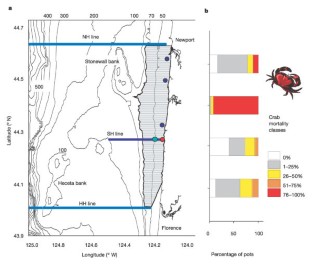
The alternative text for this image may have been generated using AI.
Figure 2: Timeline of observations, both continuous (a–c) and discrete (1–6).
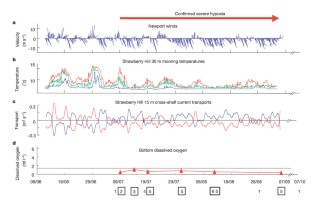
The alternative text for this image may have been generated using AI.
Figure 3: Impact of hypoxia on rockfish communities.
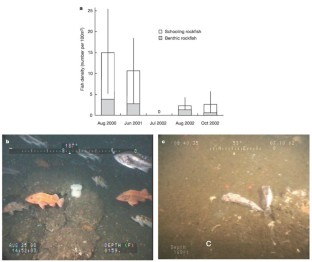
The alternative text for this image may have been generated using AI.
Figure 4: Dissolved-oxygen profiles.
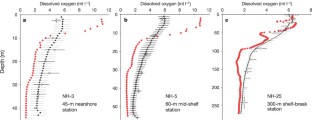
The alternative text for this image may have been generated using AI.
References
- Naqvi, S. W. A. et al. Increased marine production of N2O due to intensifying anoxia on the Indian continental shelf. Nature 408, 346–349 (2000)
Article ADS CAS Google Scholar - Diaz, R. J. Overview of hypoxia around the world. J. Environ. Qual. 30, 275–281 (2001)
Article CAS Google Scholar - Rabalais, N. N. & Turner, R. E. in Coastal Hypoxia: Consequences for Living Resources and Ecosystems (eds Rabalais, N. N. & Turner, R. E.) 1–36 (American Geophysical Union, Washington DC, 2001)
Google Scholar - National Research Council. Coastal Waters: Understanding and Reducing the Effects of Nutrient Pollution (National Academy Press, Washington DC, 2000)
Google Scholar - Pauly, D. & Christensen, V. Primary production required to sustain global fisheries. Nature 374, 255–257 (1995)
Article ADS CAS Google Scholar - Chavez, F. P., Ryan, J., Lluch-Cota, S. E. & Niquen, M. From anchovies to sardines and back: Multidecadal change in the Pacific Ocean. Science 299, 217–221 (2003)
Article ADS CAS Google Scholar - Bakun, A. Global climate change and intensification of coastal ocean upwelling. Science 247, 198–201 (1990)
Article ADS CAS Google Scholar - Roemmich, D. & McGowan, J. Climatic warming and the decline of zooplankton in the California Current. Science 267, 1324–1326 (1995)
Article ADS CAS Google Scholar - Wheeler, P. A., Huyer, A. & Fleischbein, J. Cold halocline, increased nutrients and higher productivity off Oregon in 2002. Geophys. Res. Lett. [online] 30, 8021 (2003) (doi:10.1029/2003GL017395)
ADS Google Scholar - Freeland, H. J., Gatien, G., Huyer, A. & Smith, R. L. Cold halocline in the northern California current: an invasion of subarctic water. Geophys. Res. Lett. [online] 30, 1141 (2003) (doi:10.1029/2002GL016663)
Article ADS Google Scholar - Diaz, R. J. & Rosenberg, R. Marine benthic hypoxia: a review of its ecological effects and the behavioural responses of benthic macrofauna. Oceanogr. Mar. Biol. Ann. Rev. 33, 245–303 (1995)
Google Scholar - National Marine Fisheries Service. Our Living Oceans (NOAA Technical Memo NMFS-F/SPO-41, US Department of Commerce, Washington DC, 1999)
Google Scholar - Dillman, T. Abundance of Fish on Area Reefs Delights, Puzzles Divers (Newport News-Times, Newport, Oregon, 2002)
Google Scholar - Huyer, A. Coastal upwelling in the California current system. Prog. Oceanogr. 112, 259–284 (1983)
Article ADS Google Scholar - Kamykowski, D. & Zentara, S. J. Hypoxia in the world ocean as recorded in the historical data set. Deep-Sea Res. 37, 1861–1874 (1990)
Article ADS CAS Google Scholar - Fleischbein, J. Northeast Pacific long term observation program. US GLOBEC 〈http://globec.oce.orst.edu/groups/nep/index.html〉 (2003)
- Huyer, A., Smith, R. L. & Pillsbury, R. D. Observations in a coastal upwelling region during a period of variable winds (Oregon coast, July 1972). Tethys 6, 391–404 (1974)
Google Scholar - Oke, P. R. et al. A modelling study of the three-dimensional continental shelf circulation off Oregon. Part I: Model-data comparisons. J. Phys. Oceanogr. 32, 1360–1382 (2002)
Article ADS Google Scholar - Thomas, A. C., Strub, T., Brickley, P. & James, C. Anomalous satellite-measured chlorophyll concentrations in the northern California Current in 2001–2002. Geophys. Res. Lett. [online] 30, 8022 (2003) (doi:10.1029/2003GL017409)
ADS Google Scholar - Bailey, G. W., Beyers, C. J. B. & Lipschitz, S. R. Seasonal variation of oxygen deficiency in waters off southern south west Africa in 1975 and 1976 and its relation to the catchability and distribution of the cape rock lobster Jasus lalandii. S. Afr. J. Mar. Sci. 3, 197–214 (1985)
Article Google Scholar - Morales, C. E., Hormazabal, S. E. & Blanco, J. L. Interannual variability in the mesoscale distribution of the depth of the upper boundary of the oxygen minimum layer off northern Chile (18–24S): Implications for the pelagic system and biogeochemical cycling. J. Mar. Res. 57, 909–932 (1999)
Article CAS Google Scholar - Strub, P. T. & James, C. Altimeter estimates of anomalous transports into the northern California Current during 2000–2002. Geophys. Res. Lett. [online] 30, 8025 (2003) (doi:10.1029/2003GL017513)
ADS Google Scholar - Barth, J. A. Anomalous southward advection during 2002 in the northern California Current: evidence from Lagrangian surface drifters. Geophys. Res. Lett. [online] 30, 8024 (2003) (doi:10.1029/2003GL017511)
ADS Google Scholar - Kosro, P. M. Enhanced southward flow over the Oregon shelf in 2002: a conduit for subarctic water. Geophys. Res. Lett. [online] 30, 8023 (2003) (doi:10.1029/2003GL017436)
ADS Google Scholar - Murphree, T., Bograd, S. J., Schwing, F. B. & Ford, B. Large-scale atmosphere–ocean anomalies in the northeast Pacific during 2002. Geophys. Res. Lett. [online] 30, 8026 (2003) (doi:10.1029/2003GL017303)
ADS Google Scholar - Fox, D. S., Amend, M., Merems, A. & Appy, M. Near-shore rocky reef assessment. Oregon Dept. Fish Wildl. Mar. Prog. 〈http://hmsc.oregonstate.edu/odfw/habitat/reports/2000kelp_reef_report.pdf〉 (2000)
- O'Malley, R. SeaSoar observations during the Coastal Ocean Advances in Shelf Transport (COAST) mesoscale surveys I and II. 〈http://damp.coas.oregonstate.edu/coast/seasoar〉 (2003).
Acknowledgements
We thank A. Kirincich for ADCP analyses, S. Oda and A. Walters for assistance and A. Pazar for crab fishery data. The Partnership for Interdisciplinary Studies of Coastal Oceans, funded by the David and Lucile Packard Foundation, and the US GLOBEC program, jointly funded by NSF and NOAA, both contributed to this work. J.A.B. acknowledges additional funding from NSF. ODFW ROV survey work was funded in part by the Oregon Department of Land Conservation and Development through NOAA.
Author information
Author notes
- Brian A. Grantham, Francis Chan and Karina J. Nielsen: These authors contributed equally to this work
Authors and Affiliations
- Washington State Department of Ecology, Coastal and Estuarine Assessment Unit, Olympia, Washington, 98504, USA
Brian A. Grantham - Department of Zoology, Oregon State University, Corvallis, Oregon, 97331, USA
Francis Chan, Jane Lubchenco & Bruce A. Menge - College of Oceanic and Atmospheric Sciences, Corvallis, Oregon, 97331, USA
John A. Barth & Adriana Huyer - Department of Biology, Sonoma State University, Rohnert Park, California, 94928, USA
Karina J. Nielsen - Oregon Department of Fish and Wildlife, Marine Resources Program, Newport, Oregon, 97365, USA
David S. Fox
Authors
- Brian A. Grantham
- Francis Chan
- Karina J. Nielsen
- David S. Fox
- John A. Barth
- Adriana Huyer
- Jane Lubchenco
- Bruce A. Menge
Corresponding author
Correspondence toFrancis Chan.
Ethics declarations
Competing interests
The authors declare that they have no competing financial interests.
Supplementary information
Rights and permissions
About this article
Cite this article
Grantham, B., Chan, F., Nielsen, K. et al. Upwelling-driven nearshore hypoxia signals ecosystem and oceanographic changes in the northeast Pacific.Nature 429, 749–754 (2004). https://doi.org/10.1038/nature02605
- Received: 12 March 2004
- Accepted: 27 April 2004
- Issue date: 17 June 2004
- DOI: https://doi.org/10.1038/nature02605