Disruptive coloration and background pattern matching (original) (raw)
- Letter
- Published: 03 March 2005
- Martin Stevens1,
- Jenna Sheppard1,
- Tracey Maddocks1,
- C. Alejandro Párraga2 &
- …
- Tom S. Troscianko2
Nature volume 434, pages 72–74 (2005)Cite this article
- 21k Accesses
- 523 Citations
- 89 Altmetric
- Metrics details
Abstract
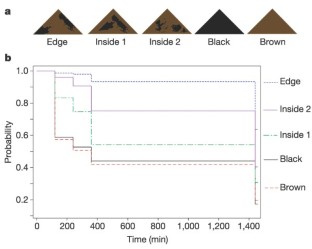
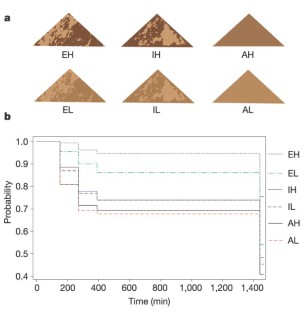
Effective camouflage renders a target indistinguishable from irrelevant background objects. Two interrelated but logically distinct mechanisms for this are background pattern matching (crypsis1,2) and disruptive coloration: in the former, the animal's colours are a random sample of the background1,2; in the latter, bold contrasting colours on the animal's periphery break up its outline. The latter has long been proposed as an explanation for some apparently conspicuous coloration in animals3,4, and is standard textbook material. Surprisingly, only one quantitative test5 of the theory exists, and one experimental test of its effectiveness against non-human predators6. Here we test two key predictions: that patterns on the body's outline should be particularly effective in promoting concealment and that highly contrasting colours should enhance this disruptive effect. Artificial moth-like targets were exposed to bird predation in the field, with the experimental colour patterns on the ‘wings’ and a dead mealworm as the edible ‘body’. Survival analysis supported the predictions, indicating that disruptive coloration is an effective means of camouflage, above and beyond background pattern matching.
This is a preview of subscription content, access via your institution
Access options
Subscribe to this journal
Receive 51 print issues and online access
$199.00 per year
only $3.90 per issue
Buy this article
- Purchase on SpringerLink
- Instant access to the full article PDF.
USD 39.95
Prices may be subject to local taxes which are calculated during checkout
Additional access options:
Figure 1: Patterns placed on the body's outline enhance survival.
The alternative text for this image may have been generated using AI.
Figure 2: High-contrast disruptive patterns enhance survival.
The alternative text for this image may have been generated using AI.
References
- Endler, J. A. Progressive background in moths, and a quantitative measure of crypsis. Biol. J. Linn. Soc. 22, 187–231 (1984)
Article Google Scholar - Endler, J. A. An overview of the relationships between mimicry and crypsis. Biol. J. Linn. Soc. 16, 25–31 (1981)
Article Google Scholar - Thayer, G. H. Concealing Coloration in the Animal Kingdom; An Exposition of the Laws of Disguise through Color and Pattern; Being a Summary of Abbott H. Thayer's Discoveries (Macmillan, New York, 1909)
Google Scholar - Cott, H. B. Adaptive Coloration in Animals (Methuen, London, 1940)
Google Scholar - Merilaita, S. Crypsis through disruptive coloration in an isopod. Proc. R. Soc. Lond. B 265, 1059–1064 (1998)
Article Google Scholar - Silberglied, R. E., Aiello, A. & Windsor, D. M. Disruptive coloration in butterflies - lack of support in Anartia fatima. Science 209, 617–619 (1980)
Article ADS CAS Google Scholar - Behrens, R. R. False Colors: Art, Design and Modern Camouflage (Bobolink, Dysart, Iowa, 2002)
Google Scholar - Thayer, A. H. The law which underlies protective coloration. Auk 13, 124–129 (1896)
Article Google Scholar - Endler, J. A. On the measurement and classification of colour in studies of animal colour patterns. Biol. J. Linn. Soc. 41, 315–352 (1990)
Article Google Scholar - Endler, J. A. A predator's view of animal color patterns. Evol. Biol. 11, 319–364 (1978)
Google Scholar - Bennett, A. T. D., Cuthill, I. C. & Norris, K. J. Sexual selection and the mismeasure of color. Am. Nat. 144, 848–860 (1994)
Article Google Scholar - Kiltie, R. A. Countershading: universally deceptive or deceptively universal? Trends Ecol. Evol. 3, 21–23 (1988)
Article CAS Google Scholar - Ruxton, G. D., Speed, M. P. & Kelly, D. J. What, if anything, is the adaptive function of countershading? Anim. Behav. 68, 445–451 (2004)
Article Google Scholar - Waldbauer, G. P. & Sternburg, J. G. A pitfall in using painted insects in studies of protective coloration. Evolution 37, 1085–1086 (1983)
Article CAS Google Scholar - Merilaita, S., Tuomi, J. & Jormalainen, V. Optimization of cryptic coloration in heterogeneous habitats. Biol. J. Linn. Soc. 67, 151–161 (1999)
Article Google Scholar - Maddocks, S. A., Church, S. C. & Cuthill, I. C. The effects of the light environment on prey choice by zebra finches. J. Exp. Biol. 204, 2509–2515 (2001)
CAS PubMed Google Scholar - Hart, N. S., Partridge, J. C., Cuthill, I. C. & Bennett, A. T. D. Visual pigments, oil droplets, ocular media and cone photoreceptor distribution in two species of passerine: the blue tit (Parus caeruleus L.) and the blackbird (Turdus merula L.). J. Comp. Physiol. [A] 186, 375–387 (2000)
Article CAS Google Scholar - Rasband, W. ImageJ v. 1.30 (http://rsb.info.nih.gov/ij/docs/, National Institutes of Health, USA, 2003).
- Parraga, C. A., Troscianko, T. & Tolhurst, D. J. Spatiochromatic properties of natural images and human vision. Curr. Biol. 12, 483–487 (2002)
Article CAS Google Scholar - Cuthill, I. C. et al. Ultraviolet vision in birds. Adv. Stud. Behav. 29, 159–214 (2000)
Article Google Scholar - Majerus, M. E. N., Brunton, C. F. A. & Stalker, J. A bird's eye view of the peppered moth. J. Evol. Biol. 13, 155–159 (2000)
Article Google Scholar - Cuthill, I. C. et al. Avian colour vision and avian video playback experiments. Acta Ethol. 3, 29–37 (2000)
Article Google Scholar - Cox, D. R. Regression models and life-tables. J. R. Stat. Soc. B 34, 187–220 (1972)
MathSciNet MATH Google Scholar - SPSS for Windows Release 9.0 (SPSS Inc., Chicago, 2003).
Acknowledgements
We thank J. Endler for suggestions. The research was supported by a BBSRC grant to I.C.C., T.S.T. and J. C. Partridge.Authors' contributions I.C.C. designed the experiments and stimuli; M.S., J.S., T.M. and I.C.C. performed the experiments; A.P. wrote the programs for colour analysis and camera calibration; T.S.T. advised on design and colour modelling.
Author information
Authors and Affiliations
- School of Biological Sciences, University of Bristol, Woodland Road, BS8 1UG, Bristol, UK
Innes C. Cuthill, Martin Stevens, Jenna Sheppard & Tracey Maddocks - Department of Experimental Psychology, University of Bristol, Woodland Road, BS8 1TN, Bristol, UK
C. Alejandro Párraga & Tom S. Troscianko
Authors
- Innes C. Cuthill
- Martin Stevens
- Jenna Sheppard
- Tracey Maddocks
- C. Alejandro Párraga
- Tom S. Troscianko
Corresponding author
Correspondence toInnes C. Cuthill.
Ethics declarations
Competing interests
The authors declare that they have no competing financial interests.
Rights and permissions
About this article
Cite this article
Cuthill, I., Stevens, M., Sheppard, J. et al. Disruptive coloration and background pattern matching.Nature 434, 72–74 (2005). https://doi.org/10.1038/nature03312
- Received: 23 September 2004
- Accepted: 30 December 2004
- Issue date: 03 March 2005
- DOI: https://doi.org/10.1038/nature03312