Nucleosynthetic signatures of the first stars (original) (raw)
- Letter
- Published: 14 April 2005
- Wako Aoki2,
- Norbert Christlieb2,3,
- Hiroyasu Ando2,
- Martin Asplund1,
- Paul S. Barklem4,
- Timothy C. Beers5,
- Kjell Eriksson4,
- Cora Fechner3,
- Masayuki Y. Fujimoto6,
- Satoshi Honda2,
- Toshitaka Kajino2,
- Takeo Minezaki7,
- Ken'ichi Nomoto8,
- John E. Norris1,
- Sean G. Ryan9,
- Masahide Takada-Hidai10,
- Stelios Tsangarides9 &
- …
- Yuzuru Yoshii7
Nature volume 434, pages 871–873 (2005)Cite this article
- 2302 Accesses
- 494 Citations
- 46 Altmetric
- Metrics details
Abstract
The chemically most primitive stars provide constraints on the nature of the first stellar objects that formed in the Universe; elements other than hydrogen, helium and traces of lithium present within these objects were generated by nucleosynthesis in the very first stars. The relative abundances of elements in the surviving primitive stars reflect the masses of the first stars, because the pathways of nucleosynthesis are quite sensitive to stellar masses. Several models1,2,3,4,5 have been suggested to explain the origin of the abundance pattern of the giant star HE0107–5240, which hitherto exhibited the highest deficiency of heavy elements known1,6. Here we report the discovery of HE1327–2326, a subgiant or main-sequence star with an iron abundance about a factor of two lower than that of HE0107–5240. Both stars show extreme overabundances of carbon and nitrogen with respect to iron, suggesting a similar origin of the abundance patterns. The unexpectedly low Li and high Sr abundances of HE1327–2326, however, challenge existing theoretical understanding: no model predicts the high Sr abundance or provides a Li depletion mechanism consistent with data available for the most metal-poor stars.
This is a preview of subscription content, access via your institution
Access options
Subscribe to this journal
Receive 51 print issues and online access
$199.00 per year
only $3.90 per issue
Buy this article
- Purchase on SpringerLink
- Instant access to the full article PDF.
USD 39.95
Prices may be subject to local taxes which are calculated during checkout
Additional access options:
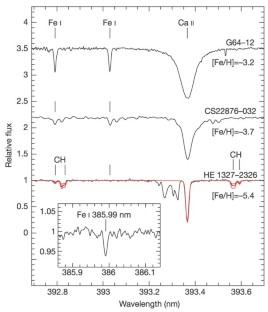
Figure 1: Comparison of high-resolution spectra of HE1327–2326 with G64–12 and CS 22876–032.
The alternative text for this image may have been generated using AI.
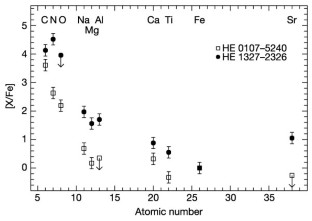
Figure 2: Abundance patterns of HE1327–2326 (subgiant solution, filled circles) and HE0107–5240 (open squares).
The alternative text for this image may have been generated using AI.
References
- Christlieb, N. et al. A stellar relic from the early Milky Way. Nature 419, 904–906 (2002)
Article ADS CAS Google Scholar - Shigeyama, T., Tsujimoto, T. & Yoshii, Y. Excavation of the first stars. Astrophys. J. 568, L57–L60 (2003)
Article ADS Google Scholar - Umeda, H. & Nomoto, K. First-generation black-hole-forming supernovae and the metal abundance pattern of a very iron-poor star. Nature 422, 871–873 (2003)
Article ADS CAS Google Scholar - Limongi, M., Chieffi, A. & Bonifacio, P. On the origin of HE 0107–5240, the most iron-deficient star presently known. Astrophys. J. 594, L123–L126 (2003)
Article ADS CAS Google Scholar - Suda, T., Aikawa, M., Machida, M. N., Fujimoto, M. Y. & Iben, I. Jr. Is HE 0107–5240 a primordial star? The characteristics of extremely metal-poor carbon-rich stars. Astrophys. J. 611, 476–493 (2004)
Article ADS CAS Google Scholar - Christlieb, N. et al. HE 0107–5240, a chemically ancient star. I. A detailed abundance analysis. Astrophys. J. 603, 708–728 (2004)
Article ADS CAS Google Scholar - Wisotzki, L. et al. The Hamburg/ESO survey for bright QSOs. III. A large flux-limited sample of QSOs. Astron. Astrophys. 358, 77–87 (2000)
ADS CAS Google Scholar - Noguchi, K. et al. High dispersion spectrograph (HDS) for the Subaru telescope. Publ. Astron. Soc. Jpn 54, 855–864 (2002)
Article ADS Google Scholar - Beers, T. C. & Christlieb, N. The discovery and analysis of very metal-poor stars in the galaxy. Annu. Rev. Astron. Astrophys. (in the press)
- Coc, A., Vangioni-Flam, E., Descouvemont, P., Adahchour, A. & Angulo, C. Updated big bang nucleosynthesis compared with Wilkinson microwave anisotropy probe observations and the abundance of light elements. Astrophys. J. 600, 544–552 (2004)
Article ADS CAS Google Scholar - Ryan, S. G., Norris, J. E. & Beers, T. C. The Spite lithium plateau: ultrathin but postprimordial. Astrophys. J. 523, 654–677 (1999)
Article ADS CAS Google Scholar - Ryan, S. G., Gregory, S. G., Kolb, U., Beers, T. C. & Kajino, T. Rapid rotation of ultra-Li-depleted halo stars and their association with blue stragglers. Astrophys. J. 571, 501–511 (2002)
Article ADS Google Scholar - Pinsonneault, M. H., Walker, T. P., Steigman, G. & Narayanan, V. K. Halo star lithium depletion. Astrophys. J. 527, 180–198 (1999)
Article ADS CAS Google Scholar - Richard, O., Michaud, G. & Richer, J. Models of metal-poor stars with gravitational settling and radiative accelerations. III. Metallicity dependence. Astrophys. J. 580, 1100–1117 (2002)
Article ADS CAS Google Scholar - Aoki, W., Norris, J. E., Ryan, S. G., Beers, T. C. & Ando, H. Detection of lead in the carbon-rich, very metal-poor star LP 625–44: A strong constraint on s-process nucleosynthesis at low metallicity. Astrophys. J. 536, L97–L100 (2000)
Article ADS CAS Google Scholar - Travaglio, C. et al. Galactic evolution of Sr, Y, and Zr. A multiplicity of nucleosynthetic processes. Astrophys. J. 601, 864–884 (2004)
Article ADS CAS Google Scholar - Christlieb, N. et al. The Hamburg/ESO R-process enhanced star survey (HERES). I. Project description, and discovery of two stars with strong enhancements of neutron-capture elements. Astron. Astrophys. 428, 1027–1037 (2004)
Article ADS CAS Google Scholar - Fryer, C. L., Woosley, S. E. & Heger, A. Pair instability supernovae, gravity waves, and gamma-ray transients. Astrophys. J. 550, 372–382 (2001)
Article ADS CAS Google Scholar - Yoshii, Y. Metal enrichment in the atmospheres of extremely metal-deficient dwarf stars by accretion of interstellar matter. Astron. Astrophys. 97, 280–290 (1981)
ADS CAS Google Scholar - Norris, J. E., Ryan, S. G., Beers, T. C. & Deliyannis, C. P. Extremely metal-poor stars. III. The Li-depleted main-sequence turnoff dwarfs. Astrophys. J. 485, 370–379 (1997)
Article ADS CAS Google Scholar - Beers, T. C., Rossi, S., Norris, J. E., Ryan, S. G. & Shefler, T. Estimation of stellar metal abundance. II. A recalibration of the Ca II K technique, and the autocorrelation function method. Astron. J. 117, 981–1009 (1999)
Article ADS CAS Google Scholar - Asplund, M. New light on stellar abundances analyses: departures from LTE and homogeneity. Annu. Rev. Astron. Astrophys. (in the press)
- Bessell, M. S., Christlieb, N. & Gustafsson, B. On the oxygen abundance of HE 0107–5240. Astrophys. J. 612, L61–L63 (2004)
Article ADS CAS Google Scholar - Alonso, A., Arribas, S. & Martinez-Roger, C. The empirical scale of temperatures of the low main sequence (F0V–K5V). Astron. Astrophys. 313, 873–890 (1996)
ADS Google Scholar - Yoshii, Y. in New Trends in Theoretical and Observational Cosmology (eds Sato, K. & Shiromizu, T.) 235–244 (Universal Academy, Tokyo, 2002)
Google Scholar - Cutri, R. M., et al. 2MASS All-Sky Catalog of Point Sources (California Institute of Technology, Pasadena, 2003); http://irsa.ipac.caltech.edu/applications/Gator
Google Scholar - Girard, T. M. et al. The southern proper motion program. III. A near-complete catalog to V = 17.5. Astron. J. 127, 3060–3071 (2004)
Article ADS Google Scholar - Kim, Y., Demarque, P., Yi, S. K. & Alexander, D. R. The Y2 isochrones for alpha-element enhanced mixtures. Astrophys. J. Suppl. 143, 499–511 (2002)
Article ADS CAS Google Scholar - Kurucz, R. L. ATLAS9 Stellar Atmosphere Programs and 2 km/s Grid CD-ROM 13 (Smithsonian Astrophysical Observatory, Cambridge, 1993); http://kurucz.harvard.edu/cdroms.html
Google Scholar - Asplund, M., Grevesse, N. & Sauval, A. J. in Cosmic Abundances As Records Of Stellar Evolution And Nucleosynthesis (eds Bash, F. N. & Barnes, T. G.) ASP Conf. Ser. (in the press); preprint at http://www.arxiv.org/astro-ph/0410214 (2004).
Acknowledgements
We thank A. Steinhauer and C. Thom for obtaining additional observations, N. Iwamoto, K. Maeda, T. Suda, N. Tominaga and H. Umeda for valuable discussions and L. Wisotzki and D. Reimers for leading the HES. This work was supported by the Astronomical Society of Australia (A.F.), Australian Research Council (M.A., A.F., J.E.N.), Ministry of Education, Culture, Sports, Science and Technology in Japan and JSPS (all Japanese co-authors), Deutsche Forschungsgemeinschaft (N.C.), Swedish Research Council (P.S.B., K.E.), US National Science Foundation (T.C.B.) and JINA (T.C.B., N.C., A.F., J.E.N.). This work is based on data collected at the Subaru Telescope, which is operated by the National Astronomical Observatory of Japan.
Author information
Authors and Affiliations
- Research School of Astronomy & Astrophysics, The Australian National University, Cotter Road, Weston Creek, Australian Capital Territory, 2611, Australia
Anna Frebel, Martin Asplund & John E. Norris - National Astronomical Observatory of Japan, 2-21-1, Osawa, Mitaka, Tokyo, 181-8588, Japan
Wako Aoki, Norbert Christlieb, Hiroyasu Ando, Satoshi Honda & Toshitaka Kajino - Hamburger Sternwarte, Gojenbergsweg 112, 21029, Hamburg, Germany
Norbert Christlieb & Cora Fechner - Department of Physics and Space Sciences, Uppsala Astronomical Observatory, Box 515, SE-751 20, Uppsala, Sweden
Paul S. Barklem & Kjell Eriksson - Department of Physics and Astronomy, and Joint Institute for Nuclear Astrophysics (JINA), Michigan State University, East Lansing, Michigan, 48824, USA
Timothy C. Beers - Department of Physics, Hokkaido University, Sapporo, Hokkaido, 060-0810, Japan
Masayuki Y. Fujimoto - Institute of Astronomy, School of Science, University of Tokyo, Mitaka, Tokyo, 181-0015, Japan
Takeo Minezaki & Yuzuru Yoshii - Department of Astronomy, School of Science, University of Tokyo, Tokyo, 113-0033, Japan
Ken'ichi Nomoto - Department of Physics and Astronomy, Open University, Walton Hall, Milton Keynes, MK7 6AA, UK
Sean G. Ryan & Stelios Tsangarides - Liberal Arts Education Center, Tokai University, 1117 Kitakaname, Hiratsuka-shi, Kanagawa, 259-1292, Japan
Masahide Takada-Hidai
Authors
- Anna Frebel
- Wako Aoki
- Norbert Christlieb
- Hiroyasu Ando
- Martin Asplund
- Paul S. Barklem
- Timothy C. Beers
- Kjell Eriksson
- Cora Fechner
- Masayuki Y. Fujimoto
- Satoshi Honda
- Toshitaka Kajino
- Takeo Minezaki
- Ken'ichi Nomoto
- John E. Norris
- Sean G. Ryan
- Masahide Takada-Hidai
- Stelios Tsangarides
- Yuzuru Yoshii
Corresponding author
Correspondence toAnna Frebel.
Ethics declarations
Competing interests
The authors declare that they have no competing financial interests.
Rights and permissions
About this article
Cite this article
Frebel, A., Aoki, W., Christlieb, N. et al. Nucleosynthetic signatures of the first stars.Nature 434, 871–873 (2005). https://doi.org/10.1038/nature03455
- Received: 22 November 2004
- Accepted: 08 February 2005
- Issue date: 14 April 2005
- DOI: https://doi.org/10.1038/nature03455
This article is cited by
Editorial Summary
Low-metal stars: second site
When HE010715240 was discovered in 2002 it was the most metal-deficient star known. (Astrophysicists use the term ‘metal’ for all elements bar hydrogen and helium.) It had an iron abundance 20 times lower than previously recorded, suggesting that here was a relic, a star formed soon after the Big Bang. Now a second ‘unevolved’ star has been discovered: HE132712326, with an iron abundance about half that of HE010715240. One low-metal star was a novelty; two is a new class of stellar object. The similarities (in C and N content) and contrasts (in Li and Sr) between these two stellar relics present challenges to theories of star formation and may lead to new discoveries about how the elements were synthesized in the first stars.