Global pattern of trends in streamflow and water availability in a changing climate (original) (raw)
- Letter
- Published: 17 November 2005
Nature volume 438, pages 347–350 (2005) Cite this article
- 17k Accesses
- 1990 Citations
- 98 Altmetric
- Metrics details
Abstract
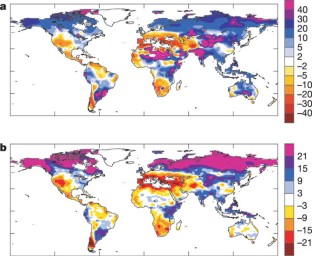
Water availability on the continents is important for human health1,2, economic activity3, ecosystem function4 and geophysical processes5. Because the saturation vapour pressure of water in air is highly sensitive to temperature, perturbations in the global water cycle are expected to accompany climate warming6. Regional patterns of warming-induced changes in surface hydroclimate are complex and less certain than those in temperature, however, with both regional increases and decreases expected in precipitation and runoff. Here we show that an ensemble of 12 climate models exhibits qualitative and statistically significant skill in simulating observed regional patterns of twentieth-century multidecadal changes in streamflow. These models project 10–40% increases in runoff in eastern equatorial Africa, the La Plata basin and high-latitude North America and Eurasia, and 10–30% decreases in runoff in southern Africa, southern Europe, the Middle East and mid-latitude western North America by the year 2050. Such changes in sustainable water availability would have considerable regional-scale consequences for economies as well as ecosystems.
This is a preview of subscription content, access via your institution
Access options
Subscribe to this journal
Receive 52 print issues and online access
$199.00 per year
only $3.83 per issue
Buy this article
- Purchase on SpringerLink
- Instant access to the full article PDF.
USD 39.95
Prices may be subject to local taxes which are calculated during checkout
Additional access options:
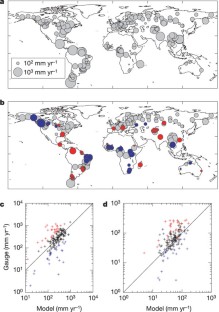
Figure 1: Annual runoff rate (streamflow per unit basin area, in mm yr -1).
The alternative text for this image may have been generated using AI.
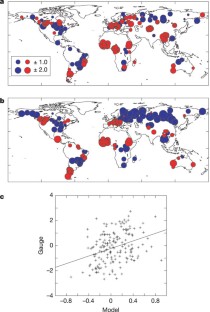
Figure 2: Global distributions of trend ( Z ) in streamflow from 1900–70 to 1971–98.
The alternative text for this image may have been generated using AI.
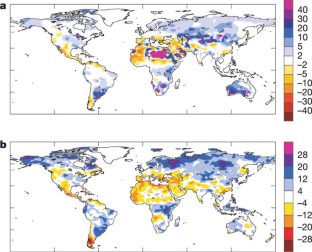
Figure 3: Relative change in runoff during the twentieth century.
The alternative text for this image may have been generated using AI.
Figure 4: Relative change in runoff in the twenty-first century.
The alternative text for this image may have been generated using AI.
References
- Reiter, L., Falk, H., Groat, C. & Coussens, C. M. (eds) From Source Water to Drinking Water: Workshop Summary (National Academies Press, Washington DC, 2004)
- United Nations Educational Scientific and Cultural Organization. Water for People—Water for Life, The United Nations World Water Development Report (Berghahn Books, Oxford, 2003)
Google Scholar - Shiklomanov, I. A. & Rodda, J. C. (eds) World Water Resources at the Beginning of the 21st Century (Cambridge Univ. Press, Cambridge, 2003)
- Mooney, H., Cropper, A. & Reid, W. Confronting the human dilemma. Nature 434, 561–562 (2005)
Article ADS CAS Google Scholar - Cazenave, A. et al. Space techniques used to measure change in terrestrial waters. Eos 48, 59 (2004)
ADS Google Scholar - Allen, M. & Ingram, W. J. Constraints on future changes in climate and the hydrologic cycle. Nature 419, 224–232 (2002)
ADS CAS PubMed Google Scholar - Brockwell, P. J. & Davis, R. A. Time Series: Theory and Methods Ch. 7 (Springer, New York, 1987)
Book Google Scholar - Manabe, S., Wetherald, R. T., Milly, P. C. D., Delworth, T. L. & Stouffer, R. J. Century-scale change in water availability: CO2-quadrupling experiment. Clim. Change 64, 59–76 (2004)
Article CAS Google Scholar - Fekete, B. M., Vörösmarty, C. J. & Grabs, W. High-resolution fields of global runoff combining observed river discharge and simulated water balances. Glob. Biogeochem. Cycles 16 (2002); published online 7 August 2002 (doi:10.1029/1999GB001254)
- Siebert, S., Döll, P., Feick, S. & Hoogeveen, J. Global Map of Irrigated Areas version 2.2 (Johann Wolfgang Goethe University, Frankfurt am Main, Germany; Food and Agriculture Organization of the United Nations, Rome, 2005)
Google Scholar - Darnell, W. L. et al. Surface Radiation Budget: A Long-term Global Dataset of Shortwave and Longwave Fluxes [online] http://www.agu.org/eos_elec/95206e.html (1996).
- Adler, R. F. et al. The Version 2 Global Precipitation Climatology Project (GPCP) monthly precipitation analysis (1979–present). J. Hydrometeorol. 4, 1147–1167 (2003)
Article ADS Google Scholar - Vörösmarty, C. J., Fekete, B. M., Meybeck, M. & Lammers, R. B. Global system of rivers: Its role in organizing continental land mass and defining land-to-ocean linkages. Glob. Biogeochem. Cycles 14, 599–621 (2000)
Article ADS Google Scholar
Acknowledgements
We thank T. Cohn, T. Delworth, I. Held, G. Hodgkins, H. Lins and R. Stouffer for advice. Streamflow data were provided by national hydrometric services through the Global Runoff Data Centre, Koblenz, Germany. Climate-model outputs were provided by modelling centres through PCMDI. We acknowledge the JSC/CLIVAR Working Group on Coupled Modelling and their Coupled Model Intercomparison Project and Climate Simulation Panel for organizing the model data analysis activity, and the IPCC WG1 TSU for technical support. This investigation was performed within the IPCC Global Hydroclimates Analysis Project.
Author information
Authors and Affiliations
- US Geological Survey, Geophysical Fluid Dynamics Laboratory/NOAA, PO Box 308, New Jersey, 08542, Princeton, USA
P. C. D. Milly & K. A. Dunne - US Geological Survey, 821 E. Interstate Ave., North Dakota, 58503-1199, Bismarck, USA
A. V. Vecchia
Authors
- P. C. D. Milly
- K. A. Dunne
- A. V. Vecchia
Corresponding author
Correspondence toP. C. D. Milly.
Ethics declarations
Competing interests
Reprints and permissions information is available at npg.nature.com/reprintsandpermissions. The authors declare no competing financial interests.
Rights and permissions
About this article
Cite this article
Milly, P., Dunne, K. & Vecchia, A. Global pattern of trends in streamflow and water availability in a changing climate.Nature 438, 347–350 (2005). https://doi.org/10.1038/nature04312
- Received: 18 May 2005
- Accepted: 12 October 2005
- Issue date: 17 November 2005
- DOI: https://doi.org/10.1038/nature04312
This article is cited by
Editorial Summary
Climate change
Health warning Nature this week includes reviews, original research and comment on a hot topic, the regional effects of climate change. The cover image — Chicago during the July 1995 heatwave — highlights one potential risk. Patz et al. consider the available evidence and suggest that climate warming already contributes to ill health and thousands of premature deaths across the world, and is likely to have serious health implications in the future. Recent work suggests that some regions are particularly at risk: areas where climate is dominated by El Niño/Southern Oscillation events, sub-Saharan Africa, and sprawling urban areas subject to the heat island effect are already suffering from climate impacts and these are projected to increase. In many cases, regions at high risk are those least responsible for causing climate change.
Sure thing All currently available climate models predict a near-surface warming trend under the influence of rising levels of greenhouse gases in the atmosphere. Barnett et al. evaluate the effect of such a warming trend on regional hydrology, particularly in snowmelt-dominated environments. They suggest that warming will cause a change from snowfall to rain, diminishing natural water storage capacity, as well as earlier melting of winter snow, shifting peak river runoff away from the periods of highest demand in summer and autumn. The reduction in glaciers and snow-packs are likely to have severe consequences for the water supply of one-sixth of the Earth's population.
Water supply It is generally assumed that climate change will alter the hydrological cycle, but predicting which parts of the world will be drier and which will be wetter is a difficult problem. Milly et al. focus on streamflow and water availability trends and find that an ensemble of twelve current climate models accurately accounts for twentieth-century changes. The same models project potentially crucial regional effects on streamflow in the future that could threaten the availability of freshwater in many regions of the world by the year 2050.