Nitrogen limitation constrains sustainability of ecosystem response to CO2 (original) (raw)
- Letter
- Published: 13 April 2006
- Sarah E. Hobbie2,
- Tali Lee1,3,
- David S. Ellsworth4,
- Jason B. West2,
- David Tilman2,
- Johannes M. H. Knops5,
- Shahid Naeem6 &
- …
- Jared Trost1
Nature volume 440, pages 922–925 (2006) Cite this article
- 8087 Accesses
- 837 Citations
- 50 Altmetric
- Metrics details
Abstract
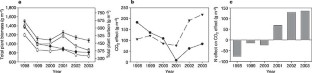
Enhanced plant biomass accumulation in response to elevated atmospheric CO2 concentration could dampen the future rate of increase in CO2 levels and associated climate warming. However, it is unknown whether CO2-induced stimulation of plant growth and biomass accumulation will be sustained or whether limited nitrogen (N) availability constrains greater plant growth in a CO2-enriched world1,2,3,4,5,6,7,8,9. Here we show, after a six-year field study of perennial grassland species grown under ambient and elevated levels of CO2 and N, that low availability of N progressively suppresses the positive response of plant biomass to elevated CO2. Initially, the stimulation of total plant biomass by elevated CO2 was no greater at enriched than at ambient N supply. After four to six years, however, elevated CO2 stimulated plant biomass much less under ambient than enriched N supply. This response was consistent with the temporally divergent effects of elevated CO2 on soil and plant N dynamics at differing levels of N supply. Our results indicate that variability in availability of soil N and deposition of atmospheric N are both likely to influence the response of plant biomass accumulation to elevated atmospheric CO2. Given that limitations to productivity resulting from the insufficient availability of N are widespread in both unmanaged and managed vegetation5,7,8,9, soil N supply is probably an important constraint on global terrestrial responses to elevated CO2.
This is a preview of subscription content, access via your institution
Access options
Subscribe to this journal
Receive 52 print issues and online access
$199.00 per year
only $3.83 per issue
Buy this article
- Purchase on SpringerLink
- Instant access to the full article PDF.
USD 39.95
Prices may be subject to local taxes which are calculated during checkout
Additional access options:
Figure 1: Effects of CO 2 and N on total plant biomass over time.
The alternative text for this image may have been generated using AI.
References
- Intergovernmental Panel on Climate Change. Climate Change 2001: The Scientific Basis (Cambridge Univ. Press, New York, 2001)
Google Scholar - Rastetter, E. B., Agren, G. I. & Shaver, G. R. Responses of N-limited ecosystems to increased CO2: a balanced-nutrition coupled-element-cycles model. Ecol. Appl. 7, 444–460 (1997)
Google Scholar - McMurtrie, R. E., Dewar, R. C., Medlyn, B. E. & Jeffreys, M. P. Effects of rising CO2 on growth and carbon sequestration in forests: a modelling analysis of the consequences of altered litter quantity and quality. Plant Soil 224, 135–152 (2000)
Article CAS Google Scholar - Zak, D. R., Pregitzer, K. S., Curtis, P. S. & Holmes, W. E. Atmospheric CO2 and the composition and function of soil microbial communities. Ecol. Appl. 10, 47–59 (2000)
Google Scholar - Oren, R. et al. Soil fertility limits carbon sequestration by forest ecosystems in a CO2 enriched world. Nature 411, 469–472 (2001)
Article ADS CAS Google Scholar - Shaw, M. R. et al. Grassland responses to global environmental changes suppressed by elevated CO2 . Science 298, 1987–1990 (2002)
Article ADS CAS Google Scholar - Hungate, B. A., Dukes, J. S., Shaw, M. R., Luo, Y. Q. & Field, C. B. Nitrogen and climate change. Science 302, 1512–1513 (2003)
Article CAS Google Scholar - Luo, Y. et al. Progressive nitrogen limitation of ecosystem responses to rising atmospheric carbon dioxide. Bioscience 54, 731–739 (2004)
Article Google Scholar - Schneider, M. K. et al. Ten years of free-air CO2 enrichment altered the mobilization of N from soil in Lolium perenne L. swards. Glob. Change Biol. 10, 1377–1388 (2004)
Article ADS Google Scholar - Lloyd, J. & Farquhar, G. D. The CO2 dependence of photosynthesis, plant growth responses to elevated atmospheric CO2 concentrations, and their interactions with soil nutrient status. I. General principles and forest ecosystems. Funct. Ecol. 10, 4–32 (1996)
Article Google Scholar - Peterson, A. G. et al. The photosynthesis–leaf nitrogen relationship at ambient and elevated atmospheric carbon dioxide: a meta-analysis. Glob. Change Biol. 5, 331–346 (1999)
Article ADS Google Scholar - Zak, D. R., Holmes, W. E., Finzi, A. C., Norby, R. J. & Schlesinger, W. H. Soil nitrogen cycling under elevated CO2: a synthesis of forest face experiments. Ecol. Appl. 13, 1508–1514 (2003)
Article Google Scholar - Vitousek, P. M. et al. Human alteration of the global nitrogen cycle: sources and consequences. Ecol. Appl. 7, 737–750 (1997)
Google Scholar - Luo, Y., Field, C. B. & Mooney, H. A. Predicting responses of photosynthesis and root fraction to elevated [CO2]: interactions among carbon, nitrogen and growth. Plant Cell Environ. 17, 1195–1204 (1994)
Article Google Scholar - Cannell, M. & Thornley, J. N-poor ecosystems may respond more to elevated [CO2] than N-rich ones in the long term. A model analysis of grassland. Glob. Change Biol. 4, 431–442 (1998)
Article ADS Google Scholar - Gill, R. A. et al. Nonlinear grassland responses to past and future atmospheric CO2 . Nature 417, 279–282 (2002)
Article ADS CAS Google Scholar - Williams, M. A., Rice, C. W. & Owensby, C. E. Carbon dynamics and microbial activity in tallgrass prairie exposed to elevated CO2 for 8 years. Plant Soil 227, 127–137 (2000)
Article CAS Google Scholar - Reich, P. B. et al. Plant diversity enhances ecosystem responses to elevated CO2 and nitrogen deposition. Nature 410, 809–812 (2001)
Article ADS CAS Google Scholar - Finzi, A. C. & Schlesinger, W. H. Soil-nitrogen cycling in a pine forest exposed to 5 years of elevated carbon dioxide. Ecosystems 6, 444–456 (2003)
Article CAS Google Scholar - Owensby, C. E., Auen, L. M. & Coyne, P. I. Biomass production in a nitrogen fertilized, tallgrass prairie ecosystem exposed to ambient and elevated levels of CO2 . Plant Soil 165, 105–113 (1994)
Article CAS Google Scholar - Zanetti, S. et al. Does nitrogen nutrition restrict the CO2 response of fertile grassland lacking legumes? Oecologia 112, 17–25 (1997)
Article ADS CAS Google Scholar - Zak, D. R., Pregitzer, K. S., Curtis, P. S. & Holmes, W. E. Atmospheric CO2 and the composition and function of soil microbial communities. Ecol. Appl. 10, 47–59 (2000)
Google Scholar - Reich, P. B. et al. Species and functional diversity independently influence biomass accumulation and its response to CO2 and N. Proc. Natl Acad. Sci. USA 101, 10101–10106 (2004)
Article ADS CAS Google Scholar - Galloway, J. N. et al. The nitrogen cascade. Bioscience 53, 341–356 (2003)
Article Google Scholar - Reich, P. B. et al. Do species and functional groups differ in acquisition and use of C, N and water under varying atmospheric CO2 and N availability regimes? A field test with 16 grassland species. New Phytol. 150, 435–448 (2001)
Article CAS Google Scholar - Lee, T. D., Tjoelker, M. G., Ellsworth, D. S. & Reich, P. B. Leaf gas exchange responses of 13 prairie grassland species in the field under elevated carbon dioxide and increased nitrogen supply. New Phytol. 150, 405–418 (2001)
Article CAS Google Scholar - Craine, J. M., Wedin, D. A. & Reich, P. B. The response of soil CO2 flux to changes in atmospheric CO2, nitrogen supply, and plant diversity. Glob. Change Biol. 7, 947–953 (2001)
Article ADS Google Scholar - Dijkstra, F., Hobbie, S., Reich, P. & Knops, J. Divergent effects of elevated CO2, N fertilization, and plant diversity on soil C and N dynamics in a grassland field experiment. Plant Soil 272, 41–52 (2005)
Article CAS Google Scholar - Lüscher, A., Hartwig, U. A., Suter, D. & Nösberger, J. Direct evidence that in fertile grassland symbiotic N2 fixation is an important trait for a strong response of plants to elevated atmospheric CO2 . Glob. Change Biol. 6, 655–662 (2000)
Article ADS Google Scholar - Hungate, B. A. et al. CO2 elicits long-term decline in nitrogen fixation. Science 304, 1291 (2004)
Article CAS Google Scholar
Acknowledgements
We thank the US Department of Energy Program for Ecosystem Research, the National Science Foundation Long-Term Ecological Research and Biocomplexity Coupled Biogeochemical Cycles Programs, and the University of Minnesota for supporting this research. Author Contributions All authors were involved in the design or implementation of the experiment, or both, with P.B.R. having the major responsibility for these. P.B.R., D.E., D.T., J.K. and S.N. were involved in the initial experimental design. J.T. was responsible for a substantial fraction of the experimental management and data collection, with smaller contributions in this area from T.L., D.E., J.B.W., J.K. and S.H. P.B.R. performed the statistical analyses and wrote the paper, with assistance from S.H., T.L., D.E., S.N. and J.B.W. All authors discussed the results and commented on the manuscript.
Author information
Authors and Affiliations
- Department of Forest Resources,
Peter B. Reich, Tali Lee & Jared Trost - Department of Ecology, Evolution and Behavior, University of Minnesota, Minnesota, 55108, St Paul, USA
Sarah E. Hobbie, Jason B. West & David Tilman - Department of Biology, University of Wisconsin–Eau Claire, Eau Claire, Wisconsin, 54701, USA
Tali Lee - School of Natural Resources and Environment, University of Michigan, Ann Arbor, Michigan, 48109, USA
David S. Ellsworth - School of Biological Sciences, University of Nebraska, Lincoln, Nebraska, 68588, USA
Johannes M. H. Knops - Department of Ecology, Evolution, and Environmental Biology, Columbia University, New York, New York, 10027, USA
Shahid Naeem
Authors
- Peter B. Reich
- Sarah E. Hobbie
- Tali Lee
- David S. Ellsworth
- Jason B. West
- David Tilman
- Johannes M. H. Knops
- Shahid Naeem
- Jared Trost
Corresponding author
Correspondence toPeter B. Reich.
Ethics declarations
Competing interests
Reprints and permissions information is available at npg.nature.com/reprintsandpermissions. The authors declare no competing financial interests.
Supplementary information
Rights and permissions
About this article
Cite this article
Reich, P., Hobbie, S., Lee, T. et al. Nitrogen limitation constrains sustainability of ecosystem response to CO2.Nature 440, 922–925 (2006). https://doi.org/10.1038/nature04486
- Received: 10 October 2005
- Accepted: 29 November 2005
- Issue date: 13 April 2006
- DOI: https://doi.org/10.1038/nature04486
This article is cited by
Editorial Summary
Nitrogen sets the scene
Future trends in atmospheric CO2 concentrations, and thus future climate, will depend in part on the degree to which terrestrial ecosystems can accumulate CO2 emissions from human activities. A six-year grassland field study has found that the biomass enhancement due to elevated CO2 declines over time under ambient nitrogen supply, but not under nitrogen enrichment, suggesting that both natural variation among soils and variation in nitrogen deposition rates are likely to influence plant biomass accumulation responses to elevated CO2. Nitrogen is a limiting factor in many managed and unmanaged soils, so soil nitrogen may be an important constraint on the global response to elevated CO2.