Biodiversity and ecosystem stability in a decade-long grassland experiment (original) (raw)
- Letter
- Published: 01 June 2006
Nature volume 441, pages 629–632 (2006) Cite this article
- 27k Accesses
- 2006 Citations
- 64 Altmetric
- Metrics details
Abstract
Human-driven ecosystem simplification has highlighted questions about how the number of species in an ecosystem influences its functioning. Although biodiversity is now known to affect ecosystem productivity1,2,3,4,5,6, its effects on stability are debated6,7,8,9,10,11,12,13. Here we present a long-term experimental field test of the diversity–stability hypothesis. During a decade of data collection in an experiment that directly controlled the number of perennial prairie species4, growing-season climate varied considerably, causing year-to-year variation in abundances of plant species and in ecosystem productivity. We found that greater numbers of plant species led to greater temporal stability of ecosystem annual aboveground plant production. In particular, the decadal temporal stability of the ecosystem, whether measured with intervals of two, five or ten years, was significantly greater at higher plant diversity and tended to increase as plots matured. Ecosystem stability was also positively dependent on root mass, which is a measure of perenniating biomass. Temporal stability of the ecosystem increased with diversity, despite a lower temporal stability of individual species, because of both portfolio (statistical averaging) and overyielding effects. However, we found no evidence of a covariance effect. Our results indicate that the reliable, efficient and sustainable supply of some foods (for example, livestock fodder), biofuels and ecosystem services can be enhanced by the use of biodiversity.
This is a preview of subscription content, access via your institution
Access options
Subscribe to this journal
Receive 52 print issues and online access
$199.00 per year
only $3.83 per issue
Buy this article
- Purchase on SpringerLink
- Instant access to the full article PDF.
USD 39.95
Prices may be subject to local taxes which are calculated during checkout
Additional access options:
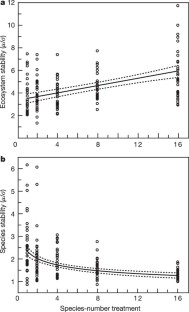
Figure 1: Dependence of temporal stability of each plot on experimentally imposed species-number treatment.
The alternative text for this image may have been generated using AI.
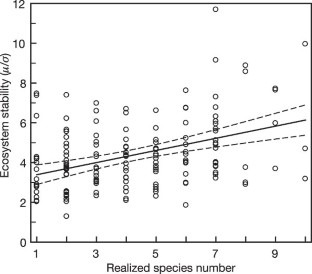
Figure 2: Dependence of ecosystem temporal stability from 1996 to 2005 on realized species number.
The alternative text for this image may have been generated using AI.
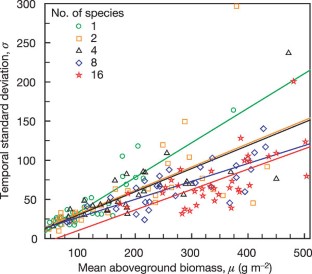
Figure 3: Effects of plant diversity on the relationship between mean biomass and its temporal standard deviation.
The alternative text for this image may have been generated using AI.
References
- Naeem, S., Håkenson, K., Lawton, J. H., Crawley, M. J. & Thompson, L. J. Biodiversity and plant productivity in a model assemblage of plant species. Oikos 76, 259–264 (1996)
Article Google Scholar - Tilman, D., Wedin, D. & Knops, J. Productivity and sustainability influenced by biodiversity in grassland ecosystems. Nature 379, 718–720 (1996)
Article ADS CAS Google Scholar - Hector, A. et al. Plant diversity and productivity experiments in European grasslands. Science 286, 1123–1127 (1999)
Article CAS Google Scholar - Tilman, D. et al. Diversity and productivity in a long-term grassland experiment. Science 294, 843–845 (2001)
Article ADS CAS Google Scholar - Hector, A., Bazeley-White, E., Loreau, M., Otway, S. & Schmid, B. Overyielding in grassland communities: Testing the sampling effect hypothesis with replicated biodiversity experiments. Ecol. Lett. 5, 502–511 (2002)
Article Google Scholar - Hooper, D. U. et al. Effects of biodiversity on ecosystem functioning: a consensus of current knowledge. Ecol. Monogr. 75, 3–35 (2005)
Article Google Scholar - Elton, C. S. The Ecology of Invasions by Animals and Plants (Methuen, London, 1958)
Book Google Scholar - May, R. M. Stability and Complexity in Model Ecosystems (Princeton Univ. Press, Princeton, 1973)
Google Scholar - McNaughton, S. J. Stability and diversity of ecological communities. Nature 274, 251–253 (1978)
Article ADS Google Scholar - Tilman, D. & Downing, J. A. Biodiversity and stability in grasslands. Nature 367, 363–365 (1994)
Article ADS Google Scholar - Tilman, D. Biodiversity: Population versus ecosystem stability. Ecology 77, 350–363 (1996)
Article Google Scholar - Huston, M. A. Hidden treatments in ecological experiments: Re-evaluating the ecosystem function of biodiversity. Oecologia 110, 449–460 (1997)
Article ADS Google Scholar - Pfisterer, A. B. & Schmid, B. Diversity-dependent production can decrease the stability of ecosystem functioning. Nature 416, 84–86 (2002)
Article ADS CAS Google Scholar - McNaughton, S. J. in Biodiversity and Ecosystem Function (eds Schulze, E.-D. & Mooney, H. A.) 361–383 (Springer, Berlin, 1993)
Google Scholar - Frank, D. A. & McNaughton, S. J. Stability increases with diversity in plant communities: Empirical evidence from the 1988 Yellowstone drought. Oikos 62, 360–362 (1991)
Article Google Scholar - McGrady-Steed, J., Harris, P. M. & Morin, P. J. Biodiversity regulates ecosystem predictability. Nature 390, 162–165 (1997)
Article ADS CAS Google Scholar - Naeem, S. & Li, S. Biodiversity enhances ecosystem reliability. Nature 390, 507–509 (1997)
Article ADS CAS Google Scholar - Petchey, O. L., McPhearson, P. T., Casey, T. M. & Morin, P. J. Environmental warming alters food-web structure and ecosystem function. Nature 402, 69–72 (1999)
Article ADS CAS Google Scholar - Lehman, C. L. & Tilman, D. Biodiversity, stability, and productivity in competitive communities. Am. Nat. 156, 534–552 (2000)
Article Google Scholar - Naeem, S. Biodiversity equals instability? Nature 416, 23–24 (2002)
Article ADS CAS Google Scholar - Pimm, S. L. The complexity and stability of ecosystems. Nature 307, 321–326 (1984)
Article ADS Google Scholar - Tilman, D. The ecological consequences of changes in biodiversity: A search for general principles. Ecology 80, 1455–1474 (1999)
Google Scholar - Tilman, D. & El Haddi, A. Drought and biodiversity in grasslands. Oecologia 89, 257–264 (1992)
Article ADS CAS Google Scholar - Fargione, J. E. & Tilman, D. Diversity decreases invasion via both sampling and complementarity effects. Ecol. Lett. 8, 604–611 (2005)
Article Google Scholar - Pfisterer, A. B., Joshi, J., Schmid, B. & Fischer, M. Rapid decay of diversity–productivity relationships after invasion of experimental plant communities. Basic Appl. Ecol. 5, 5–14 (2004)
Article Google Scholar - Doak, D. F. et al. The statistical inevitability of stability–diversity relationships in community ecology. Am. Nat. 151, 264–276 (1998)
CAS PubMed Google Scholar - Tilman, D., Lehman, C. L. & Bristow, C. E. Diversity–stability relationships: Statistical inevitability or ecological consequence? Am. Nat. 151, 277–282 (1998)
CAS PubMed Google Scholar - Daily, G. C. Nature's Services: Societal Dependence on Natural Ecosystems (Island Press, Washington DC, 1997)
Google Scholar - Kremen, C. Managing ecosystem services: What do we need to know about their ecology? Ecol. Lett. 8, 468–479 (2005)
Article Google Scholar
Acknowledgements
We thank J. Fargione for insightful comments, and T. Mielke, N. Larson, S. Bauer and our summer interns for assistance. The National Science Foundation, the Bush Foundation and the Andrew Mellon Foundation provided financial support.
Author information
Authors and Affiliations
- Department of Ecology, Evolution and Behavior, University of Minnesota, 1987 Upper Buford Circle, Minnesota, 55108, St Paul, USA
David Tilman - Department of Forest Resources, University of Minnesota, 1530 North Cleveland Avenue, Minnesota, 55108, St Paul, USA
Peter B. Reich - School of Biological Sciences, University of Nebraska, 348 Manter Hall, Nebraska, 68588-0118, Lincoln, USA
Johannes M. H. Knops
Authors
- David Tilman
- Peter B. Reich
- Johannes M. H. Knops
Corresponding author
Correspondence toDavid Tilman.
Ethics declarations
Competing interests
Reprints and permissions information is available at npg.nature.com/reprintsandpermissions. The authors declare no competing financial interests.
Rights and permissions
About this article
Cite this article
Tilman, D., Reich, P. & Knops, J. Biodiversity and ecosystem stability in a decade-long grassland experiment.Nature 441, 629–632 (2006). https://doi.org/10.1038/nature04742
- Received: 20 December 2005
- Accepted: 23 March 2006
- Issue date: 01 June 2006
- DOI: https://doi.org/10.1038/nature04742
This article is cited by
Editorial Summary
Where the grass is greener
The idea that greater biodiversity increases ecosystem stability has been around for about 50 years, and has been furiously debated for much of that time. There have been precious few rigorous long-term field experiments to test the theory, but a decade-long biodiversity experiment in grassland at the University of Minnesota's Cedar Creek experimental ecological reserve set out to do that. The results are now in and they show that the presence of greater numbers of plant species increases both stability and productivity.