Magma-maintained rift segmentation at continental rupture in the 2005 Afar dyking episode (original) (raw)
- Letter
- Published: 20 July 2006
- Cindy Ebinger2 nAff6,
- Juliet Biggs1,
- Atalay Ayele3,
- Gezahegn Yirgu4,
- Derek Keir2 &
- …
- Anna Stork1
Nature volume 442, pages 291–294 (2006) Cite this article
- 4195 Accesses
- 506 Citations
- 27 Altmetric
- Metrics details
Abstract
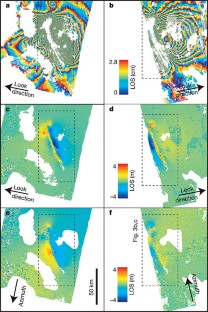
Seafloor spreading centres show a regular along-axis segmentation thought to be produced by a segmented magma supply in the passively upwelling mantle1,2. On the other hand, continental rifts are segmented by large offset normal faults, and many lack magmatism. It is unclear how, when and where the ubiquitous segmented melt zones are emplaced during the continental rupture process. Between 14 September and 4 October 2005, 163 earthquakes (magnitudes greater than 3.9) and a volcanic eruption occurred within the ∼60-km-long Dabbahu magmatic segment of the Afar rift, a nascent seafloor spreading centre in stretched continental lithosphere3,4. Here we present a three-dimensional deformation field for the Dabbahu rifting episode derived from satellite radar data, which shows that the entire segment ruptured, making it the largest to have occurred on land in the era of satellite geodesy. Simple elastic modelling shows that the magmatic segment opened by up to 8 m, yet seismic rupture can account for only 8 per cent of the observed deformation. Magma was injected along a dyke between depths of 2 and 9 km, corresponding to a total intrusion volume of ∼2.5 km3. Much of the magma appears to have originated from shallow chambers beneath Dabbahu and Gabho volcanoes at the northern end of the segment, where an explosive fissural eruption occurred on 26 September 2005. Although comparable in magnitude to the ten year (1975–84) Krafla events in Iceland5, seismic data suggest that most of the Dabbahu dyke intrusion occurred in less than a week. Thus, magma intrusion via dyking, rather than segmented normal faulting, maintains and probably initiated the along-axis segmentation along this sector of the Nubia–Arabia plate boundary.
This is a preview of subscription content, access via your institution
Access options
Additional access options:
Figure 1: Coloured and shaded relief map for northern Afar, and study area.

The alternative text for this image may have been generated using AI.
Figure 2: Satellite radar data spanning the 2005 Dabbahu rifting event produced using data from ESA's Envisat satellite.
The alternative text for this image may have been generated using AI.
Figure 3: Observed and modelled three-dimensional deformation field of the 2005 Dabbahu rifting episode.

The alternative text for this image may have been generated using AI.
References
- Lin, J., Purdy, G., Schouten, H., Sempère, J.-C. & Zervas, C. Evidence from gravity data for focused magmatic accretion along the Mid-Atlantic Ridge. Nature 344, 627–632 (1990)
Article ADS Google Scholar - Whitehead, J., Dick, J. H. B. & Schouten, H. A mechanism for magmatic accretion under spreading centres. Nature 312, 146–148 (1984)
Article ADS CAS Google Scholar - Barberi, F. & Varet, J. Volcanism of Afar: Small-scale plate tectonic implications. Geol. Soc. Am. Bull. 88, 1251–1266 (1977)
Article ADS CAS Google Scholar - Hayward, N. & Ebinger, C. Variations in the along-axis segmentation of the Afar rift system. Tectonics 15, 244–257 (1996)
Article ADS Google Scholar - Sigmundsson, F. Iceland Geodynamics: Crustal Deformation and Divergent Plate Tectonics (Springer-Praxis, Chichester, UK, 2006)
Google Scholar - Hirn, A., Lépine, J.-C. & Sapine, M. Triple junction and ridge hot spots: Earthquakes, faults, and volcanism in Afar, the Azores, and Iceland. J. Geophys. Res. 98, 11995–12001 (1993)
Article ADS Google Scholar - Ruegg, J.-C. et al. First epoch geodetic GPS measurements across the Afar plate boundary zone. Geophys. Res. Lett. 20, 1899–1902 (1993)
Article ADS Google Scholar - Dugda, M. & Nyblade, A. in The Afar Volcanic Province within the East African Rift System (eds Yirgu, G., Ebinger, C. J. & Maguire, P. K. H.) 239–253 (Special Publication, Geological Society of London, 2006)
Google Scholar - Kreemer, C., Holt, W. E. & Haines, A. J. An integrated global model of present-day plate motions and plate boundary deformation. Geophys. J. Int. 154, 8–34 (2003)
Article ADS Google Scholar - Michel, R., Avouac, J. P. & Taboury, J. Measuring ground displacements from SAR amplitude images: application to the Landers earthquake. Geophys. Res. Lett. 26(7), 875–878 (1999)
Article ADS Google Scholar - Wright, T. J., Parsons, B. E. & Lu, Z. Towards mapping surface deformation in three dimensions using InSAR. Geophys. Res. Lett. 31, L01607, doi:10.1029/2003GL018827 (2004)
Article ADS Google Scholar - Rubin, A. & Pollard, D. Dike-induced faulting in rift zones in Iceland and Afar. Geology 16, 413–417 (1988)
Article ADS Google Scholar - Abdallah, A. et al. Relevance of Afar seismicity and volcanism to the mechanics of accreting plate boundaries. Nature 282, 17–23 (1979)
Article ADS Google Scholar - Mogi, K. Relations between the eruptions of various volcanoes and the deformation of the ground surfaces around them. Bull. Earthq. Res. Inst. 36, 99–134 (1958)
Google Scholar - Okada, Y. Surface deformation due to shear and tensile faults in a half-space. Bull. Seismol. Soc. Am. 75, 1135–1154 (1985)
Google Scholar - Wright, T. J., Lu, Z. & Wicks, C. Constraining the slip distribution and fault geometry of the _M_w 7.9, 3 November 2002, Denali fault earthquake with Interferometric Synthetic Aperture Radar and Global Positioning System data. Bull. Seismol. Soc. Am. 94(6B), S175–S189 (2004)
Article Google Scholar - Wright, T. J., Lu, Z. & Wicks, C. Source model for the _M_w 6.7 23 October 2002 Nenana Mountain Earthquake (Alaska) from InSAR. Geophys. Res. Lett. 30, doi:10.1029/2003GL018014 (2003)
- McTigue, D. Elastic stress and deformation near a finite spherical magma body: resolution of the point source paradox. J. Geophys. Res. 92(B12), 12931–12940 (1987)
Article ADS Google Scholar - Delaney, P. & McTigue, D. Volume of magma accumulation or withdrawal estimated from surface uplift or subsidence, with application to the 1960 collapse of Kilauea Volcano. Bull. Volcanol. 56, 417–424 (1994)
Article ADS Google Scholar - Johnson, D., Sigmundsson, F. & Delaney, P. Comment on “Volume of magma accumulation or withdrawal estimated from surface uplift or subsidence, with application to the 1960 collapse of Kilauea Volcano” by P.T. Delaney and D.F. McTigue. Bull. Volcanol. 61, 491–493 (2000)
Article ADS Google Scholar - Nishimura, T. Pressure recovery in magma due to bubble growth. Geophys. Res. Lett. 31, doi:10.1029/2004GL019810 (2004)
- de Zeeuw-van Dalfsen, E., Pedersen, R., Sigmundsson, F. & Pagli, C. Satellite radar interferometry suggests deep accumulation of magma near the crust-mantle boundary beneath the Krafla volcanic system, Iceland. Geophys. Res. Lett. 31, doi:10.1029/2004GL020368 (2004)
- Hofstetter, R. & Beyth, M. The Afar Depression: interpretation of the 1960–2000 earthquakes. Geophys. J. Int. 155, 715–732 (2003)
Article ADS Google Scholar - Cattin, R. et al. Numerical modelling of Quaternary deformation and post-seismic displacement in the Asal-Ghoubbet rift (Djibouti, Africa). Earth Planet. Sci. Lett. 239, 352–367 (2005)
Article ADS CAS Google Scholar - Keir, D., Ebinger, C., Stuart, G., Daly, E. & Ayele, A. Strain accommodation by magmatism and faulting as rifting proceeds to breakup: Seismicity of the northern Ethiopian rift. J. Geophys. Res. 111, B05314, doi:10.1029/2005JB003748 (2006)
Article ADS Google Scholar - Foulger, G. et al. Post-rifting stress relaxation at the divergent plate boundary in Northeast Iceland. Nature 358, 488–490 (1992)
Article ADS Google Scholar - Pollitz, F. & Sacks, I. Viscosity structure beneath northeast Iceland. J. Geophys. Res. 101(B8), 17771–17794 (1996)
Article ADS Google Scholar
Acknowledgements
Staff at Addis Ababa University, especially L. M. Asfaw, are thanked for their rapid response to the Dabbahu crisis, as are the Ethiopian Air Force for helicopter support. C. Oppenheimer, T. Kidane, A. Philpotts, D. Ayalew, G. Orsi and A. Asrat provided field reports and initial volcanological observations. This report benefited from discussions with B. Parsons, E. Calais, R. Buck, L. Asfaw, C. Wicks and J. Cann. Our work was supported by an NERC urgency grant, Addis Ababa University, the Ministry of Capacity Building of the Ethiopian Federal Government, and the Afar Regional Government. SAR data were provided quickly by the European Space Agency. T.J.W. is funded by a Royal Society University Research Fellowship. Author Contributions T.J.W., C.E., G.Y. and A.A. planned the project; T.J.W. and J.B. processed, analysed and modelled the radar data; A.S., D.K. and A.A. analysed seismic data; G.Y. and C.E. provided petrological and tectonic context; and T.J.W., C.E., D.K. and J.B. wrote the paper.
Author information
Author notes
- Tim J. Wright
Present address: School of Earth and Environment, University of Leeds, Leeds, LS2 9JT, UK - Cindy Ebinger
Present address: Department of Earth and Environmental Sciences, University of Rochester, Rochester, New York, 14627, USA
Authors and Affiliations
- Department of Earth Sciences, University of Oxford, OX1 3PR, Oxford, UK
Tim J. Wright, Juliet Biggs & Anna Stork - Department of Geology, Royal Holloway, University of London, TW20 0EX, Egham, UK
Cindy Ebinger & Derek Keir - The Geophysical Observatory,
Atalay Ayele - Department of Earth Sciences, Addis Ababa University, Addis Ababa, Ethiopia
Gezahegn Yirgu
Authors
- Tim J. Wright
- Cindy Ebinger
- Juliet Biggs
- Atalay Ayele
- Gezahegn Yirgu
- Derek Keir
- Anna Stork
Corresponding author
Correspondence toTim J. Wright.
Ethics declarations
Competing interests
Reprints and permissions information is available at npg.nature.com/reprintsandpermissions. The authors declare no competing financial interests.
Supplementary information
Rights and permissions
About this article
Cite this article
Wright, T., Ebinger, C., Biggs, J. et al. Magma-maintained rift segmentation at continental rupture in the 2005 Afar dyking episode.Nature 442, 291–294 (2006). https://doi.org/10.1038/nature04978
- Received: 29 December 2005
- Accepted: 08 June 2006
- Issue date: 20 July 2006
- DOI: https://doi.org/10.1038/nature04978
This article is cited by
Editorial Summary
A continent divided
Occurring mainly over a week in September 2005, a 60-km-long section of the Afar depression in Ethiopia was torn apart by the injection of over 2 cubic kilometres of molten rock into the plate: an 8-metre-wide gap appeared at the surface. Satellite radar imagery reveals that a series of fissures opened, the rift shoulders rose, and the ground surface dropped above the molten rock. A similarly large rift took place in Krafla in Iceland 25 years ago, but in a series of events over a ten year period. The Afar incident suggests that magma intrusion into a dyke, rather than faulting of the crust, may be responsible for the segmentation of continental rifts.