Fishing elevates variability in the abundance of exploited species (original) (raw)
- Letter
- Published: 19 October 2006
- Christian S. Reiss2,
- John R. Hunter1,
- John R. Beddington3,
- Robert M. May4 &
- …
- George Sugihara1
Nature volume 443, pages 859–862 (2006) Cite this article
- 4920 Accesses
- 526 Citations
- 44 Altmetric
- Metrics details
Abstract
The separation of the effects of environmental variability from the impacts of fishing has been elusive, but is essential for sound fisheries management1,2,3,4,5,6,7. We distinguish environmental effects from fishing effects by comparing the temporal variability of exploited versus unexploited fish stocks living in the same environments. Using the unique suite of 50-year-long larval fish surveys from the California Cooperative Oceanic Fisheries Investigations4 we analyse fishing as a treatment effect in a long-term ecological experiment. Here we present evidence from the marine environment that exploited species exhibit higher temporal variability in abundance than unexploited species. This remains true after accounting for life-history effects, abundance, ecological traits and phylogeny. The increased variability of exploited populations is probably caused by fishery-induced truncation of the age structure, which reduces the capacity of populations to buffer environmental events1,5,8,9. Therefore, to avoid collapse, fisheries must be managed not only to sustain the total viable biomass but also to prevent the significant truncation of age structure1,5,8,9. The double jeopardy of fishing to potentially deplete stock sizes and, more immediately, to amplify the peaks and valleys of population variability7, calls for a precautionary management approach10,11.
This is a preview of subscription content, access via your institution
Access options
Subscribe to this journal
Receive 52 print issues and online access
$199.00 per year
only $3.83 per issue
Buy this article
- Purchase on SpringerLink
- Instant access to the full article PDF.
USD 39.95
Prices may be subject to local taxes which are calculated during checkout
Additional access options:
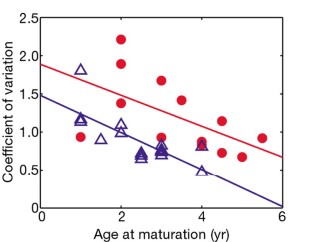
Figure 1: Relationships between coefficients of variation of annual larval abundance and age at maturation for exploited and unexploited species.
The alternative text for this image may have been generated using AI.
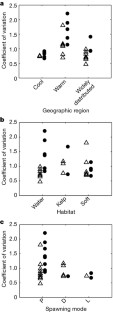
Figure 2: Coefficients of variation of annual larval abundance of exploited and unexploited species associated with geographic regions, habitats and spawning modes.
The alternative text for this image may have been generated using AI.
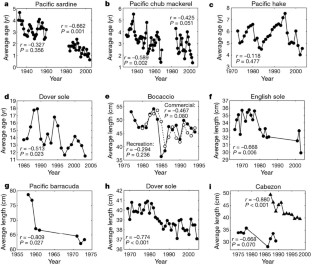
Figure 3: Long-term declining trends in the average age and length of exploited species.
The alternative text for this image may have been generated using AI.
References
- Berkeley, S. A., Hixon, M. A., Larson, R. J. & Love, M. S. Fisheries sustainability via protection of age structure and spatial distribution of fish populations. Fisheries 29, 23–32 (2004)
Article Google Scholar - Daan, N., Christensen, V. & Cury, P. M. Quantitative ecosystem indicators for fisheries management. ICES J. Mar. Sci. 62, 307–614 (2005)
Article Google Scholar - Pikitch, E. K. et al. Ecosystem-based fishery management. Science 305, 346–347 (2004)
Article CAS Google Scholar - Hsieh, C. H. et al. A comparison of long-term trends and variability in populations of larvae of exploited and unexploited fishes in the Southern California region: a community approach. Prog. Oceanogr. 67, 160–185 (2005)
Article ADS Google Scholar - Hutchings, J. A. & Reynolds, J. D. Marine fish population collapses: consequences for recovery and extinction risk. Bioscience 13, 297–309 (2004)
Article Google Scholar - Garcia, S. M., Zerbi, A., Aliaume, C., Do Chi, T. & Lasserre, G. The ecosystem approach to fisheries. Issues, terminology, principles, institutional foundations, implementation and outlook. FAO Fish. Tech. Pap. 443, 1–71 (2003)
Google Scholar - Beddington, J. R. & May, R. M. Harvesting natural populations in a randomly fluctuating environment. Science 197, 463–465 (1977)
Article ADS CAS Google Scholar - Murawski, S. A., Rago, P. J. & Trippel, E. A. Impacts of demographic variation in spawning characteristics on reference points for fishery management. ICES J. Mar. Sci. 58, 1002–1014 (2001)
Article Google Scholar - Murphy, G. I. Vital statistics of the Pacific sardine (Sardinops Caerulea) and the population consequences. Ecology 48, 731–736 (1967)
Article Google Scholar - Hsieh, C. H., Glaser, S. M., Lucas, A. J. & Sugihara, G. Distinguishing random environmental fluctuations from ecological catastrophes for the North Pacific Ocean. Nature 435, 336–340 (2005)
Article ADS CAS Google Scholar - Scheffer, M., Carpenter, S., Foley, J. A., Folkes, C. & Walker, B. Catastrophic shifts in ecosystems. Nature 413, 591–596 (2001)
Article ADS CAS Google Scholar - Food and Agriculture Organization of the United Nations. (FAO). Review of the State of World Marine Fishery Resources (FAO, Rome, 2005)
- Myers, R. A. & Worm, B. Rapid worldwide depletion of predatory fish communities. Nature 423, 280–283 (2003)
Article ADS CAS Google Scholar - Hutchings, J. A. Collapse and recovery of marine fishes. Nature 406, 882–885 (2000)
Article ADS CAS Google Scholar - Beaugrand, G., Brander, K. M., Lindley, J. A., Souissi, S. & Reid, P. C. Plankton effect on cod recruitment in the North Sea. Nature 426, 661–664 (2003)
Article ADS CAS Google Scholar - Finney, B. P., Gregory-Eaves, I., Douglas, M. S. V. & Smol, J. P. Fisheries productivity in the northeastern Pacific Ocean over the past 2,200 years. Nature 416, 729–733 (2002)
Article ADS CAS Google Scholar - Mantua, N. J., Hare, S. R., Zhang, Y., Wallace, J. M. & Francis, R. C. A Pacific interdecadal climate oscillation with impacts on salmon production. Bull. Am. Meteorol. Soc. 78, 1069–1079 (1997)
Article ADS Google Scholar - May, R., Beddington, J. R., Horwood, J. W. & Shepherd, J. G. Exploiting natural populations in an uncertain world. Math. Biosci. 42, 219–252 (1978)
Article MathSciNet Google Scholar - Hilborn, R., Maquire, J., Parma, A. M. & Rosenberg, A. A. The precautionary approach and risk management: can they increase the probability of successes in fishery management?. Can. J. Fish. Aquat. Sci. 58, 99–107 (2001)
Article Google Scholar - Pimm, S. L. The Balance of Nature? Ecological Issues in the Conservation of Species and Communities 39–58 (University of Chicago, Chicago, 1991)
- Ludwig, D., Hilborn, R. & Waters, C. Uncertainty, resource exploitation, and conservation: lessons from history. Science 260, 17, 36 (1993)
Article ADS CAS Google Scholar - Winemiller, K. O. & Rose, K. A. Patterns of life-history diversification in North American fishes: implications for population regulation. Can. J. Fish. Aquat. Sci. 49, 2196–2218 (1992)
Article Google Scholar - Mertz, G. & Myers, R. A. Match/mismatch predictions of spawning duration versus recruitment variability. Fish. Oceanogr. 3, 1–14 (1994)
Article Google Scholar - Mertz, G. & Myers, R. A. Influence of fecundity on recruitment variability of marine fish. Can. J. Fish. Aquat. Sci. 53, 1618–1625 (1996)
Article Google Scholar - Hutchings, J. & Baum, J. Measuring marine fishes biodiversity: temporal changes in abundance, life history and demography. Phil. Trans. R. Soc. Lond. B 360, 315–338 (2005)
Article Google Scholar - Hutchings, J. A. & Myers, R. A. Effect of age on the seasonality of maturation and spawning of Atlantic cod, Gadus morhua, in the northwest Atlantic. Can. J. Fish. Aquat. Sci. 50, 2468–2474 (1993)
Article Google Scholar - Lambert, T. C. Duration and intensity of spawning in herring Clupea harengus as related to the age structure of the population. Mar. Ecol. Prog. Ser. 39, 209–220 (1987)
Article ADS Google Scholar - Marteinsdottir, G. & Steinarsson, A. Maternal influence on the size and viability of Iceland cod (Gadus morhua) eggs and larvae. J. Fish Biol. 52, 1241–1258 (1998)
Google Scholar - Shepherd, J. G. & Cushing, D. H. Regulation in fish populations: myth or mirage?. Phil. Trans. R. Soc. Lond. B 330, 151–164 (1990)
Article ADS Google Scholar - Little, R. J. A. & Rubin, D. B. Statistical Analysis with Missing Data 164–220 (John Wiley & Sons, New York, 2002)
Acknowledgements
We thank the CalCOFI for the use of the data. R. Hewitt, D. Checkley, M. Ohman, S. Sandin, M. Maunder, P. Hastings, K. Roy, D. Lucas and S. Glaser provided discussion and comments on this work. A. MacCall, K. Hill, D. Sampson, I. Stewart, J. Cope, D. Aseltin-Nelson and J. Mason provided fisheries-related data. B. Macewicz, N. Lo, B. Watson and S. Suyama provided data and comments on life-history traits of fishes. Our study was funded by NOAA Fisheries and the Environment (FATE), the National Marine Fisheries Service, NSF/LTER CCE ‘Nonlinear Transitions in the California Current Coastal Pelagic Ecosystem’, the Center for Marine Bioscience and Biotechnology, National Taiwan Oceanic University, the Deutsche Bank Complexity Studies Fund and the Sugihara Family Trust. Author Contributions C.H. and G.S. conceived the original study. C.H. is responsible for the statistical analyses and uncovering the main result. All co-authors contributed to refining the analysis, framing and interpreting the result, and to its final exposition.
Author information
Authors and Affiliations
- Scripps Institution of Oceanography, University of California, San Diego, 9500 Gilman Drive, California, 92093-0202, La Jolla, USA
Chih-hao Hsieh, John R. Hunter & George Sugihara - Southwest Fisheries Science Center, National Marine Fisheries Service, 8604 La Jolla Shores Drive, California, 92037-1508, La Jolla, USA
Christian S. Reiss - Division of Biology, Faculty of Natural Sciences, Imperial College London, RSM Building, South Kensington campus, SW7 2AZ, London, UK
John R. Beddington - Department of Zoology, University of Oxford, South Parks Road, OX1 3PS, Oxford, UK
Robert M. May
Authors
- Chih-hao Hsieh
- Christian S. Reiss
- John R. Hunter
- John R. Beddington
- Robert M. May
- George Sugihara
Corresponding author
Correspondence toGeorge Sugihara.
Ethics declarations
Competing interests
Reprints and permissions information is available at www.nature.com/reprints. The authors declare no competing financial interests.
Supplementary information
Supplementary Notes (download PDF )
This file contains Supplementary Methods, Supplementary Results, Supplementary Discussion, Supplementary Tables and Supplementary Figures (PDF 1507 kb)
Rights and permissions
About this article
Cite this article
Hsieh, Ch., Reiss, C., Hunter, J. et al. Fishing elevates variability in the abundance of exploited species.Nature 443, 859–862 (2006). https://doi.org/10.1038/nature05232
- Received: 02 May 2006
- Accepted: 04 September 2006
- Issue date: 19 October 2006
- DOI: https://doi.org/10.1038/nature05232
This article is cited by
Editorial Summary
What fishing does to fish
Fishing depletes fish stocks by removing fish from the sea. Clear enough, but in the late 1970s, theorists suggested that it also reduces the resilience of fish populations in the face of change. Discussion on the topic has remained theoretical until now: the availability of a 50-year larval fish survey of waters off California, begun when sardine populations there collapsed in the 1940s, provides the data. And it seems that fishing does magnify population variability (reducing resilience) in ways that extend beyond the removals themselves. A truncated age structure, with larger and older fish being removed first, is the likely cause. This suggests that to avoid collapse, fisheries must be managed not only to sustain total biomass, but also to maintain the age structure of a population.