Habitat modification alters the structure of tropical host–parasitoid food webs (original) (raw)
- Letter
- Published: 11 January 2007
Nature volume 445, pages 202–205 (2007) Cite this article
- 11k Accesses
- 839 Citations
- 33 Altmetric
- Metrics details
Abstract
Global conversion of natural habitats to agriculture has led to marked changes in species diversity and composition1. However, it is less clear how habitat modification affects interactions among species2. Networks of feeding interactions (food webs) describe the underlying structure of ecological communities, and might be crucially linked to their stability and function3,4,5,6,7. Here, we analyse 48 quantitative food webs8,9 for cavity-nesting bees, wasps and their parasitoids across five tropical habitat types. We found marked changes in food-web structure10,11 across the modification gradient, despite little variation in species richness. The evenness of interaction frequencies declined with habitat modification, with most energy flowing along one or a few pathways in intensively managed agricultural habitats. In modified habitats there was a higher ratio of parasitoid to host species and increased parasitism rates, with implications for the important ecosystem services, such as pollination and biological control, that are performed by host bees and wasps12. The most abundant parasitoid species was more specialized in modified habitats, with reduced attack rates on alternative hosts. Conventional community descriptors failed to discriminate adequately among habitats, indicating that perturbation of the structure and function of ecological communities might be overlooked in studies that do not document and quantify species interactions. Altered interaction structure therefore represents an insidious and functionally important hidden effect of habitat modification by humans.
This is a preview of subscription content, access via your institution
Access options
Subscribe to this journal
Receive 51 print issues and online access
$199.00 per year
only $3.90 per issue
Buy this article
- Purchase on SpringerLink
- Instant access to the full article PDF.
USD 39.95
Prices may be subject to local taxes which are calculated during checkout
Additional access options:
Figure 1: Quantitative host–parasitoid food webs along a gradient of increasing habitat modification (top to bottom).
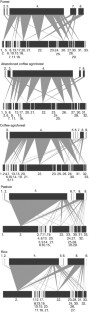
The alternative text for this image may have been generated using AI.
Figure 2: The effects of habitat modification on rates of parasitism (mean ± s.e.m.) and six quantitative food web metrics (see Supplementary Methods 1): linkage density (LD), generality, vulnerability, evenness, connectance and compartment diversity.

The alternative text for this image may have been generated using AI.
References
- Tilman, D. et al. Forecasting agriculturally driven global environmental change. Science 292, 281–284 (2001)
Article ADS CAS Google Scholar - van der Putten, W. H. et al. Trophic interactions in a changing world. Basic Appl. Ecol. 5, 487–494 (2004)
Article Google Scholar - McCann, K. The diversity–stability debate. Nature 405, 228–233 (2000)
Article CAS Google Scholar - Melián, C. J. & Bascompte, J. Food web structure and habitat loss. Ecol. Lett. 5, 37–46 (2002)
Article Google Scholar - Ives, A. R. & Cardinale, B. J. Food-web interactions govern the resistance of communities after non-random extinctions. Nature 429, 174–177 (2004)
Article ADS CAS Google Scholar - Rooney, N., McCann, K., Gellner, G. & Moore, J. C. Structural asymmetry and the stability of diverse food webs. Nature 442, 265–269 (2006)
Article ADS CAS Google Scholar - Montoya, J. M., Pimm, S. L. & Solé, R. V. Ecological networks and their fragility. Nature 442, 259–264 (2006)
Article ADS CAS Google Scholar - Memmott, J., Godfray, H. C. J. & Gauld, I. D. The structure of a tropical host–parasitoid community. J. Anim. Ecol. 63, 521–540 (1994)
Article Google Scholar - Müller, C. B., Adriaanse, I. C. T., Belshaw, R. & Godfray, H. C. J. The structure of an aphid–parasitoid community. J. Anim. Ecol. 68, 346–370 (1999)
Article Google Scholar - Bersier, L. F., Banasek-Richter, C. & Cattin, M. F. Quantitative descriptors of food-web matrices. Ecology 83, 2394–2407 (2002)
Article Google Scholar - Banasek-Richter, C., Cattin, M. F. & Bersier, L. F. Sampling effects and the robustness of quantitative and qualitative food-web descriptors. J. Theor. Biol. 226, 23–32 (2004)
Article MathSciNet Google Scholar - Losey, J. E. & Vaughan, M. The economic value of ecological services provided by insects. Bioscience 56, 311–323 (2006)
Article Google Scholar - Foley, J. A. et al. Global consequences of land use. Science 309, 570–574 (2005)
Article ADS CAS Google Scholar - Paine, R. T. Food webs: Road maps of interactions or grist for theoretical development? Ecology 69, 1648–1654 (1988)
Article Google Scholar - Janzen, D. H. The deflowering of Central America. Nat. Hist. 83, 48–53 (1974)
Google Scholar - Kearns, C. A., Inouye, D. W. & Waser, N. M. Endangered mutualisms: the conservation of plant–pollinator interactions. Annu. Rev. Ecol. Syst. 29, 83–112 (1998)
Article Google Scholar - Costanza, R. et al. The value of the world’s ecosystem services and natural capital. Nature 387, 253–260 (1997)
Article ADS CAS Google Scholar - Cohen, J. E. et al. Improving food webs. Ecology 74, 252–258 (1993)
Article Google Scholar - Goldwasser, L. & Roughgarden, J. Sampling effects and the estimation of food-web properties. Ecology 78, 41–54 (1997)
Article Google Scholar - Martinez, N. D., Hawkins, B. A., Dawah, H. A. & Feifarek, B. P. Effects of sampling effort on characterization of food-web structure. Ecology 80, 1044–1055 (1999)
Article Google Scholar - Morris, R. J., Lewis, O. T. & Godfray, H. C. J. Experimental evidence for apparent competition in a tropical forest food web. Nature 428, 310–313 (2004)
Article ADS CAS Google Scholar - Lewis, O. T. et al. Structure of a diverse tropical forest insect–parasitoid community. J. Anim. Ecol. 71, 855–873 (2002)
Article Google Scholar - Memmott, J. The structure of a plant–pollinator food web. Ecol. Lett. 2, 276–280 (1999)
Article Google Scholar - Henneman, M. L. & Memmott, J. Infiltration of a Hawaiian community by introduced biological control agents. Science 293, 1314–1316 (2001)
Article ADS CAS Google Scholar - Kremen, C., Williams, N. M. & Thorp, R. W. Crop pollination from native bees at risk from agricultural intensification. Proc. Natl Acad. Sci. USA 99, 16812–16816 (2002)
Article ADS CAS Google Scholar - Tylianakis, J. M., Klein, A. M. & Tscharntke, T. Spatiotemporal variation in the effects of a tropical habitat gradient on Hymenoptera diversity. Ecology 86, 3296–3302 (2005)
Article Google Scholar - Tylianakis, J. M., Klein, A. M. & Tscharntke, T. Spatial scale of observation affects α, β and γ diversity of cavity-nesting bees and wasps across a tropical land use gradient. J. Biogeogr. 33, 1295–1304 (2006)
Article Google Scholar - Rand, T., Tylianakis, J. M. & Tscharntke, T. Spillover edge effects: the dispersal of agriculturally-subsidized insect natural enemies into adjacent natural habitats. Ecol. Lett. 9, 603–614 (2006)
Article Google Scholar - Tylianakis, J. M., Tscharntke, T. & Klein, A. M. Diversity, ecosystem function and stability of parasitoid–host interactions across a tropical habitat gradient. Ecology 87, 3047–3057 (2006)
Article Google Scholar - Hawkins, B. A., Mills, N. J., Jervis, M. A. & Price, P. W. Is the biological control of insects a natural phenomenon? Oikos 86, 493–506 (1999)
Article Google Scholar
Acknowledgements
We thank J. Bascompte, M. B. Bonsall, M. M. Bos, H. C. J. Godfray, B. A. Hawkins, R. J. Morris, C. B. Müller and T. Roslin for discussions or comments, and J. Casquete, J. Pico, G. Sacoto, C. Valarezo, C. Calderon, A. Choez, J. Lino, R. Olschewski, G. H. J. de Koning and B. Pico for assistance with field or laboratory work and coordination. H. C. J. Godfray provided software and advice for drawing food webs and calculating compartmentalization. This research was funded by the Federal Ministry for Research and Education (BMBF) Germany, and a Royal Society University Research Fellowship to O.T.L.
Author Contributions J.M.T. was responsible for writing, field data collection, research planning and analysis; T.T. for research planning, site selection and funding application; and O.T.L. for writing, analysis and preparation of food webs (Fig. 1). All authors discussed the results and edited the manuscript.
Author information
Author notes
- Jason M. Tylianakis
Present address: School of Biological Sciences, University of Canterbury, Private Bag 4800, Christchurch, 8020, New Zealand
Authors and Affiliations
- Agroecology, Georg August University, Waldweg 26, Goettingen, D-37073, Germany
Jason M. Tylianakis & Teja Tscharntke - Department of Zoology, University of Oxford, South Parks Road, Oxford, OX1 3PS, UK
Owen T. Lewis
Authors
- Jason M. Tylianakis
- Teja Tscharntke
- Owen T. Lewis
Corresponding author
Correspondence toJason M. Tylianakis.
Ethics declarations
Competing interests
Reprints and permissions information is available at www.nature.com/reprints. The authors declare no competing financial interests.
Supplementary information
Supplementary Information (download PDF )
This file contains Supplementary Methods 1-3 detailing calculation of food web statistics, and analyses of evenness and parasitism; Supplementary Figure 1 showing qualitative food web values across habitats; and Supplementary Tables 1-4 presenting results of supporting analyses and details of host and parasitoid codes used in Fig. 1. (PDF 563 kb)
Rights and permissions
About this article
Cite this article
Tylianakis, J., Tscharntke, T. & Lewis, O. Habitat modification alters the structure of tropical host–parasitoid food webs.Nature 445, 202–205 (2007). https://doi.org/10.1038/nature05429
- Received: 14 October 2006
- Accepted: 03 November 2006
- Issue date: 11 January 2007
- DOI: https://doi.org/10.1038/nature05429
This article is cited by
Editorial Summary
A tangled web
Global change has the potential to influence species interactions, but the consequences for ecosystem function and stability are hard to predict. Quantitative food webs provide a powerful tool to probe such questions, but to date they have been used mainly to describe individual communities. A study of 48 plots in the Choco-Manabi region of Ecuador, where large-scale agriculture threatens biodiversity, now confirms that human habitat modification can dramatically affect networks of feeding interactions among species in host–parasitoid food webs. The switch from tropical rainforest to intensive agriculture has negative consequences for bees and wasps, which are important for pollination and biological pest control.