Dark matter maps reveal cosmic scaffolding (original) (raw)
- Letter
- Published: 07 January 2007
- Jason Rhodes1,2,
- Richard Ellis1,
- Nick Scoville1,
- Alexie Leauthaud3,
- Alexis Finoguenov4,
- Peter Capak1,
- David Bacon5,
- Hervé Aussel6,
- Jean-Paul Kneib3,
- Anton Koekemoer7,
- Henry McCracken8,
- Bahram Mobasher7,
- Sandrine Pires9,
- Alexandre Refregier6,
- Shunji Sasaki10,
- Jean-Luc Starck9,
- Yoshi Taniguchi10,
- Andy Taylor5 &
- …
- James Taylor11
Nature volume 445, pages 286–290 (2007)Cite this article
- 2777 Accesses
- 289 Citations
- 36 Altmetric
- Metrics details
Abstract
Ordinary baryonic particles (such as protons and neutrons) account for only one-sixth of the total matter in the Universe1,2,3. The remainder is a mysterious ‘dark matter’ component, which does not interact via electromagnetism and thus neither emits nor reflects light. As dark matter cannot be seen directly using traditional observations, very little is currently known about its properties. It does interact via gravity, and is most effectively probed through gravitational lensing: the deflection of light from distant galaxies by the gravitational attraction of foreground mass concentrations4,5. This is a purely geometrical effect that is free of astrophysical assumptions and sensitive to all matter—whether baryonic or dark6,7. Here we show high-fidelity maps of the large-scale distribution of dark matter, resolved in both angle and depth. We find a loose network of filaments, growing over time, which intersect in massive structures at the locations of clusters of galaxies. Our results are consistent with predictions of gravitationally induced structure formation8,9, in which the initial, smooth distribution of dark matter collapses into filaments then into clusters, forming a gravitational scaffold into which gas can accumulate, and stars can be built10.
This is a preview of subscription content, access via your institution
Access options
Subscribe to this journal
Receive 51 print issues and online access
$199.00 per year
only $3.90 per issue
Buy this article
- Purchase on SpringerLink
- Instant access to the full article PDF.
USD 39.95
Prices may be subject to local taxes which are calculated during checkout
Additional access options:
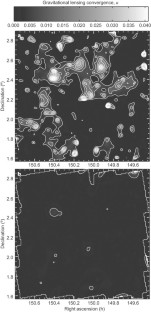
Figure 1: Map of the dark matter distribution in the two-square-degrees COSMOS field.
The alternative text for this image may have been generated using AI.
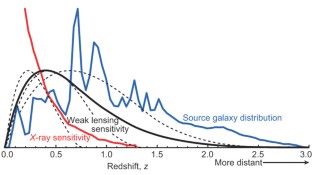
Figure 2: Sensitivity of probes of large-scale structure, as a function of distance.
The alternative text for this image may have been generated using AI.
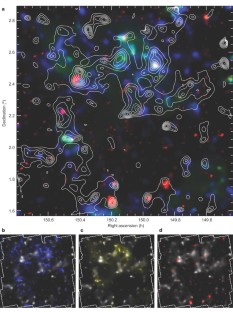
Figure 3: Comparison of baryonic and non-baryonic large-scale structure.
The alternative text for this image may have been generated using AI.
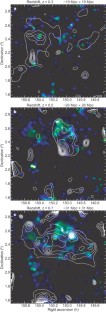
Figure 4: Growth of large-scale structure.
The alternative text for this image may have been generated using AI.
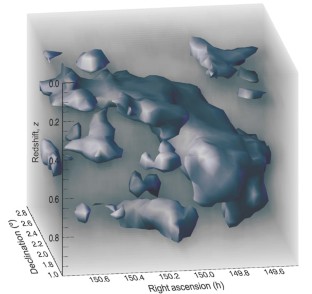
Figure 5: Three-dimensional reconstruction of the dark matter distribution.
The alternative text for this image may have been generated using AI.
References
- Zwicky, F. Die Rotverschiebung von extragalaktischen Nebeln. Helv. Phys. Acta 6, 110–127 (1933)
ADS MATH Google Scholar - Bergstrom, L. Nonbaryonic dark matter: observational evidence and detection methods. Rep. Prog. Phys. 63, 793–841 (2003)
Article ADS Google Scholar - Clowe, D. et al. A direct empirical proof of the existence of dark matter. Astrophys. J. 648, L109–L113 (2006)
Article ADS CAS Google Scholar - Blandford, R., Saust, A., Brainerd, T. & Villumsen, J. The distortion of distant galaxies by large-scale structure. Mon. Not. R. Astron. Soc. 251, 600–627 (1991)
Article ADS Google Scholar - Kaiser, N. Weak gravitational lensing of distant galaxies. Mon. Not. R. Astron. Soc. 388, 272–286 (1992)
ADS Google Scholar - Bartelmann, M. & Schneider, P. Weak gravitational lensing. Phys. Rep. 340, 291–472 (2001)
Article ADS Google Scholar - Refregier, A. Weak gravitational lensing by large-scale structure. Annu. Rev. Astron. Astrophys. 41, 645–668 (2004)
Article ADS Google Scholar - Davis, M., Efstathiou, G., Frenk, C. & White, S. The evolution of large-scale structure in a universe dominated by cold dark matter. Astrophys. J. 292, 371–394 (1985)
Article ADS CAS Google Scholar - Springel, V. et al. Simulating the joint evolution of quasars, galaxies and their large-scale distribution. Nature 435, 629–636 (2005)
Article ADS CAS Google Scholar - Dekel, A. & Lahav, O. Stochastic nonlinear galaxy biasing. Astrophys. J. 520, 24–34 (1999)
Article ADS Google Scholar - Scoville, N. et al. COSMOS: Hubble Space Telescope observations. Astrophys. J. (in the press).
- Leauthaud, A. et al. COSMOS: ACS galaxy catalog. Astrophys. J. (submitted).
- Schneider, P., van Waerbeke, L. & Mellier, Y. B-modes in cosmic shear from source redshift clustering. Astron. Astrophys. 389, 729–741 (2002)
Article ADS Google Scholar - Hasinger, G. et al. The XMM-Newton wide-field survey in the COSMOS field: I. Survey description. Astrophys. J. (in the press).
- Guzzo, G. et al. A large-scale stucture at _z_=0.73 and the relation of galaxy morphologies to local environment. Astrophys. J. (submitted).
- Shen, J., Abel, T., Mo, H. & Sheth, R. An excursion set model of the cosmic web: the abundance of sheets, filaments, and halos. Astrophys. J. 645, 783–791 (2006)
Article ADS Google Scholar - Massey, R. et al. Weak lensing from space: II. Dark matter mapping. Astron. J. 127, 3089–3101 (2004)
Article ADS Google Scholar - Bacon, D. & Taylor, A. Mapping the 3D dark matter potential with weak shear. Mon. Not. R. Astron. Soc. 344, 1307–1326 (2003)
Article ADS Google Scholar - Taylor, A. et al. Mapping the 3D dark matter with weak lensing in COMBO-17. Mon. Not. R. Astron. Soc. 353, 1176–1196 (2003)
Article ADS Google Scholar - Saunders, W. et al. Density and velocity fields from the PSCz survey. In Towards an Understanding of Cosmic Flows (eds Courteau S., Strauss M. & Willick, J) ASP Conf. Ser. 201, 228–236 (Astronomical Society of the Pacific, San Francisco, 1999)
Google Scholar - Rhodes, J., Refregier, A. & Groth, E. Weak lensing measurements: a revisited method and application to Hubble Space Telescope images. Astrophys. J. 536, 79–100 (2000)
Article ADS Google Scholar - Kaiser, N. & Squires, G. Mapping the dark matter with weak gravitational lensing. Astrophys. J. 404, 441–450 (1993)
Article ADS Google Scholar - Starck, J.-L. & Murtagh, F. Astronomical Image and Data Analysis 2nd edition (Springer, Heidelberg, 2006)
Book Google Scholar - Starck, J.-L., Pires, S. & Refregier, A. Weak lensing mass reconstruction using wavelets. Astron. Astrophys. 451, 1139–1150 (2006)
Article ADS Google Scholar - Hopkinson, G., Dale, C. & Marshall, P. Proton effects in charge-coupled devices. IEEE Trans. Nucl. Sci. 43, 614–627 (1996)
Article ADS CAS Google Scholar - Rhodes, J. et al. Removing the effects of the Advanced Camera for Surveys point spread function. Astrophys. J. (submitted).
- Capak, P. et al. Photometric redshifts of galaxies in COSMOS. Astrophys. J. (submitted).
- Benítez, N. Bayesian photometric redshift estimation. Astrophys. J. 536, 571–583 (2000)
Article ADS Google Scholar - Mobasher, B. et al. The first release COSMOS optical and near-IR data and catalog. Astrophys. J. (submitted).
- Steidel, C. et al. A study of star-forming galaxies in the 1.4<z<2.5 redshift desert: overview. Astrophys. J. 604, 534–550 (2004)
Article ADS CAS Google Scholar
Acknowledgements
This work was based on observations with the NASA/ESA Hubble Space Telescope, obtained at the Space Telescope Science Institute, which is operated by the Association of Universities for Research in Astronomy, Inc. (AURA). We also used data collected from: the XMM-Newton, an ESA science mission with instruments and contributions directly funded by ESA member states and NASA; the Subaru Telescope, which is operated by the National Astronomical Observatory of Japan; the European Southern Observatory, Chile; the Kitt Peak National Observatory, the Cerro Tololo Inter-American Observatory, and the National Optical Astronomy Observatory, which are operated by AURA under cooperative agreement with the American National Science Foundation; the National Radio Astronomy Observatory, which is a facility of the American National Science Foundation operated under cooperative agreement by Associated Universities, Inc.; and the Canada-France-Hawaii Telescope operated by the National Research Council of Canada, the Centre National de la Recherche Scientifique de France and the University of Hawaii. The photometric redshifts used here were validated using spectra from the European Southern Observatory Very Large Telescope zCOSMOS survey. We gratefully acknowledge the contributions of the entire COSMOS collaboration, consisting of more than 70 scientists. We thank T. Roman, D. Taylor and D. Soderblom for help scheduling the extensive COSMOS observations; and A. Laity, A. Alexov, B. Berriman and J. Good for managing online archives and servers for the COSMOS data sets at NASA IPAC/IRSA. This work was supported by grants from NASA (to N.S. and R.M.).
Author Contributions A.K. processed the raw HST data, and J.-P.K. masked defects in the image. A.L., J.R. and R.M. catalogued the positions and shapes of galaxies. Y.T. and S.S. obtained multicolour follow-up data, which was processed and calibrated by S.S., P.C., H.McC. and H.A. P.C. determined galaxies’ redshifts, and B.M. their stellar mass. N.S. constructed maps of stellar mass and galaxy density. A.F. processed the X-ray image and removed point sources. R.M. and A.R. produced the two-dimensional and tomographic mass maps; J.-L.S. and S.P. developed the wavelet filtering technique. D.B. and A.T. produced the three-dimensional mass reconstruction. J.T., A.F., R.E. and R.M. compared the various tracers of large-scale structure.
Author information
Authors and Affiliations
- California Institute of Technology MC105-24, 1200 E. California Boulevard, Pasadena, California, 91125, USA
Richard Massey, Jason Rhodes, Richard Ellis, Nick Scoville & Peter Capak - Jet Propulsion Laboratory, Pasadena, California, 91109, USA
Jason Rhodes - Laboratoire d'Astrophysique de Marseille, 13376, Marseille Cedex, 12, France
Alexie Leauthaud & Jean-Paul Kneib - Max-Planck-Institut für extraterrestrische Physik, Giessenbachstraße, 85748, Garching, Germany
Alexis Finoguenov - Institute for Astronomy, Blackford Hill, Edinburgh, EH9 3HJ, UK
David Bacon & Andy Taylor - AIM, Unité Mixte de Recherche CEA, CNRS et Université de Paris VII, UMR no. 7158 CE Saclay, 91191, Gif-sur-Yvette, France
Hervé Aussel & Alexandre Refregier - Space Telescope Science Institute, 3700 San Martin Drive, Baltimore, Maryland, 21218, USA
Anton Koekemoer & Bahram Mobasher - Institut d’Astrophysique de Paris, Université Pierre et Marie Curie, 98 bis Boulevard Arago, 75014, Paris, France
Henry McCracken - CEA/DSM/DAPNIA/SEDI, CE Saclay, 91191, Gif-sur-Yvette, France
Sandrine Pires & Jean-Luc Starck - Physics Department, Ehime University, 2-5 Bunkyou, Matuyama, 790-8577, Japan
Shunji Sasaki & Yoshi Taniguchi - Department of Physics and Astronomy, University of Waterloo, Waterloo, Ontario, N2L 3G1, Canada
James Taylor
Authors
- Richard Massey
- Jason Rhodes
- Richard Ellis
- Nick Scoville
- Alexie Leauthaud
- Alexis Finoguenov
- Peter Capak
- David Bacon
- Hervé Aussel
- Jean-Paul Kneib
- Anton Koekemoer
- Henry McCracken
- Bahram Mobasher
- Sandrine Pires
- Alexandre Refregier
- Shunji Sasaki
- Jean-Luc Starck
- Yoshi Taniguchi
- Andy Taylor
- James Taylor
Corresponding author
Correspondence toRichard Massey.
Ethics declarations
Competing interests
Reprints and permissions information is available at www.nature.com/reprints. The authors declare no competing financial interests.
Supplementary information
Supplementary Information (download PDF )
This file contains Supplementary Figures S1-S7 and Supplementary Table S1. Figure S1 illustrates the process of gravitational lensing. Figure S2 shows spurious signal due to imperfect Charge Transfer Efficiency (CTE) before correction. Figure S3 shows correction for Charge Transfer Efficiency (CTE). Figure S4 shows realisation of noise level in the tomographic mass reconstructions. Figure S5 shows photometric redshift accuracy for bright galaxies. Figure S6 shows measured and expected number counts of faint galaxies. Figure S7 shows additional views of the 3 dimensional mass reconstruction. Table S1 shows dilution of the lensing signal by the spurious inclusion of low redshift galaxies at high redshift. (PDF 3354 kb)
Rights and permissions
About this article
Cite this article
Massey, R., Rhodes, J., Ellis, R. et al. Dark matter maps reveal cosmic scaffolding.Nature 445, 286–290 (2007). https://doi.org/10.1038/nature05497
- Received: 14 November 2006
- Accepted: 30 November 2006
- Published: 07 January 2007
- Issue date: 18 January 2007
- DOI: https://doi.org/10.1038/nature05497
This article is cited by
The local dark sector
- Joel Bergé
- Laura Baudis
- Nan Yu
Experimental Astronomy (2021)
First-order electroweak phase transition in a complex singlet model with ℤ3 symmetry
- Cheng-Wei Chiang
- Bo-Qiang Lu
Journal of High Energy Physics (2020)
On Sinkholes and Galaxies: An Example of Fractal Universality
- Eulogio Pardo-Igúzquiza
- Peter A. Dowd
- Luis David Rizo-Decelis
Mathematical Geosciences (2020)
Cosmology and fundamental physics with the Euclid satellite
- Luca Amendola
- Stephen Appleby
- Tom Zlosnik
Living Reviews in Relativity (2018)
A survey of dark matter and related topics in cosmology
- Bing-Lin Young
Frontiers of Physics (2017)
- Bing-Lin Young
Editorial Summary
The unseen universe
The cover shows part of the first map of the large-scale distribution of 'dark matter' in the Universe, constructed using images obtained in the largest ever survey with the Hubble Space Telescope. Dark matter is a mysterious substance that dominates the mass of the Universe, but neither emits nor reflects light, so is consequently invisible. It can be detected indirectly via gravitational lensing, the deflection of light from distant galaxies by any foreground concentrations of mass. The new map depicts a network of dark matter filaments that have grown over time and are separated by huge voids. Ordinary 'baryonic' particles (which account for only a sixth of the total mass in the Universe) subsequently build all stars, galaxies and planets inside this underlying scaffold of dark matter, during a process of gravitationally induced structure formation. (Cover image: NASA/ESA/R. Massey.)