Climate sensitivity constrained by CO2 concentrations over the past 420 million years (original) (raw)
- Letter
- Published: 29 March 2007
Nature volume 446, pages 530–532 (2007)Cite this article
- 3353 Accesses
- 193 Citations
- 33 Altmetric
- Metrics details
Abstract
A firm understanding of the relationship between atmospheric carbon dioxide concentration and temperature is critical for interpreting past climate change and for predicting future climate change1. A recent synthesis2 suggests that the increase in global-mean surface temperature in response to a doubling of the atmospheric carbon dioxide concentration, termed ‘climate sensitivity’, is between 1.5 and 6.2 °C (5–95 per cent likelihood range), but some evidence is inconsistent with this range1,2,3,4,[5](/articles/nature05699#ref-CR5 "Alley, R. et al. Climate change 2007: The physical science basis. Summary for policymakers. 〈 http://www.ipcc.ch/SPM2feb07.pdf
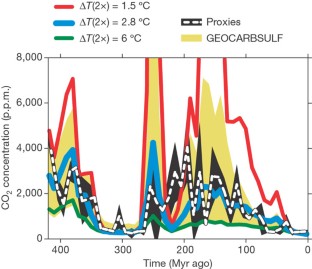
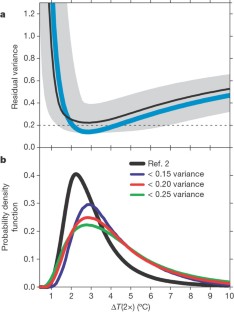
〉 (2007)"). Moreover, most estimates of climate sensitivity are based on records of climate change over the past few decades to thousands of years, when carbon dioxide concentrations and global temperatures were similar to or lower than today[1](/articles/nature05699#ref-CR1 "Houghton, J. T. et al. Climate Change 2001: The Scientific Basis (Cambridge Univ. Press, Cambridge, UK, 2001)"),[6](/articles/nature05699#ref-CR6 "Siegenthaler, U. et al. Stable carbon cycle-climate relationship during the late Pleistocene. Science 310, 1313–1317 (2005)"), so such calculations tend to underestimate the magnitude of large climate-change events[7](/articles/nature05699#ref-CR7 "Huber, B. T., MacLeod, K. G. & Wing, S. L. Warm Climates in Earth History (Cambridge Univ. Press, Cambridge, UK, 2000)") and may not be applicable to climate change under warmer conditions in the future. Here we estimate long-term equilibrium climate sensitivity by modelling carbon dioxide concentrations over the past 420 million years and comparing our calculations with a proxy record. Our estimates are broadly consistent with estimates based on short-term climate records, and indicate that a weak radiative forcing by carbon dioxide is highly unlikely on multi-million-year timescales. We conclude that a climate sensitivity greater than 1.5 °C has probably been a robust feature of the Earth’s climate system over the past 420 million years, regardless of temporal scaling.This is a preview of subscription content, access via your institution
Access options
Subscribe to this journal
Receive 51 print issues and online access
$199.00 per year
only $3.90 per issue
Buy this article
- Purchase on SpringerLink
- Instant access to the full article PDF.
USD 39.95
Prices may be subject to local taxes which are calculated during checkout
Additional access options:
Figure 1: Comparison of CO 2 calculated by GEOCARBSULF for varying Δ T (2×) to an independent CO 2 record from proxies.
The alternative text for this image may have been generated using AI.
Figure 2: Calculation of the long-term equilibrium climate sensitivity to CO 2.
The alternative text for this image may have been generated using AI.
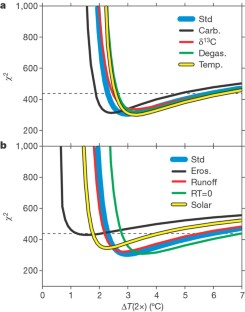
Figure 3: Sensitivity analysis for the effect of nine additional parameters in the GEOCARBSULF carbon cycle model on the fit between model-derived and proxy CO 2 values for varying Δ T (2×).
The alternative text for this image may have been generated using AI.
References
- Houghton, J. T. et al. Climate Change 2001: The Scientific Basis (Cambridge Univ. Press, Cambridge, UK, 2001)
Google Scholar - Hegerl, G. C., Crowley, T. J., Hyde, W. T. & Frame, D. J. Climate sensitivity constrained by temperature reconstructions over the past seven centuries. Nature 440, 1029–1032 (2006)
Article ADS CAS Google Scholar - Forest, C. E., Stone, P. H., Sokolov, A. P., Allen, M. R. & Webster, M. D. Quantifying uncertainties in climate system properties with the use of recent climate observations. Science 295, 113–117 (2002)
Article ADS CAS Google Scholar - Knutti, R., Stocker, T. F., Joos, F. & Plattner, G.-K. Constraints on radiative forcing and future climate change from observations and climate model ensembles. Nature 416, 719–723 (2002)
Article ADS CAS Google Scholar - Alley, R. et al. Climate change 2007: The physical science basis. Summary for policymakers. 〈http://www.ipcc.ch/SPM2feb07.pdf〉 (2007)
- Siegenthaler, U. et al. Stable carbon cycle-climate relationship during the late Pleistocene. Science 310, 1313–1317 (2005)
Article ADS CAS Google Scholar - Huber, B. T., MacLeod, K. G. & Wing, S. L. Warm Climates in Earth History (Cambridge Univ. Press, Cambridge, UK, 2000)
Google Scholar - Frakes, L. A., Francis, J. E. & Syktus, J. I. Climate Modes of the Phanerozoic (Cambridge Univ. Press, Cambridge, UK, 1992)
Book Google Scholar - Royer, D. L. CO2-forced climate thresholds during the Phanerozoic. Geochim. Cosmochim. Acta 70, 5665–5675 (2006)
Article ADS CAS Google Scholar - Montañez, I. P. et al. CO2-forced climate and vegetation instability during late Paleozoic deglaciation. Science 315, 87–91 (2007)
Article ADS Google Scholar - Berner, R. A. The Phanerozoic Carbon Cycle: CO2 and O2 (Oxford Univ. Press, New York, 2004)
Google Scholar - Berner, R. A. GEOCARBSULF: A combined model for Phanerozoic atmospheric O2 and CO2 . Geochim. Cosmochim. Acta 70, 5653–5664 (2006)
Article ADS CAS Google Scholar - Dessert, C. et al. Erosion of Deccan Traps determined by river geochemistry: impact on the global climate and the 87Sr/86Sr ratio of seawater. Earth Planet. Sci. Lett. 188, 459–474 (2001)
Article ADS CAS Google Scholar - Higgens, J. A. & Schrag, D. P. Beyond methane: Towards a theory for the Paleocene-Eocene thermal maximum. Earth Planet. Sci. Lett. 245, 523–537 (2006)
Article ADS Google Scholar - Pagani, M., Caldeira, K., Archer, D. & Zachos, J. C. An ancient carbon mystery. Science 314, 1556–1557 (2006)
Article CAS Google Scholar - Riebe, C. S., Kirchner, J. W. & Finkel, R. C. Sharp decrease in long-term chemical weathering rates along an altitudinal transect. Earth Planet. Sci. Lett. 218, 421–434 (2004)
Article ADS CAS Google Scholar - Moulton, K. L., West, J. & Berner, R. A. Solute flux and mineral mass balance approaches to the quantification of plant effects on silicate weathering. Am. J. Sci. 300, 539–570 (2000)
Article ADS CAS Google Scholar
Acknowledgements
We thank L. D. Harvey, E. W. Bolton and T. J. Crowley for discussions, and G. C. Hegerl for data. This work was supported in part by the US Department of Energy (R.A.B.).
Author Contributions D.L.R. and R.A.B. initiated the project, and all authors developed it. R.A.B. performed the carbon cycle calculations and J.P. performed most of the statistical analyses. D.L.R. managed the project and wrote most of the paper.
Author information
Authors and Affiliations
- Department of Earth and Environmental Sciences, Wesleyan University, Middletown, Connecticut 06459, USA,
Dana L. Royer - Department of Geology and Geophysics, Yale University, New Haven, Connecticut 06520, USA,
Robert A. Berner & Jeffrey Park
Authors
- Dana L. Royer
- Robert A. Berner
- Jeffrey Park
Corresponding author
Correspondence toDana L. Royer.
Ethics declarations
Competing interests
Reprints and permissions information is available at www.nature.com/reprints. The authors declare no competing financial interests.
Supplementary information
Supplementary Figure 1 (download PDF )
This file contains Supplementary Figure 1 with Legend. The Supplementary Figure 1 illustrates sensitivity analysis for the effect of variation of four critical parameters in the GEOCARBSULF carbon cycle model on the fit between model-derived and proxy CO2 values for varying ΔT(2x). (PDF 160 kb)
Rights and permissions
About this article
Cite this article
Royer, D., Berner, R. & Park, J. Climate sensitivity constrained by CO2 concentrations over the past 420 million years.Nature 446, 530–532 (2007). https://doi.org/10.1038/nature05699
- Received: 10 October 2006
- Accepted: 23 February 2007
- Issue date: 29 March 2007
- DOI: https://doi.org/10.1038/nature05699
This article is cited by
Editorial Summary
Calibrating the climate
Understanding the response of global mean surface temperature to changes in atmospheric carbon dioxide concentration is critical for interpreting past climate change, and for predicting future trends. Most estimates of the temperature increase resulting from a doubling of atmospheric carbon dioxide, the 'climate sensitivity', are based on records spanning the past few decades to millennia, so may have limited applicability under different climate conditions. Royer et al. use a novel approach, which involves modelling carbon dioxide concentrations and comparing the simulations with proxy records, to estimate climate sensitivity on long timescales. The results indicate that climate sensitivity was almost certainly greater than 1.5 °C. This is consistent with estimates based on short-term records, suggesting that it may have been a robust feature of Earth's climate system over the past 420 million years.