Giant cladoxylopsid trees resolve the enigma of the Earth’s earliest forest stumps at Gilboa (original) (raw)
- Letter
- Published: 19 April 2007
Nature volume 446, pages 904–907 (2007) Cite this article
- 3810 Accesses
- 193 Citations
- 113 Altmetric
- Metrics details
Abstract
The evolution of trees of modern size growing together in forests fundamentally changed terrestrial ecosystems1,2,3. The oldest trees are often thought to be of latest Devonian age (about 380–360 Myr old) as indicated by the widespread occurrence of Archaeopteris (Progymnospermopsida)4. Late Middle Devonian fossil tree stumps, rooted and still in life position, discovered in the 1870s from Gilboa, New York5, and later named Eospermatopteris, are widely cited as evidence of the Earth’s ‘oldest forest’6,7. However, their affinities and significance have proved to be elusive because the aerial portion of the plant has been unknown until now. Here we report spectacular specimens from Schoharie County, New York, showing an intact crown belonging to the cladoxylopsid Wattieza (Pseudosporochnales)8 and its attachment to Eospermatopteris trunk and base. This evidence allows the reconstruction of a tall (at least 8 m), tree-fern-like plant with a trunk bearing large branches in longitudinal ranks. The branches were probably abscised as frond-like modules. Lower portions of the trunk show longitudinal carbonaceous strands typical of Eospermatopteris, and a flat bottom with many small anchoring roots. These specimens provide new insight into Earth’s earliest trees and forest ecosystems. The tree-fern-like morphology described here is the oldest example so far of an evolutionarily recurrent arborescent body plan within vascular plants. Given their modular construction, these plants probably produced abundant litter, indicating the potential for significant terrestrial carbon accumulation and a detritus-based arthropod fauna by the Middle Devonian period.
This is a preview of subscription content, access via your institution
Access options
Subscribe to this journal
Receive 52 print issues and online access
$199.00 per year
only $3.83 per issue
Buy this article
- Purchase on SpringerLink
- Instant access to the full article PDF.
USD 39.95
Prices may be subject to local taxes which are calculated during checkout
Additional access options:
Figure 1: Wattieza Stockmans from South Mountain, New York, NYSM 17039.

The alternative text for this image may have been generated using AI.
Figure 2: Large trunk and reconstruction of plant from South Mountain, New York.

The alternative text for this image may have been generated using AI.
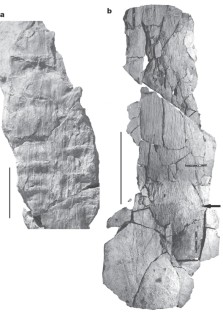
Figure 3: Trunk top and base of Wattieza Stockmans from South Mountain, New York; details of the large trunk specimen, NYSM 17040.
The alternative text for this image may have been generated using AI.
References
- Algeo, T. J., Scheckler, S. E. & Maynard, J. B. in Plants Invade the Land: Evolutionary and Environmental Approaches (eds Gensel, P. G. & Edwards, D.) 213–236 (Columbia Univ. Press, New York, 2001)
Google Scholar - Driese, S. G. & Mora, C. I. in Plants Invade the Land: Evolutionary and Environmental Approaches (eds Gensel, P. G. & Edwards, D.) 237–253 (Columbia Univ. Press, New York, 2001)
Google Scholar - Greb, S. F., DiMichele, W. A. & Gastaldo, R. A. in Wetlands Through Time (eds DiMichele, W.A., & Greb, S.) 1–40 (Geol. Soc. Am. Special Paper no. 399, Boulder, Colorado, 2006)
Book Google Scholar - Meyer-Berthaud, B., Scheckler, S. E. & Wendt, J. Archaeopteris is the earliest known modern tree. Nature 938, 700–701 (1999)
Article ADS Google Scholar - Dawson, J. W. On new tree ferns and other fossils from the Devonian. Q. J. Geol. Soc. Lond. 27, 269–275 (1871)
Article Google Scholar - Goldring, W. The oldest known petrified forest. Sci. Mthly 24, 514–529 (1927)
ADS Google Scholar - Driese, S., Mora, C. I. & Elick, J. M. Morphology and taphonomy of root and stump casts of the earliest trees (Middle to Late Devonian), Pennsylvania and New York, USA. Palaios 12, 524–537 (1997)
Article ADS Google Scholar - Berry, C. M. A reconsideration of Wattieza Stockmans (here attributed to Cladoxylopsida) based on a new species from the Devonian of Venezuela. Rev. Palaeobot. Palynol. 112, 125–146 (2000)
Article CAS Google Scholar - Goldring, W. The Upper Devonian forest of seed ferns. NY State Mus. Bull. 521, 50–72 (1924)
Google Scholar - Kräusel, R. & Weyland, H. Pflanzenreste aus dem Devon IX. Ein Stamm von Eospermatopteris Bau aus dem Mittledevon des Kirberges, Elberfeld. Senckenbergiana 17, 1–20 (1935)
Google Scholar - Beck, C. B. Current status of the progymnospermopsida. Rev. Palaeobot. Palynol. 21, 5–23 (1976)
Article Google Scholar - Pigg, K. B. Evolution of Isoetalean lycopsids. Ann. Mo. Bot. Gdn 79, 589–612 (1992)
Article Google Scholar - Boyer, J. S. & Matten, L. C. Anatomy of Eospermatopteris eriana from the Upper Middle Devonian ( = Givetian) of New York. Int. Org. Palaeobot. 5, 13 (1996)
Google Scholar - Berry, C. M. & Fairon-Demaret, M. in Plants Invade the Land: Evolutionary and Environmental Approaches (eds Gensel, P. G. & Edwards, D.) 120–158 (Columbia Univ. Press, New York, 2001)
Google Scholar - Lemoigne, Y. & Iurina, Y. A. Xenocladia medullosina Ch. A. Arnold (1940) 1952 du Dévonien moyen du Kazakhstan (URSS). Geobios 16, 513–547 (1983)
Article Google Scholar - Stein, W. E. & Hueber, F. M. The anatomy of Pseudosporochnus: P. hueberi from the Devonian of New York. Rev. Palaeobot. Palynol. 60, 311–359 (1989)
Article Google Scholar - Berry, C. M. & Yi, W. A new plant attributed to Cladoxylopsida from the Middle Devonian of Yunnan province, China. Rev. Palaeobot. Palynol. 142, 63–78 (2006)
Article Google Scholar - Soria, A., Meyer-Berthaud, B. & Scheckler, S. E. Reconstructing the architecture and growth habit of Pietschia levis sp. nov. (Cladoxylopsida) from the Late Devonian of southeastern Morocco. Int. J. Plant Sci. 162, 911–926 (2001)
Article Google Scholar - Hilton, J., Geng, B. & Kenrick, P. A novel late Devonian (Frasnian) woody cladoxylopsid from China. Int. J. Plant Sci. 164, 793–805 (2003)
Article Google Scholar - Leclercq, S. & Banks, H. P. Pseudosporochnus nodosus sp. nov., a Middle Devonian plant with cladoxylalean affinities. Palaeontographica B 110, 1–34 (1962)
Google Scholar - Berry, C. M. & Fairon-Demaret, M. A reinvestigation of the cladoxylopsid Pseudosporochnus nodosus Leclercq et Banks from the Middle Devonian of Goé, Belgium. Int. J. Plant Sci. 158, 350–372 (1997)
Article Google Scholar - Berry, C. M. & Fairon-Demaret, M. The architecture of Pseudosporochnus nodosus Leclercq et Banks: a Middle Devonian cladoxylopsid from Belgium. Int. J. Plant Sci. 163, 699–713 (2002)
Article Google Scholar - Bridge, J. S. & Willis, B. J. Marine transgressions and regressions recorded in Middle Devonian shore-zone deposits of the Catskill clastic wedge. Geol. Soc. Am. Bull. 106, 1440–1458 (1994)
Article ADS Google Scholar - Banks, H. P., Grierson, J. D. & Bonamo, P. M. in The Catskill Delta (eds Woodrow, D. L. & Sevon, W. D.) 125–141 (Geol. Soc. Am. Special Paper no. 201, Boulder, Colorado, 1985)
Book Google Scholar - Traverse, A. & Schuyler, A. Palynostratigraphy of the Catskill and part of the Chemung magnifacies, southern New York State, USA. Courier Forschungsinstitut Senckenberg 169, 261–274 (1994)
Google Scholar - Soria, A. & Meyer-Berthaud, B. Tree fern growth strategy in the late Devonian cladoxylopsid species Pietzschia levis from the study of its stem and root system. Am. J. Bot. 91, 10–23 (2004)
Article Google Scholar - Hammond, S. E. & Berry, C. M. A new species of Tetraxylopteris (Aneurophytales) from the Devonian of Venezuela. Bot. J. Linn. Soc. 148, 275–303 (2005)
Article Google Scholar
Acknowledgements
Financial support was provided by the New York State Museum.
Author Contributions L.V.H. and F.M. were responsible for initial discovery, field work and museum curation, E.L. for geological interpretation, W.E.S. and C.M.B. for palaeobotanical interpretation, F.M. for drawing the reconstruction in Fig. 2, and W.E.S. for writing the paper.
Author information
Authors and Affiliations
- Department of Biological Sciences, Binghamton University, Binghamton, New York 13902-6000, USA,
William E. Stein - New York State Museum, Albany, New York 12230, USA,
Frank Mannolini, Linda VanAller Hernick & Ed Landing - School of Earth, Ocean and Planetary Sciences, Cardiff University, Cardiff CF10 3YE, UK,
Christopher M. Berry
Authors
- William E. Stein
- Frank Mannolini
- Linda VanAller Hernick
- Ed Landing
- Christopher M. Berry
Corresponding authors
Correspondence toWilliam E. Stein or Christopher M. Berry.
Ethics declarations
Competing interests
Reprints and permissions information is available at www.nature.com/reprints. The authors declare no competing financial interests.
Supplementary information
Rights and permissions
About this article
Cite this article
Stein, W., Mannolini, F., Hernick, L. et al. Giant cladoxylopsid trees resolve the enigma of the Earth’s earliest forest stumps at Gilboa.Nature 446, 904–907 (2007). https://doi.org/10.1038/nature05705
- Received: 13 November 2006
- Accepted: 26 February 2007
- Issue date: 19 April 2007
- DOI: https://doi.org/10.1038/nature05705
This article is cited by
Late Devonian (Famennian) phacopid trilobites from western Xinjiang, Northwest China
- Catherine Crônier
- Johnny A. Waters
Palaeobiodiversity and Palaeoenvironments (2023)
The impact of vegetation on meandering rivers
- Alessandro Ielpi
- Mathieu G. A. Lapôtre
- C. Kevin Boyce
Nature Reviews Earth & Environment (2022)
Late Devonian (Famennian) phacopid trilobites from western Mongolia
- C. Crônier
- M. Ariuntogos
- S. K. Carmichael
Palaeobiodiversity and Palaeoenvironments (2021)
The Hushoot Shiveetiin gol section (Baruunhuurai Terrane, Mongolia): sedimentology and facies from a Late Devonian island arc setting
- A. Munkhjargal
- P. Königshof
- A. Dombrowski
Palaeobiodiversity and Palaeoenvironments (2021)
Advanced vascular function discovered in a widespread moss
- T. J. Brodribb
- M. Carriquí
- N. M. Holbrook
Nature Plants (2020)
Editorial Summary
Forest stump is crowned
The evolution of the tree habit was fundamental to the Earth's terrestrial ecosystem. The earliest known evidence for forests consists of fossil tree stumps, about 385 million years old, from Gilboa in Upstate New York. These have been known since the 1870s and named 'Eospermatopteris'. But in the absence of the aerial portions of these trees, the affinities and significance of these stumps has remained unknown. Stein et al. now describe a spectacular tacular fossil tree from Schoharie County, New York, showing for the first time an intact crown belonging to a previously known plant type called Wattieza, attached to an Eospermatopteris trunk and base. This complete fossil of a tree-like fern provides the evidence needed for a detailed reconstruction of the appearance of the world's earliest forests.