Controlling cavity reflectivity with a single quantum dot (original) (raw)
- Letter
- Published: 06 December 2007
- Andrei Faraon1 na1,
- Ilya Fushman1 na1,
- Nick Stoltz2,
- Pierre Petroff2 &
- …
- Jelena Vučković1
Nature volume 450, pages 857–861 (2007)Cite this article
- 12k Accesses
- 619 Citations
- 19 Altmetric
- Metrics details
Abstract
Solid-state cavity quantum electrodynamics (QED) systems offer a robust and scalable platform for quantum optics experiments and the development of quantum information processing devices. In particular, systems based on photonic crystal nanocavities and semiconductor quantum dots have seen rapid progress. Recent experiments have allowed the observation of weak1 and strong coupling2,3 regimes of interaction between the photonic crystal cavity and a single quantum dot in photoluminescence. In the weak coupling regime1, the quantum dot radiative lifetime is modified; in the strong coupling regime3, the coupled quantum dot also modifies the cavity spectrum. Several proposals for scalable quantum information networks and quantum computation rely on direct probing of the cavity–quantum dot coupling, by means of resonant light scattering from strongly or weakly coupled quantum dots4,5,6,7,8,9. Such experiments have recently been performed in atomic systems10,11,12 and superconducting circuit QED systems13, but not in solid-state quantum dot–cavity QED systems. Here we present experimental evidence that this interaction can be probed in solid-state systems, and show that, as expected from theory, the quantum dot strongly modifies the cavity transmission and reflection spectra. We show that when the quantum dot is coupled to the cavity, photons that are resonant with its transition are prohibited from entering the cavity. We observe this effect as the quantum dot is tuned through the cavity and the coupling strength between them changes. At high intensity of the probe beam, we observe rapid saturation of the transmission dip. These measurements provide both a method for probing the cavity–quantum dot system and a step towards the realization of quantum devices based on coherent light scattering and large optical nonlinearities from quantum dots in photonic crystal cavities.
This is a preview of subscription content, access via your institution
Access options
Subscribe to this journal
Receive 51 print issues and online access
$199.00 per year
only $3.90 per issue
Buy this article
- Purchase on SpringerLink
- Instant access to the full article PDF.
USD 39.95
Prices may be subject to local taxes which are calculated during checkout
Additional access options:
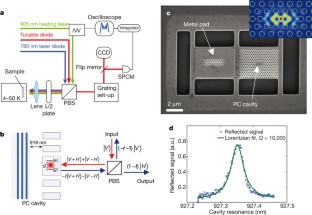
Figure 1: Experiment set-up.
The alternative text for this image may have been generated using AI.
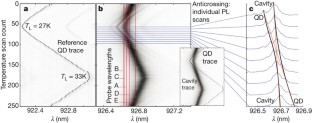
Figure 2: Photoluminescence of a single quantum dot tuned through strong coupling to a photonic crystal cavity.
The alternative text for this image may have been generated using AI.
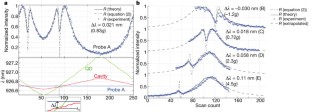
Figure 3: Quantum dot–controlled cavity reflectivity at different probe wavelengths A–E, as indicated in Fig. 2b .
The alternative text for this image may have been generated using AI.
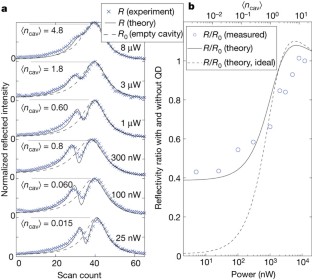
Figure 4: Quantum-dot-controlled cavity reflectivity versus probe beam power for probe laser detuning of Δ λ = -0.012 nm from the anticrossing point.
The alternative text for this image may have been generated using AI.
Cloaking a qubit in a cavity
Article Open access 09 October 2023
References
- Englund, D. et al. Controlling the spontaneous emission rate of single quantum dots in a two-dimensional photonic crystal. Phys. Rev. Lett. 95, 013904 (2005)
Article ADS PubMed Google Scholar - Yoshie, T. et al. Vacuum Rabi splitting with a single quantum dot in a photonic crystal nanocavity. Nature 432, 200–203 (2004)
Article ADS CAS PubMed Google Scholar - Hennessy, K. et al. Quantum nature of a strongly coupled single quantum dot-cavity system. Nature 445, 896–899 (2007)
Article ADS CAS PubMed Google Scholar - Cirac, J. I., Zoller, P., Kimble, H. J. & Mabuchi, H. Quantum state transfer and entanglement distribution among distant nodes in a quantum network. Phys. Rev. Lett. 78, 3221–3224 (1997)
Article ADS CAS Google Scholar - Imamoglu, A. et al. Quantum information processing using quantum dot spins and cavity QED. Phys. Rev. Lett. 83, 4204–4207 (1999)
Article ADS CAS Google Scholar - Duan, L. M. & Kimble, H. J. Scalable photonic quantum computation through cavity-assisted interactions. Phys. Rev. Lett. 92, 127902 (2004)
Article ADS PubMed Google Scholar - Childress, L., Taylor, J. M., Sorensen, A. S. & Lukin, M. D. Fault-tolerant quantum repeaters with minimal physical resources and implementations based on single-photon emitters. Phys. Rev. A 72, 052330 (2005)
Article ADS Google Scholar - Waks, E. & Vučković, J. Dipole induced transparency in drop-filter cavity-waveguide systems. Phys. Rev. Lett. 96, 153601 (2006)
Article ADS PubMed Google Scholar - Ladd, T. D., van Loock, P. K., Nemoto, K., Munro, W. J. & Yamamoto, Y. Hybrid quantum repeater based on dispersive CQED interactions between matter qubits and bright coherent light. N. J. Phys. 8, 184 (2006)
Article Google Scholar - Birnbaum, K. M. et al. Photon blockade in an optical cavity with one trapped atom. Nature 436, 87–90 (2005)
Article ADS CAS PubMed Google Scholar - Rauschenbeutel, A. et al. Coherent operation of a tunable quantum phase gate in cavity QED. Phys. Rev. Lett. 83, 5166–5169 (1999)
Article ADS CAS Google Scholar - Nogues, G. et al. Seeing a single photon without destroying it. Nature 400, 239–242 (1999)
Article ADS CAS Google Scholar - Schuster, D. I. et al. Resolving photon number states in a superconducting circuit. Nature 445, 515–518 (2007)
Article ADS CAS PubMed Google Scholar - Kimble, H. J. in Cavity Quantum Electrodynamics (ed. Berman, P.) 213–219 (Academic, San Diego, 1994)
Google Scholar - Akahane, Y., Asano, T., Song, B.-S. & Noda, S. High-Q photonic nanocavity in a two-dimensional photonic crystal. Nature 425, 944–947 (2003)
Article ADS CAS PubMed Google Scholar - Faraon, A. et al. Local quantum dot tuning on photonic crystal chips. Appl. Phys. Lett. 90, 213110 (2007)
Article ADS Google Scholar - Gerardot, B. D. et al. Contrast in transmission spectroscopy of a single quantum dot. Appl. Phys. Lett. 90, 221106 (2007)
Article ADS Google Scholar - Tan, S. M. A computational toolbox for quantum and atomic physics. J. Opt. B 1, 424–432 (1999)
Article ADS CAS Google Scholar - Hood, C. J., Chapman, M. S., Lynn, T. W. & Kimble, H. J. Real-time cavity QED with single atoms. Phys. Rev. Lett. 80, 4157–4160 (1998)
Article ADS CAS Google Scholar - Auffeves-Garnier, A., Simon, C., Gerard, J. M. & Poizat, J.-P. Giant optical nonlinearity induced by a single two-level system interacting with a cavity in the Purcell regime. Phys. Rev. A 75, 053823 (2007)
Article ADS Google Scholar - Englund, D., Faraon, A., Zhang, B., Yamamoto, Y. & Vučković, J. Generation and transfer of single photons on a photonic crystal chip. Opt. Express 15, 5550–5558 (2007)
Article ADS PubMed Google Scholar - Faraon, A., Waks, E., Englund, D., Fushman, I. & Vučković, J. Efficient photonic crystal cavity-waveguide couplers. Appl. Phys. Lett. 90, 073102 (2007)
Article ADS Google Scholar - Reiner, J. E., Smith, W. P., Orozco, L. A., Carmichael, H. J. & Rice, P. R. Time evolution and squeezing of the field amplitude in cavity QED. J. Opt. Soc. Am. B 18, 1911–1921 (2001)
Article ADS CAS Google Scholar - Imoto, N., Haus, H. A. & Yamamoto, Y. Quantum nondemolition measurement of the photon number via the optical Kerr effect. Phys. Rev. A 32, 2287–2292 (1985)
Article ADS CAS Google Scholar - Vučković, J., Englund, D., Fattal, D., Waks, E. & Yamamoto, Y. Generation and manipulation of nonclassical light using photonic crystals. Physica E 32, 466–470 (2006)
Article ADS Google Scholar
Acknowledgements
Financial support was provided by the ONR Young Investigator Award, the MURI Center for photonic quantum information systems (ARO/DTO Program), the Okawa Foundation Faculty Research Grant, and the CIS Seed fund. D.E. and I.F. were also supported by the NDSEG fellowship. Work was performed in part at the Stanford Nanofabrication Facility of NNIN supported by the National Science Foundation.
Author information
Author notes
- Dirk Englund, Andrei Faraon and Ilya Fushman: These authors contributed equally to this work.
Authors and Affiliations
- Ginzton Laboratory, Stanford University, Stanford, California 94305, USA ,
Dirk Englund, Andrei Faraon, Ilya Fushman & Jelena Vučković - Department of Electrical and Computer Engineering, University of California, Santa Barbara, California 93106, USA,
Nick Stoltz & Pierre Petroff
Authors
- Dirk Englund
- Andrei Faraon
- Ilya Fushman
- Nick Stoltz
- Pierre Petroff
- Jelena Vučković
Corresponding author
Correspondence toJelena Vučković.
Rights and permissions
About this article
Cite this article
Englund, D., Faraon, A., Fushman, I. et al. Controlling cavity reflectivity with a single quantum dot.Nature 450, 857–861 (2007). https://doi.org/10.1038/nature06234
- Received: 05 June 2007
- Accepted: 04 September 2007
- Issue date: 06 December 2007
- DOI: https://doi.org/10.1038/nature06234