Dissolved organic carbon trends resulting from changes in atmospheric deposition chemistry (original) (raw)
- Letter
- Published: 22 November 2007
- John L. Stoddard2 na1,
- Christopher D. Evans3,
- Heleen A. de Wit4,
- Martin Forsius5,
- Tore Høgåsen4,
- Anders Wilander6,
- Brit Lisa Skjelkvåle4,
- Dean S. Jeffries7,
- Jussi Vuorenmaa5,
- Bill Keller8,
- Jiri Kopácek9 &
- …
- Josef Vesely10 na2
Nature volume 450, pages 537–540 (2007) Cite this article
- 14k Accesses
- 1588 Citations
- 105 Altmetric
- Metrics details
Abstract
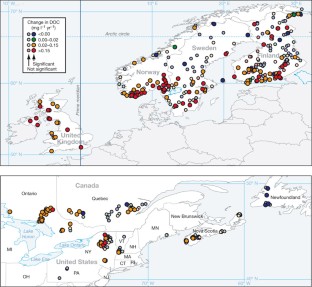
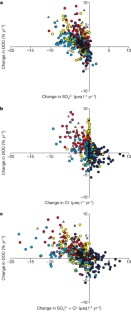
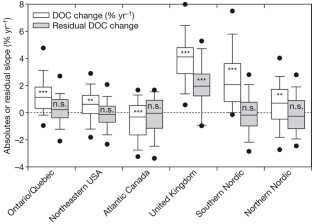
Several hypotheses have been proposed to explain recent, widespread increases in concentrations of dissolved organic carbon (DOC) in the surface waters of glaciated landscapes across eastern North America and northern and central Europe1,2,3. Some invoke anthropogenic forcing through mechanisms related to climate change3,4,5, nitrogen deposition6 or changes in land use7, and by implication suggest that current concentrations and fluxes are without precedent. All of these hypotheses imply that DOC levels will continue to rise, with unpredictable consequences for the global carbon cycle. Alternatively, it has been proposed that DOC concentrations are returning toward pre-industrial levels as a result of a gradual decline in the sulphate content of atmospheric deposition8,9,10. Here we show, through the assessment of time series data from 522 remote lakes and streams in North America and northern Europe, that rising trends in DOC between 1990 and 2004 can be concisely explained by a simple model based solely on changes in deposition chemistry and catchment acid-sensitivity. We demonstrate that DOC concentrations have increased in proportion to the rates at which atmospherically deposited anthropogenic sulphur and sea salt have declined. We conclude that acid deposition to these ecosystems has been partially buffered by changes in organic acidity and that the rise in DOC is integral to recovery from acidification. Over recent decades, deposition-driven increases in organic matter solubility may have increased the export of DOC to the oceans, a potentially important component of regional carbon balances11. The increase in DOC concentrations in these regions appears unrelated to other climatic factors.
This is a preview of subscription content, access via your institution
Access options
Subscribe to this journal
Receive 51 print issues and online access
$199.00 per year
only $3.90 per issue
Buy this article
- Purchase on SpringerLink
- Instant access to the full article PDF.
USD 39.95
Prices may be subject to local taxes which are calculated during checkout
Additional access options:
Figure 1: Trends in dissolved organic carbon (mg l -1 yr -1).
The alternative text for this image may have been generated using AI.
Figure 2: Relationship between %ΔDOC, ΔSO 4 2- and ΔCl - and the equivalent sum of ΔSO 4 2- and ΔCl - , used as surrogates for changes in atmospheric deposition.
The alternative text for this image may have been generated using AI.
Figure 3: Distributions of %ΔDOC and residuals from multiple regression, by region.
The alternative text for this image may have been generated using AI.
References
- Roulet, N. & Moore, T. R. Browning the waters. Nature 444, 283–284 (2006)
Article ADS CAS Google Scholar - Skjelkvåle, B. L. et al. Regional scale evidence for improvements in surface water chemistry 1990–2001. Environ. Pollut. 137, 165–176 (2005)
Article Google Scholar - Worrall, F., Burt, T. & Shedden, R. Long term records of riverine dissolved organic matter. Biogeochemistry 64, 165–178 (2003)
Article CAS Google Scholar - Freeman, C., Evans, C. D., Monteith, D. T., Reynolds, B. & Fenner, N. Export of organic carbon from peat soils. Nature 412, 785 (2001)
Article ADS CAS Google Scholar - Freeman, C. et al. Export of dissolved organic carbon from peatlands under elevated carbon dioxide levels. Nature 430, 195–198 (2004)
Article ADS CAS Google Scholar - Findlay, S. E. G. Increased carbon transport in the Hudson River: unexpected consequence of nitrogen deposition? Frontiers Ecol. Environ. 3, 133–137 (2005)
Article Google Scholar - Garnett, M. H., Ineson, P. & Stevenson, A. C. Effects of burning and grazing on carbon sequestration in a Pennine blanket bog. Holocene 10, 729–736 (2000)
Article ADS Google Scholar - Evans, C. D., Chapman, P. J., Clark, J. M., Monteith, D. T. & Cresser, M. S. Alternative explanations for rising dissolved organic carbon export from organic soils. Glob. Change Biol. 12, 1–10 (2006)
Article Google Scholar - Stoddard, J. L. et al. Response of Surface Water Chemistry to the Clean Air Act Amendments of 1990. Report EPA/620/R-03/001 (US Environmental Protection Agency, Washington DC, 2003)
Google Scholar - Vuorenmaa, J., Forsius, M. & Mannio, J. Increasing trends of total organic carbon concentrations in small forest lakes in Finland from 1987 to 2003. Sci. Total Environ. 365, 47–65 (2006)
Article ADS CAS Google Scholar - Siemens, J. The European carbon budget: a gap. Science 302, 1681 (2003)
Article CAS Google Scholar - Evans, C. D. & Monteith, D. T. Chemical trends at lakes and streams in the UK Acid Waters Monitoring Network, 1988–2000: Evidence for recent recovery at a national scale. Hydrol. Earth Syst. Sci. 5, 351–366 (2001)
Article ADS Google Scholar - Alewell, C., Mitchell, M. J., Likens, G. E. & Krouse, H. R. Sources of stream sulfate at the Hubbard Brook Experimental Forest. Biogeochemistry 44, 281–299 (1999)
Google Scholar - Tranvik, I. J. & Jansson, M. Terrestrial export of organic carbon. Nature 415, 861–862 (2002)
Article ADS CAS Google Scholar - Hejzlar, J., Dubrovsky, M., Buchtele, J. & Ruzicka, M. The apparent and potential effects of climate change on the inferred concentration of dissolved organic matter in a temperate stream (the Malse River, South Bohemia). Sci. Total Environ. 310, 142–152 (2003)
Article ADS Google Scholar - Evans, C. D., Monteith, D. T. & Cooper, D. M. Long-term increases in surface water dissolved organic carbon: Observations, possible causes and environmental impacts. Environ. Pollut. 137, 55–71 (2005)
Article CAS Google Scholar - Zhu, Y. & Day, R. L. Analysis of streamflow trends and the effects of climate in Pennsylvania, 1971 to 2001. J. Am. Water Resour. Assoc. 41, 1393–1405 (2005)
Article ADS Google Scholar - de Wit, H. A., Hindar, A. & Hole, L. Winter climate affects long-term trends in stream water nitrate in acid-sensitive catchments in southern Norway. Hydrol. Earth Syst. Sci. 4, 3055–3085 (2007)
Article Google Scholar - Whitfield, P. H. & Cannon, A. J. Recent variations in climate and hydrology in Canada. Can. Water Resour. J. 25, 19–65 (2000)
Article Google Scholar - Hyvärinen, V. Trends and characteristics of hydrological time series in Finland. Nordic Hydrol. 34, 71–90 (2003)
Article Google Scholar - Wright, R. F. et al. Trends in nitrogen deposition and leaching in acid-sensitive streams in Europe. Hydrol. Earth Syst. Sci. 5, 299–310 (2001)
Article ADS Google Scholar - Krug, E. C. & Frink, C. R. Acid rain on acid soil: a new perspective. Science 221, 520–525 (1983)
Article ADS CAS Google Scholar - Clark, J. M., Chapman, P. J., Heathwaite, A. L. & Adamson, J. K. Suppression of dissolved organic carbon by sulphate induced acidification during simulated droughts. Environ. Sci. Technol. 40, 1776–1783 (2006)
Article ADS CAS Google Scholar - de Wit, H. A., Groseth, T. & Mulder, J. Predicting aluminum and soil organic matter solubility using the mechanistic equilibrium model WHAM. Soil Sci. Soc. Am. J. 65, 1089–1100 (2001)
Article ADS CAS Google Scholar - Vogt, R. D., Ranneklev, S. B. & Mykkelbost, T. C. The impact of acid treatment on soilwater chemistry at the HUMEX site. Environ. Int. 3, 277–286 (1994)
Article Google Scholar - Tipping, E. & Hurley, M. A. A model of solid-solution interactions in acid organic soils, based on the complexation properties of humic substances. J. Soil Sci. 39, 505–519 (1988)
Article CAS Google Scholar - Tipping, E. & Woof, C. The distribution of humic substances between the solid and aqueous phases of acid organic soils; a description based on humic heterogeneity and charge-dependent sorption equilibria. J. Soil Sci. 42, 437–448 (1991)
Article CAS Google Scholar - Evans, A., Zelazny, L. W. & Zipper, C. E. Solution parameters influencing dissolved organic carbon levels in three forest soils. Soil Sci. Soc. Am. J. 52, 1789–1792 (1988)
Article ADS CAS Google Scholar - Sokal, R. R. & Rohlf, F. J. Biometry 532–538 (W. H. Freeman, San Francisco, 1969)
MATH Google Scholar - Sen, P. K. On a class of aligned rank order tests in two-way layouts. Ann. Math. Stat. 39, 1115–1124 (1968)
Article MathSciNet Google Scholar
Acknowledgements
We thank the LRTAP Working Group on Effects and the EU 6th Framework Programme Euro-limpacs for support in the production and analysis of international, quality-controlled, comparable data. We also acknowledge the work of the ICP Waters Programme Centre at the Norwegian Institute of Water Research (NIVA), where the data were collated, verified and archived. The authors are indebted to many colleagues and organisations who provided data for this assessment, including: T. A. Clair, S. Couture, C. Gagnon, D. K. McNicol, R. C. Weeber, A. Paterson (Canada); J. S. Kahl, J. Kellogg, K. Roy, M. R. Hale, D. R. DeWalle (USA); the Finnish Environment Institute (SYKE) and Regional Environment Centres; the Norwegian Institute of Water Research (NIVA); the Swedish Environmental Protection Agency (Naturvårdsverket); and the UK Acid Waters Monitoring Network (supported by the Department for Environment Food and Rural Affairs) and supporting laboratories at: Fisheries Research Services, Pitlochry; Centre for Ecology and Hydrology, Wallingford; and the Environment Agency Llanelli. The information in this document has been funded in part by the US Environmental Protection Agency. It has been subjected to review by the National Health and Environmental Effects Research Laboratory, and approved for publication. Approval does not signify that the contents reflect the views of the Agency, nor does mention of trade names or commercial products constitute endorsement or recommendation for use.
Author Contributions D.T.M. and J.L.S. formulated the working hypothesis and analysed and interpreted the trend data. C.D.E. and H.A.d.W. contributed to the development of the hypothesis, assisted in the interpretation of the data, provided additional text and edited the manuscript. M.F., T.H., A.W., B.L.S., D.S.J., B.K. and J. Vuorenmaa provided data and commented on the text. J.K. provided advice and ideas on processes and contributed data from the Czech Republic (not included in the final analysis due to number and length of time series) consistent with the hypothesis. J. Vesely contributed advice, ideas and data in the early stages of development of our work.
Author information
Author notes
- Donald T. Monteith and John L. Stoddard: These authors contributed equally to this work.
- Josef Vesely: Deceased.
Authors and Affiliations
- Environmental Change Research Centre, UCL, London, WC1E 6BT, UK ,
Donald T. Monteith - US EPA, Corvallis, Oregon 97333, USA ,
John L. Stoddard - Centre for Ecology and Hydrology, Bangor, LL57 2UW, UK ,
Christopher D. Evans - Norwegian Institute for Water Research, N-0349 Oslo, Norway
Heleen A. de Wit, Tore Høgåsen & Brit Lisa Skjelkvåle - Finnish Environment Institute, PO Box 140, FI-00251 Helsinki, Finland ,
Martin Forsius & Jussi Vuorenmaa - Department of Environment Assessment SLU, SE-75007 Uppsala, Sweden
Anders Wilander - Environment Canada, Burlington, Ontario, L7R4A6, Canada ,
Dean S. Jeffries - Ontario Ministry of the Environment, Laurentian University, Sudbury, Ontario, P3E 2C6, Canada ,
Bill Keller - Biology Centre, Institute of Hydrobiology, 37005 České Budějovice, Czech Republic
Jiri Kopácek - Czech Geological Survey, 152 00 Prague, Czech Republic
Josef Vesely
Authors
- Donald T. Monteith
- John L. Stoddard
- Christopher D. Evans
- Heleen A. de Wit
- Martin Forsius
- Tore Høgåsen
- Anders Wilander
- Brit Lisa Skjelkvåle
- Dean S. Jeffries
- Jussi Vuorenmaa
- Bill Keller
- Jiri Kopácek
- Josef Vesely
Corresponding author
Correspondence toDonald T. Monteith.
Supplementary information
Rights and permissions
About this article
Cite this article
Monteith, D., Stoddard, J., Evans, C. et al. Dissolved organic carbon trends resulting from changes in atmospheric deposition chemistry.Nature 450, 537–540 (2007). https://doi.org/10.1038/nature06316
- Received: 22 December 2006
- Accepted: 24 September 2007
- Issue date: 22 November 2007
- DOI: https://doi.org/10.1038/nature06316
Editorial Summary
Brown waters
There have been widespread reports of surface waters in many remote glaciated regions of North America and Northern Europe becoming browner as levels of dissolved organic carbon have increased. Several hypotheses have been proposed to explain the effect, including recent climate change, but the question remains controversial. A new survey of time series data from more than 500 remote lakes and streams, combined with a simple model, now shows that dissolved organic carbon concentrations are in fact closely related to the decline in the sulphate and seasalt content of atmospheric deposition. Dissolved organic carbon concentrations may therefore be returning towards levels that would have been typical prior to the first onset of acid rain during the nineteenth century.