Extinction risk depends strongly on factors contributing to stochasticity (original) (raw)
- Letter
- Published: 03 July 2008
Nature volume 454, pages 100–103 (2008) Cite this article
- 8053 Accesses
- 539 Citations
- 16 Altmetric
- Metrics details
Abstract
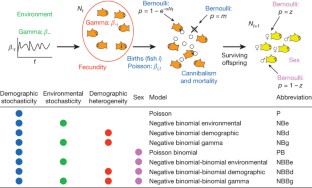
Extinction risk in natural populations depends on stochastic factors that affect individuals, and is estimated by incorporating such factors into stochastic models1,2,3,4,5,6,7,8,9. Stochasticity can be divided into four categories, which include the probabilistic nature of birth and death at the level of individuals (demographic stochasticity2), variation in population-level birth and death rates among times or locations (environmental stochasticity1,3), the sex of individuals6,8 and variation in vital rates among individuals within a population (demographic heterogeneity7,9). Mechanistic stochastic models that include all of these factors have not previously been developed to examine their combined effects on extinction risk. Here we derive a family of stochastic Ricker models using different combinations of all these stochastic factors, and show that extinction risk depends strongly on the combination of factors that contribute to stochasticity. Furthermore, we show that only with the full stochastic model can the relative importance of environmental and demographic variability, and therefore extinction risk, be correctly determined. Using the full model, we find that demographic sources of stochasticity are the prominent cause of variability in a laboratory population of Tribolium castaneum (red flour beetle), whereas using only the standard simpler models would lead to the erroneous conclusion that environmental variability dominates. Our results demonstrate that current estimates of extinction risk for natural populations could be greatly underestimated because variability has been mistakenly attributed to the environment rather than the demographic factors described here that entail much higher extinction risk for the same variability level.
This is a preview of subscription content, access via your institution
Access options
Subscribe to this journal
Receive 52 print issues and online access
$199.00 per year
only $3.83 per issue
Buy this article
- Purchase on SpringerLink
- Instant access to the full article PDF.
USD 39.95
Prices may be subject to local taxes which are calculated during checkout
Additional access options:
Figure 1: A family of stochastic Ricker models based on Ricker’s 26 assumptions about the life cycle of a fish species that cannibalises its eggs.
The alternative text for this image may have been generated using AI.
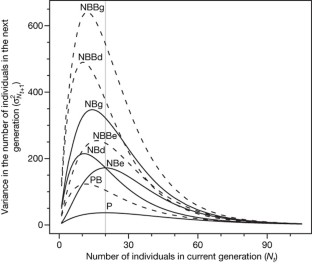
Figure 2: Variance in the number of individuals in the next generation ( N t + 1 ) as a function of the number of individuals in the current generation ( N t ) for the stochastic Ricker models.
The alternative text for this image may have been generated using AI.
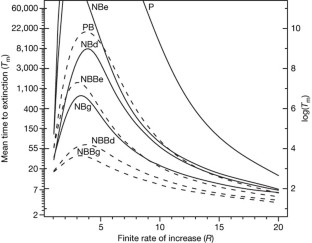
Figure 3: Intrinsic mean time to extinction 30 (T m ) for the stochastic Ricker models as a function of the finite rate of increase ( R).
The alternative text for this image may have been generated using AI.
References
- Athreya, K. B. & Karlin, S. On branching processes with random environments: extinction probabilities. Ann. Math. Stat. 42, 1499–1520 (1971)
Article MathSciNet Google Scholar - May, R. M. Stability and Complexity in Model Ecosystems (Princeton Univ. Press, Princeton, 1973)
Google Scholar - May, R. M. Stability in randomly fluctuating versus deterministic environments. Am. Nat. 107, 621–650 (1973)
Article Google Scholar - Lande, R. Risks of population extinction from demographic and environmental stochasticity and random catastrophes. Am. Nat. 142, 911–927 (1993)
Article Google Scholar - Ludwig, D. The distribution of population survival times. Am. Nat. 147, 506–526 (1996)
Article Google Scholar - Lande, R., Engen, S. & Saether, B. E. Stochastic Population Dynamics in Ecology and Conservation (Oxford Univ. Press, Oxford, UK, 2003)
Book Google Scholar - Kendall, B. E. & Fox, G. A. Unstructured individual variation and demographic stochasticity. Conserv. Biol. 17, 1170–1172 (2003)
Article Google Scholar - Saether, B. E. et al. Time to extinction in relation to mating system and type of density regulation in populations with two sexes. J. Anim. Ecol. 73, 925–934 (2004)
Article Google Scholar - Fox, G. A., Kendall, B. E., Fitzpatrick, J. W. & Woolfenden, G. E. Consequences of heterogeneity in survival probability in a population of Florida scrub-jays. J. Anim. Ecol. 75, 921–927 (2006)
Article Google Scholar - Soulé, M. E. (ed.) Viable Populations for Conservation (Cambridge Univ. Press, Cambridge, UK, 1987)
Book Google Scholar - Shaffer, M. L. Minimum population sizes for species conservation. Bioscience 31, 131–134 (1981)
Article Google Scholar - Pimm, S. L., Jones, H. L. & Diamond, J. On the risk of extinction. Am. Nat. 132, 757–785 (1988)
Article Google Scholar - Leigh, E. G. The average lifetime of a population in a varying environment. J. Theor. Biol. 90, 213–239 (1981)
Article MathSciNet Google Scholar - Goodman, D. in Viable Populations for Conservation (ed. Soulé, M. E.) 11–34 (Cambridge Univ. Press, Cambridge, UK, 1987)
Book Google Scholar - Morris, W. F. & Doak, D. F. Quantitative Conservation Biology: Theory and Practice of Population Viability Analysis (Sinauer Associates Inc., Sunderland, Massachusetts, 2002)
Google Scholar - Feller, W. Die Grundlagen der Volterraschen Theorie des Kampfes ums Dasein in wahrscheinlichkeitstheoretischer Behandlung. Acta Biotheor. 5, 11–40 (1939)
Article MathSciNet Google Scholar - Kendall, D. G. Stochastic processes and population growth. J. R. Stat. Soc. Ser. B Methodol. 11, 230–282 (1949)
MathSciNet MATH Google Scholar - Bartlett, M. S. Stochastic Population Models in Ecology and Epidemiology (Methuen, London, 1960)
MATH Google Scholar - Lewontin, R. C. & Cohen, D. On population growth in a randomly varying environment. Proc. Natl Acad. Sci. USA 62, 1056–1060 (1969)
Article ADS MathSciNet CAS Google Scholar - Roughgarden, J. A simple model for population dynamics in stochastic environments. Am. Nat. 109, 713–736 (1975)
Article Google Scholar - Tuljapurkar, S. An uncertain life: demography in random environments. Theor. Popul. Biol. 35, 227–294 (1989)
Article MathSciNet CAS Google Scholar - Gabriel, W. & Burger, R. Survival of small populations under demographic stochasticity. Theor. Popul. Biol. 41, 44–71 (1992)
Article CAS Google Scholar - Engen, S., Lande, R. & Saether, B. E. Demographic stochasticity and Allee effects in populations with two sexes. Ecology 84, 2378–2386 (2003)
Article Google Scholar - Legendre, S., Clobert, J., Moller, A. P. & Sorci, G. Demographic stochasticity and social mating system in the process of extinction of small populations: The case of passerines introduced to New Zealand. Am. Nat. 153, 449–463 (1999)
Article Google Scholar - Dennis, B., Desharnais, R. A., Cushing, J. M., Henson, S. M. & Costantino, R. F. Estimating chaos and complex dynamics in an insect population. Ecol. Monogr. 71, 277–303 (2001)
Article Google Scholar - Ricker, W. E. Stock and recruitment. J. Fish. Res. Bd Can. 11, 559–623 (1954)
Article Google Scholar - Drake, J. M. Density-dependent demographic variation determines extinction rate of experimental populations. PLoS Biol. 3, e222 (2005)
Article Google Scholar - Burnham, K. P. & Anderson, D. R. Model Selection and Multimodel Inference: A Practical Information-Theoretic Approach (Springer, New York, 2002)
MATH Google Scholar - Costantino, R. F. & Desharnais, R. A. Population Dynamics and the Tribolium Model: Genetics and Demography (Springer, New York, 1991)
Google Scholar - Grimm, V. & Wissel, C. The intrinsic mean time to extinction: a unifying approach to analysing persistence and viability of populations. Oikos 105, 501–511 (2004)
Article Google Scholar
Acknowledgements
We thank M. Gibson, D. Hodgkiss, C. Koenig, T. McCabe, D. Paulus, D. Smith, N. Tcheou, R. Villalobos and M. Wu for assistance. This study was funded by the National Science Foundation.
Author Contributions B.A.M. derived and analysed the models, and analysed the data. B.A.M. and A.H. conceived the study, planned and directed the experiments, and wrote the paper.
Author information
Authors and Affiliations
- Department of Ecology and Evolutionary Biology, University of Colorado, Boulder, Colorado 80309, USA,
Brett A. Melbourne - Department of Environmental Science and Policy, University of California, Davis, California 95616, USA,
Alan Hastings
Authors
- Brett A. Melbourne
- Alan Hastings
Corresponding author
Correspondence toBrett A. Melbourne.
Supplementary information
Supplementary information (download PDF )
This file contains Supplementary Figures 1-4, Supplementary Methods, Supplementary Table 1, Supplementary Discussion, and Supplementary Notes. The Supplementary Figures show stochastic realisations of the models (Fig. S1), the best model fitted to the Tribolium data (Fig. S2), extensions to the models (Fig. S3) , and measurement error bias (Fig. S4). The Supplementary Methods provide a detailed derivation of the stochastic Ricker models, and equations to equate the total variance for environmental stochasticity and demographic heterogeneity. Supplementary Table 1 provides pmfs for the stochastic Ricker models. The Supplementary Discussion considers extensions to the stochastic Ricker models, the robustness of the model fit, and measurement error bias. The Supplementary Notes include additional references. (PDF 1068 kb)
PowerPoint slides
Rights and permissions
About this article
Cite this article
Melbourne, B., Hastings, A. Extinction risk depends strongly on factors contributing to stochasticity.Nature 454, 100–103 (2008). https://doi.org/10.1038/nature06922
- Received: 10 December 2007
- Accepted: 13 March 2008
- Issue date: 03 July 2008
- DOI: https://doi.org/10.1038/nature06922
This article is cited by
Editorial Summary
Increased risk of extinction
The risk that a natural population can become extinct is a fundamental biological process, and is central to our understanding of biodiversity and evolution. But Brett Melbourne and Alan Hastings contend that existing mathematical models of extinction risk ascribe variability in population numbers to the wrong processes. In work that combines a new mathematical theory with experimental data, they show that different kinds of random-ness in the life of an animal combine in such a way that the risk of extinction is many times higher than previously thought possible, and that estimated risks of extinction for endangered species need to be raised.