Heterogeneous chemistry in the atmosphere of Mars (original) (raw)
- Letter
- Published: 21 August 2008
- Jean-Loup Bertaux2,3,
- R. Todd Clancy4,
- Thérèse Encrenaz2,5,
- Kelly Fast6,
- François Forget2,7,
- Sébastien Lebonnois2,7,
- Franck Montmessin2,3 &
- …
- Séverine Perrier2,3 nAff8
Nature volume 454, pages 971–975 (2008)Cite this article
- 1878 Accesses
- 129 Citations
- 3 Altmetric
- Metrics details
Abstract
Hydrogen radicals are produced in the martian atmosphere by the photolysis of water vapour and subsequently initiate catalytic cycles that recycle carbon dioxide from its photolysis product carbon monoxide1,2. These processes provide a qualitative explanation for the stability of the atmosphere of Mars, which contains 95 per cent carbon dioxide. Balancing carbon dioxide production and loss based on our current understanding of the gas-phase chemistry in the martian atmosphere has, however, proven to be difficult3,4,5. Interactions between gaseous chemical species and ice cloud particles have been shown to be key factors in the loss of polar ozone observed in the Earth’s stratosphere6, and may significantly perturb the chemistry of the Earth’s upper troposphere7. Water-ice clouds are also commonly observed in the atmosphere of Mars8,9,10 and it has been suggested previously that heterogeneous chemistry could have an important impact on the composition of the martian atmosphere3,4,5,11. Here we use a state-of-the-art general circulation model together with new observations of the martian ozone layer12,13,14,15 to show that model simulations that include chemical reactions occurring on ice clouds lead to much improved quantitative agreement with observed martian ozone levels in comparison with model simulations based on gas-phase chemistry alone. Ozone is readily destroyed by hydrogen radicals and is therefore a sensitive tracer of the chemistry that regulates the atmosphere of Mars. Our results suggest that heterogeneous chemistry on ice clouds plays an important role in controlling the stability and composition of the martian atmosphere.
This is a preview of subscription content, access via your institution
Access options
Subscribe to this journal
Receive 51 print issues and online access
$199.00 per year
only $3.90 per issue
Buy this article
- Purchase on SpringerLink
- Instant access to the full article PDF.
USD 39.95
Prices may be subject to local taxes which are calculated during checkout
Additional access options:
Figure 1: Observed and simulated seasonal evolution of water vapour and water-ice clouds.
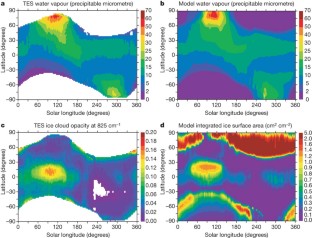
The alternative text for this image may have been generated using AI.
Figure 2: Observed and simulated seasonal evolution of martian ozone.
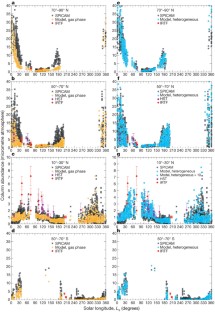
The alternative text for this image may have been generated using AI.
Figure 3: Synoptic distribution of O 3 column (micrometre atmosphere) calculated in northern spring and at aphelion.
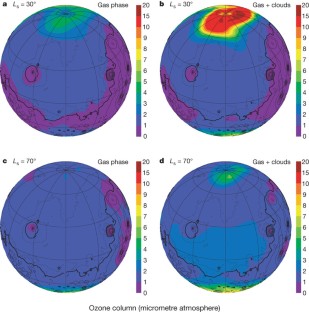
The alternative text for this image may have been generated using AI.
Figure 4: Observed and simulated seasonal evolution of martian hydrogen peroxide (H 2 O 2).
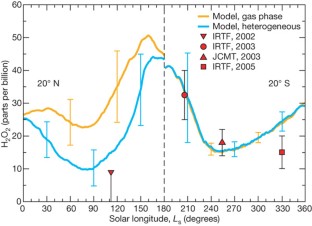
The alternative text for this image may have been generated using AI.
References
- McElroy, M. B. & Donahue, T. M. Stability of the Martian atmosphere. Science 177, 986–988 (1972)
Article ADS CAS Google Scholar - Parkinson, T. D. & Hunten, D. M. Spectroscopy and aeronomy of O2 on Mars. J. Atmos. Sci. 29, 1380–1390 (1972)
Article ADS CAS Google Scholar - Atreya, S. K. & Blamont, J. E. Stability of the Martian atmosphere: possible role of heterogeneous chemistry. Geophys. Res. Lett. 17, 287–290 (1990)
Article ADS Google Scholar - Atreya, S. K. & Gu, Z. G. Stability of the Martian atmosphere: Is heterogeneous catalysis essential? J. Geophys. Res. 99, 13133–13145 (1994)
Article ADS CAS Google Scholar - Krasnopolsky, V. A. Photochemistry of the Martian atmosphere: Seasonal, latitudinal, and diurnal variations. Icarus 185, 153–170 (2006)
Article ADS CAS Google Scholar - Solomon, S. Stratospheric ozone depletion: A review of concepts and history. Rev. Geophys. 37, 275–316 (1999)
Article ADS CAS Google Scholar - Jaeglé, L. et al. Photochemistry of HO x in the upper troposphere at northern midlatitudes. J. Geophys. Res. 105, 3877–3892 (2000)
Article ADS Google Scholar - Clancy, R. T. et al. Water vapor saturation at low altitudes around Mars aphelion: A key to Mars climate? Icarus 122, 36–62 (1996)
Article ADS CAS Google Scholar - Akabane, T., Iwasaki, K., Saito, Y. & Narumi, Y. Martian late-northern-winter polar hood opacities and non-visibility of a surface cap: 1975 and 1990 observations. Astron. Astrophys. 277, 302–308 (1993)
ADS Google Scholar - Mateshvili, N. et al. Martian ice cloud distribution obtained from SPICAM nadir UV measurements. J. Geophys. Res. 112 10.1029/2006JE002827 (2007)
- Anbar, A. D., Leu, M. T., Nair, H. A. & Yung, Y. L. Adsorption of HOx on aerosol surfaces: Implications for the atmosphere of Mars. J. Geophys. Res. 98, 10933–10940 (1993)
Article ADS CAS Google Scholar - Perrier, S. et al. Global distribution of total ozone on Mars from SPICAM/MEX UV measurements. J. Geophys. Res. 111 10.1029/2006JE002681 (2006)
- Clancy, R. T. et al. Mars ozone measurements near the 1995 aphelion: Hubble space telescope ultraviolet spectroscopy with the faint object spectrograph. J. Geophys. Res. 101, 12777–12783 (1996)
Article ADS Google Scholar - Clancy, R. T., Wolff, M. J. & James, P. B. Minimal aerosol loading and global increases in atmospheric ozone during the 1996–1997 Martian northern spring season. Icarus 138, 49–63 (1999)
Article ADS CAS Google Scholar - Fast, K. et al. Ozone abundances on Mars from infrared heterodyne spectra I: Acquisition, retrieval, and anticorrelation with water vapor. Icarus 181, 419–431 (2006)
Article ADS CAS Google Scholar - Lefèvre, F., Lebonnois, S., Montmessin, F. & Forget, F. Three-dimensional modeling of ozone on Mars. J. Geophys. Res. 109 10.1029/2004JE002268 (2004)
- Moudden, Y. & McConnell, J. C. Three-dimensional on-line chemical modeling in a Mars general circulation model. Icarus 188, 18–34 (2007)
Article ADS CAS Google Scholar - Montmessin, F., Forget, F., Rannou, P., Cabane, M. & Haberle, R. M. Origin and role of water ice clouds in the Martian water cycle as inferred from a general circulation model. J. Geophys. Res. 109 10.1029/2004JE002284 (2004)
- Smith, M. D. Interannual variability in TES atmospheric observations of Mars during 1999–2003. Icarus 167, 148–165 (2004)
Article ADS CAS Google Scholar - Clancy, R. T. & Nair, H. Annual (perihelion–aphelion) cycles in the photochemical behavior of the global Mars atmosphere. J. Geophys. Res. 101, 12785–12790 (1996)
Article ADS Google Scholar - Lebonnois, S. et al. Vertical distribution of ozone on Mars as measured by SPICAM/Mars-Express using stellar occultations. J. Geophys. Res. 111 10.1029/2005JE002643 (2006)
- Montabone, L., Lewis, S. R. & Read, P. L. Interannual variability of Martian dust storms in assimilation of several years of Mars Global Surveyor observations. Adv. Space Res. 36, 2146–2155 (2005)
Article ADS Google Scholar - Cooper, P. L. & Abbatt, J. P. Heterogeneous interactions of OH and HO2 radicals with surfaces characteristic of atmospheric particulate matter. J. Phys. Chem. 100, 2249–2254 (1996)
Article CAS Google Scholar - Sander, S. P. et al. Chemical Kinetics and Photochemical Data for Use in Atmospheric Studies, Evaluation Number 15. JPL Publ. 06–2 (Jet Propulsion Lab., Pasadena, 2006)
Google Scholar - Barth, C. A. et al. Mariner 9 ultraviolet spectrometer experiment: Seasonal variation of ozone on Mars. Science 179, 795–796 (1973)
Article ADS CAS Google Scholar - Encrenaz, T. et al. A stringent upper limit of the H2O2 abundance in the Martian atmosphere. Astron. Astrophys. 396, 1037–1044 (2002)
Article ADS CAS Google Scholar - Fouchet, T. et al. Martian water vapor: Mars Express PFS/LW observations. Icarus 190, 32–49 (2007)
Article ADS CAS Google Scholar - Encrenaz, T. et al. Hydrogen peroxide on Mars: Evidence for spatial and seasonal variations. Icarus 170, 424–429 (2004)
Article ADS CAS Google Scholar - Encrenaz, T. et al. Simultaneous mapping of H2O and H2O2 on Mars from infrared high-resolution imaging spectroscopy. Icarus 195, 547–556 (2008)
Article ADS CAS Google Scholar - Clancy, R. T., Sandor, B. J. & Moriarty-Schieven, G. H. A measurement of the 362 Ghz absorption line of Mars atmospheric H2O2 . Icarus 168, 116–121 (2004)
Article ADS CAS Google Scholar
Acknowledgements
Much of this work was done while F.L. was on leave from CNRS at the Instituto de Astrofísica de Andalucía (Granada, Spain). We thank M. Smith, who provided the TES data.
Author information
Author notes
- Séverine Perrier
Present address: Present address: Direction Générale pour l’Armement, Bagneux F-92220, France.,
Authors and Affiliations
- UPMC Univ. Paris 06, Service d’Aéronomie, Paris F-75005, France ,
Franck Lefèvre - CNRS/INSU, France
Franck Lefèvre, Jean-Loup Bertaux, Thérèse Encrenaz, François Forget, Sébastien Lebonnois, Franck Montmessin & Séverine Perrier - Université Versailles St-Quentin, Service d’Aéronomie, Verrières-le-Buisson F-91371, France ,
Jean-Loup Bertaux, Franck Montmessin & Séverine Perrier - Space Science Institute, 4750 Walnut Street, Suite 205, Boulder, Colorado 80301, USA ,
R. Todd Clancy - LESIA, Observatoire de Paris, F-92195 Meudon, France ,
Thérèse Encrenaz - Planetary Systems Laboratory, Code 693, NASA Goddard Space Flight Center, Greenbelt, Maryland 20771, USA ,
Kelly Fast - UPMC Univ. Paris 06, Laboratoire de Météorologie Dynamique, Paris F-75005, France
François Forget & Sébastien Lebonnois
Authors
- Franck Lefèvre
- Jean-Loup Bertaux
- R. Todd Clancy
- Thérèse Encrenaz
- Kelly Fast
- François Forget
- Sébastien Lebonnois
- Franck Montmessin
- Séverine Perrier
Corresponding author
Correspondence toFranck Lefèvre.
Supplementary information
Rights and permissions
About this article
Cite this article
Lefèvre, F., Bertaux, JL., Clancy, R. et al. Heterogeneous chemistry in the atmosphere of Mars.Nature 454, 971–975 (2008). https://doi.org/10.1038/nature07116
- Received: 21 November 2007
- Accepted: 27 May 2008
- Issue date: 21 August 2008
- DOI: https://doi.org/10.1038/nature07116