A record of planet migration in the main asteroid belt (original) (raw)
- Letter
- Published: 26 February 2009
Nature volume 457, pages 1109–1111 (2009)Cite this article
- 1386 Accesses
- 149 Citations
- 4 Altmetric
- Metrics details
Abstract
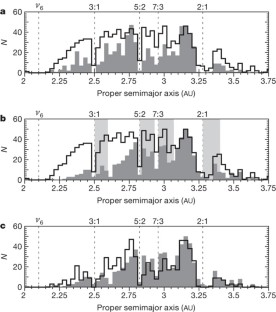
The main asteroid belt lies between the orbits of Mars and Jupiter, but the region is not uniformly filled with asteroids. There are gaps, known as the Kirkwood gaps, in distinct locations that are associated with orbital resonances with the giant planets1; asteroids placed in these locations will follow chaotic orbits and be removed2. Here we show that the observed distribution of main belt asteroids does not fill uniformly even those regions that are dynamically stable over the age of the Solar System. We find a pattern of excess depletion of asteroids, particularly just outward of the Kirkwood gaps associated with the 5:2, the 7:3 and the 2:1 Jovian resonances. These features are not accounted for by planetary perturbations in the current structure of the Solar System, but are consistent with dynamical ejection of asteroids by the sweeping of gravitational resonances during the migration of Jupiter and Saturn ∼4 Gyr ago.
This is a preview of subscription content, access via your institution
Access options
Subscribe to this journal
Receive 51 print issues and online access
$199.00 per year
only $3.90 per issue
Buy this article
- Purchase on SpringerLink
- Instant access to the full article PDF.
USD 39.95
Prices may be subject to local taxes which are calculated during checkout
Additional access options:
Figure 1: Comparison of the observed main belt asteroid distribution with our simulated asteroid belt and results of the migration simulation.
The alternative text for this image may have been generated using AI.
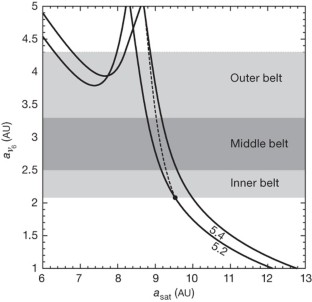
Figure 2: The location of the ν 6 secular resonance as a function of Saturn’s semimajor axis.
The alternative text for this image may have been generated using AI.
References
- Kirkwood, D. Meteoric Astronomy: A Treatise on Shooting-stars, Fireballs, and Aerolites (Lippincott, 1867)
Google Scholar - Wisdom, J. Chaotic behaviour in the solar system. Proc. R. Soc. Lond. A 413, 109–129 (1987)
Article ADS MathSciNet Google Scholar - Wisdom, J. & Holman, M. Symplectic maps for the n-body problem. Astron. J. 102, 1528–1538 (1991)
Article ADS Google Scholar - Saha, P. & Tremaine, S. Symplectic integrators for solar system dynamics. Astron. J. 104, 1633–1640 (1992)
Article ADS Google Scholar - Malhotra, R. The origin of Pluto’s peculiar orbit. Nature 365, 819–821 (1993)
Article ADS Google Scholar - Malhotra, R. The origin of Pluto’s orbit: Implications for the solar system beyond Neptune. Astron. J. 110, 420–429 (1995)
Article ADS Google Scholar - Fernandez, J. A. & Ip, W.-H. Some dynamical aspects of the accretion of Uranus and Neptune – The exchange of orbital angular momentum with planetesimals. Icarus 58, 109–120 (1984)
Article ADS Google Scholar - Hahn, J. M. & Malhotra, R. Orbital evolution of planets embedded in a planetesimal disk. Astron. J. 117, 3041–3053 (1999)
Article ADS Google Scholar - Tsiganis, K., Gomes, R., Morbidelli, A. & Levison, H. F. Origin of the orbital architecture of the giant planets of the Solar System. Nature 435, 459–461 (2005)
Article ADS CAS Google Scholar - Liou, J.-C. & Malhotra, R. Depletion of the outer asteroid belt. Science 275, 375–377 (1997)
Article ADS CAS Google Scholar - Levison, H. F. et al. Could the lunar “Late Heavy Bombardment” have been triggered by the formation of Uranus and Neptune? Icarus 151, 286–306 (2001)
Article ADS CAS Google Scholar - Gomes, R., Levison, H. F., Tsiganis, K. & Morbidelli, A. Origin of the cataclysmic Late Heavy Bombardment period of the terrestrial planets. Nature 435, 466–469 (2005)
Article ADS CAS Google Scholar - Strom, R. G., Malhotra, R., Ito, T., Yoshida, F. & Kring, D. A. The origin of planetary impactors in the inner solar system. Science 309, 1847–1850 (2005)
Article ADS CAS Google Scholar - Franklin, F. A., Lewis, N. K., Soper, P. R. & Holman, M. J. Hilda asteroids as possible probes of Jovian migration. Astron. J. 128, 1391–1406 (2004)
Article ADS Google Scholar - Murray-Clay, R. A. & Chiang, E. I. A signature of planetary migration: The origin of asymmetric capture in the 2:1 resonance. Astrophys. J. 619, 623–638 (2005)
Article ADS Google Scholar - Murray, C. D. & Dermott, S. F. Solar System Dynamics (Cambridge Univ. Press, 1999)
MATH Google Scholar - Heppenheimer, T. A. Secular resonances and the origin of eccentricities of Mars and the asteroids. Icarus 41, 76–88 (1980)
Article ADS Google Scholar - O’Brien, D. P., Morbidelli, A. & Bottke, W. F. The primordial excitation and clearing of the asteroid belt—Revisited. Icarus 191, 434–452 (2007)
Article ADS Google Scholar - Knežević, Z. & Milani, A. Proper element catalogs and asteroid families. Astron. Astrophys. 403, 1165–1173 (2003)
Article ADS Google Scholar - Malhotra, R., Fox, K., Murray, C. D. & Nicholson, P. D. Secular perturbations of the Uranian satellites – Theory and practice. Astron. Astrophys. 221, 348–358 (1989)
ADS MATH Google Scholar
Acknowledgements
We acknowledge research funding from NASA and NSF.
Author information
Authors and Affiliations
- Lunar and Planetary Laboratory, University of Arizona, 1629 East University Boulevard, Tucson, Arizona 85716, USA ,
David A. Minton & Renu Malhotra
Authors
- David A. Minton
- Renu Malhotra
Corresponding author
Correspondence toDavid A. Minton.
Supplementary information
PowerPoint slides
Rights and permissions
About this article
Cite this article
Minton, D., Malhotra, R. A record of planet migration in the main asteroid belt.Nature 457, 1109–1111 (2009). https://doi.org/10.1038/nature07778
- Received: 13 November 2008
- Accepted: 13 January 2009
- Issue date: 26 February 2009
- DOI: https://doi.org/10.1038/nature07778