Warming caused by cumulative carbon emissions towards the trillionth tonne (original) (raw)
- Letter
- Published: 30 April 2009
- David J. Frame1,2,
- Chris Huntingford3,
- Chris D. Jones4,
- Jason A. Lowe5,
- Malte Meinshausen6 &
- …
- Nicolai Meinshausen7
Nature volume 458, pages 1163–1166 (2009)Cite this article
- 24k Accesses
- 1444 Citations
- 549 Altmetric
- Metrics details
Abstract
Global efforts to mitigate climate change are guided by projections of future temperatures1. But the eventual equilibrium global mean temperature associated with a given stabilization level of atmospheric greenhouse gas concentrations remains uncertain1,2,3, complicating the setting of stabilization targets to avoid potentially dangerous levels of global warming4,5,6,7,8. Similar problems apply to the carbon cycle: observations currently provide only a weak constraint on the response to future emissions9,10,11. Here we use ensemble simulations of simple climate-carbon-cycle models constrained by observations and projections from more comprehensive models to simulate the temperature response to a broad range of carbon dioxide emission pathways. We find that the peak warming caused by a given cumulative carbon dioxide emission is better constrained than the warming response to a stabilization scenario. Furthermore, the relationship between cumulative emissions and peak warming is remarkably insensitive to the emission pathway (timing of emissions or peak emission rate). Hence policy targets based on limiting cumulative emissions of carbon dioxide are likely to be more robust to scientific uncertainty than emission-rate or concentration targets. Total anthropogenic emissions of one trillion tonnes of carbon (3.67 trillion tonnes of CO2), about half of which has already been emitted since industrialization began, results in a most likely peak carbon-dioxide-induced warming of 2 °C above pre-industrial temperatures, with a 5–95% confidence interval of 1.3–3.9 °C.
This is a preview of subscription content, access via your institution
Access options
Subscribe to this journal
Receive 51 print issues and online access
$199.00 per year
only $3.90 per issue
Buy this article
- Purchase on SpringerLink
- Instant access to the full article PDF.
USD 39.95
Prices may be subject to local taxes which are calculated during checkout
Additional access options:
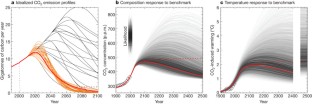
Figure 1: Idealized carbon dioxide emission scenarios and response to benchmark scenario.
The alternative text for this image may have been generated using AI.
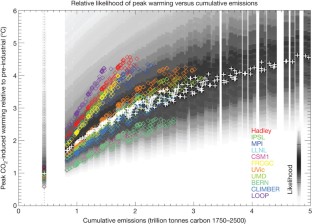
Figure 2: Peak CO 2 -induced warming as a function of total cumulative emissions 1750–2500 for 250 idealized emission scenarios.
The alternative text for this image may have been generated using AI.
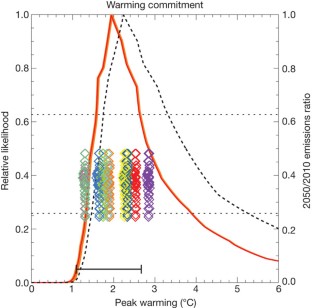
Figure 3: Warming commitment for selected scenarios shownin Fig. 1a .
The alternative text for this image may have been generated using AI.
References
- Meehl, G. A. et al. in Climate Change 2007: The Physical Science Basis (eds Solomon, S. et al.) Ch. 10 (Cambridge Univ. Press, 2007)
Google Scholar - Knutti, R. & Hegerl, G. C. The equilibrium sensitivity of the Earth’s temperature to radiation changes. Nature Geosci. 1, 735–743 (2008)
Article CAS ADS Google Scholar - Hansen, J. E. et al. Target atmospheric CO2: Where should humanity aim? Open Atmos. Sci. J. 2, 217–231 (2009)
Article Google Scholar - Solomon, S., Plattner, G.-K., Knutti, R. & Friedlingstein, P. Irreversible climate change due to carbon dioxide emissions. Proc. Natl Acad. Sci. USA 10.1073/pnas.0812721106 (2009)
- Wigley, T. M. L., Richels, R. & Edmonds, J. A. Economic and environmental choices in the stabilisation of atmospheric CO2 concentrations. Nature 379, 240–243 (1996)
Article CAS ADS Google Scholar - Schneider, S. H. & Mastrandrea, M. D. Probabilistic assessment of dangerous climate and emissions pathways. Proc. Natl Acad. Sci. USA 102, 15728–15735 (2005)
Article CAS ADS Google Scholar - Meinshausen, M. in Avoiding Dangerous Climate Change (eds Schellnhuber, H. J. et al.) Ch. 28 (Cambridge Univ. Press, 2006)
Google Scholar - Harvey, L. D. D. Allowable CO2 concentrations under the United Nations Framework Convention on Climate Change as a function of the climate sensitivity probability distribution function. Environ. Res. Lett. 2, 014001 (2007)
Article ADS Google Scholar - Friedlingstein, P. et al. How positive is the feedback between climate change and the carbon cycle? Tellus 55B, 692–700 (2003)
Article CAS ADS Google Scholar - Jones, C. D., Cox, P. M. & Huntingford, C. Climate-carbon cycle feedbacks under stabilization. Tellus 58B, 603–613 (2006)
Article CAS ADS Google Scholar - Matthews, H. D. Effect of CO2 fertilization uncertainty on future climate change in a coupled climate-carbon model. Glob. Change Biol. 13, 1068–1078 (2007)
Article ADS Google Scholar - Den Elzen, M. G. J. & Van Vuuren, D. P. Peaking profiles for achieving long-term temperature targets with more likelihood at lower costs. Proc. Natl Acad. Sci. USA 104, 17931–17936 (2007)
Article CAS ADS Google Scholar - Huntingford, C. & Lowe, J. Overshoot scenarios and climate change. Science 316, 829 (2007)
Article Google Scholar - Frame, D. J. et al. Alternatives to stabilization scenarios. Geophys. Res. Lett. 33 10.1029/2006GL025801 (2006)
- Huntingford, C. et al. Contributions of thermal and carbon cycle uncertainty to future climate projection spread. Tellus 61B, 355–360 (2009)
Article CAS ADS Google Scholar - Friedlingstein, P. et al. Climate–carbon cycle feedback analysis, results from the C4MIP model intercomparison. J. Clim. 19, 3337–3353 (2006)
Article ADS Google Scholar - Schneider, S. H. Abrupt non-linear climate change, irreversibility and surprise. Glob. Environ. Change 14, 245–258 (2004)
Article Google Scholar - Lowe, J. A. et al. How difficult is it to recover from dangerous levels of global warming? Environ. Res. Lett. 4, 014012 (2009)
Article ADS Google Scholar - Pawitan, Y. In all Likelihood: Statistical Modeling and Inference Using Likelihood Ch. 2.6 and 3.4 (Oxford Univ. Press, 2001)
MATH Google Scholar - Meinshausen, M. et al. Greenhouse-gas emission targets for limiting global warming to 2 °C. Nature 10.1038/nature08017 (this issue)
- Stott, P. A. et al. Observational constraints on past attributable warming and predictions of future global warming. J. Clim. 19, 3055–3069 (2006)
Article ADS Google Scholar - Broecker, W. S. CO2 arithmetic. Science 315, 1371 (2007)
Article CAS Google Scholar - Wigley, T. M. L. CO2 emissions: a piece of the pie. Science 316, 829–830 (2007)
Article CAS Google Scholar - Matthews, H. D. & Caldeira, K. Stabilizing climate requires near-zero emissions. Geophys. Res. Lett. 35, L04705 (2009)
ADS Google Scholar - Matthews, H. D. et al. The proportionality of global warming to cumulative carbon emissions. Nature 10.1038/nature08047 (in the press)
- Shine, K. P. et al. Alternatives to the global warming potential for comparing climate impacts of emissions of greenhouse gases. Clim. Change 68, 281–302 (2005)
Article CAS ADS Google Scholar - Shine, K. P. et al. Comparing the climate effect of emissions of short- and long-lived climate agents. Phil. Trans. R. Soc. A 365, 1903–1914 (2007)
Article CAS ADS Google Scholar - Friedlingstein, P. & Solomon, S. Contributions of past and present human generations to committed warming caused by carbon dioxide. Proc. Natl Acad. Sci. USA 102, 10832–10836 (2005)
Article CAS ADS Google Scholar - Plattner, G.-K. et al. Long-term climate commitments projected with climate-carbon cycle models. J. Clim. 21, 2721–2751 (2008)
Article ADS Google Scholar - Frame, D. J. et al. Constraining climate forecasts: the role of prior assumptions. Geophys. Res. Lett. 32 10.1029/2004GL022241 (2005)
- Keeling, C. D. & Whorf, T. P. Atmospheric CO2 records from sites in the SIO air sampling network. In Trends: A Compendium of Data on Global Change (Carbon Dioxide Information Analysis Center, Oak Ridge National Laboratory, US DOE, 2005)
Google Scholar
Acknowledgements
We thank N. Gillett, K. Shine and T. Stocker for suggestions, P. Stott for estimates of twentieth-century-attributable warming, J. Welby for help calibrating the simple climate model. P. Friedlingstein and the C4MIP modelling community for model output and I. Tracey for help with the manuscript. M.R.A. and D.J.F. acknowledge support from NERC and the FP6 ENSEMBLES project. M.R.A. received additional support from the International Detection and Attribution Working Group (IDAG), supported by the DOE Office of Science, Office of Biological and Environmental Research and NOAA Climate Program Office, and from the British Council. C.H. acknowledges the CEH Science Budget Fund. C.D.J. and J.A.L. were supported by the Joint DECC, Defra and MoD Integrated Climate Programme (DECC/Defra GA01101; MoD CBC/2B/0417_Annex C5).
Author Contributions M.R.A. and D.J.F. designed, tested and ran the simple climate model. C.H., C.D.J. and J.A.L. developed and tuned HadSCCCM1 and C.H. and J.A.L. ran the simulations; M.M. ran the MAGICC model contributing to Fig. 3 and N.M. advised on statistical analysis. All authors contributed to writing the paper.
Author information
Authors and Affiliations
- Department of Physics, University of Oxford, OX1 3PU, UK,
Myles R. Allen & David J. Frame - Smith School of Enterprise and the Environment, University of Oxford, OX1 2BQ, UK ,
David J. Frame - Centre for Ecology and Hydrology, Wallingford, OX10 8BB, UK ,
Chris Huntingford - Met Office Hadley Centre, FitzRoy Road, Exeter, EX1 3PB, UK ,
Chris D. Jones - Department of Meteorology, Met Office Hadley Centre (Reading Unit), University of Reading, RG6 6BB, Reading, UK,
Jason A. Lowe - Potsdam Institute for Climate Impact Research, 14412 Potsdam, Germany
Malte Meinshausen - Department of Statistics, University of Oxford, OX1 3TG, UK,
Nicolai Meinshausen
Authors
- Myles R. Allen
- David J. Frame
- Chris Huntingford
- Chris D. Jones
- Jason A. Lowe
- Malte Meinshausen
- Nicolai Meinshausen
Corresponding author
Correspondence toMyles R. Allen.
Supplementary information
PowerPoint slides
Rights and permissions
About this article
Cite this article
Allen, M., Frame, D., Huntingford, C. et al. Warming caused by cumulative carbon emissions towards the trillionth tonne.Nature 458, 1163–1166 (2009). https://doi.org/10.1038/nature08019
- Received: 25 September 2008
- Accepted: 25 March 2009
- Issue date: 30 April 2009
- DOI: https://doi.org/10.1038/nature08019
This article is cited by
Editorial Summary
Climate change: target acquisition
How quickly greenhouse-gas emissions need to be reduced in order to avoid what has been termed dangerous climate change is of fundamental importance. Two papers in this issue tackle the question from different standpoints, yet come to broadly similar conclusions. Meinshausen et al. relate the cumulative emission of greenhouse gasses by 2050 to the probability of exceeding the 2 °C of global warming above pre-industrial temperatures adopted by more than 100 countries as the threshold of dangerous climate change. They find that only about a third of economically recoverable oil, gas and coal reserves can be burned if global warming of 2 °C is to be avoided by 2100, an amount of fossil fuel that would be burned by 2029 if consumption remains at today's levels. Allen et al. use a combined climate and carbon cycle model to produce simulations spanning a range of climate futures consistent with the changes already observed. The 500 billionth tonne of anthropogenic carbon since 1750 was recently released into the atmosphere, and Allen et al. find that releasing a trillion tonnes of carbon in total is likely to cause a peak warming exceeding the 'acceptable' 2 °C temperature increase. Every tonne released thereafter increases the committed maximum warming in a predictable way, regardless of when it is released. Any effective climate mitigation regime must therefore achieve a cap on cumulative carbon dioxide emissions — one trillion tonnes would be a possible though optimistic target. In News and Views, Gavin Schmidt and David Archer consider these papers and other recent work focusing on establishing achievable emissions targets.