The effect of permafrost thaw on old carbon release and net carbon exchange from tundra (original) (raw)
- Letter
- Published: 28 May 2009
- Jason G. Vogel1 na1,
- Kathryn G. Crummer1,
- Hanna Lee1,
- James O. Sickman2 &
- …
- T. E. Osterkamp3
Nature volume 459, pages 556–559 (2009) Cite this article
- 16k Accesses
- 1061 Citations
- 185 Altmetric
- Metrics details
Abstract
Permafrost soils in boreal and Arctic ecosystems store almost twice as much carbon1,2 as is currently present in the atmosphere3. Permafrost thaw and the microbial decomposition of previously frozen organic carbon is considered one of the most likely positive climate feedbacks from terrestrial ecosystems to the atmosphere in a warmer world1,2,4,5,6,7. The rate of carbon release from permafrost soils is highly uncertain, but it is crucial for predicting the strength and timing of this carbon-cycle feedback effect, and thus how important permafrost thaw will be for climate change this century and beyond1,2,4,5,6,7. Sustained transfers of carbon to the atmosphere that could cause a significant positive feedback to climate change must come from old carbon, which forms the bulk of the permafrost carbon pool that accumulated over thousands of years8,9,10,11. Here we measure net ecosystem carbon exchange and the radiocarbon age of ecosystem respiration in a tundra landscape undergoing permafrost thaw12 to determine the influence of old carbon loss on ecosystem carbon balance. We find that areas that thawed over the past 15 years had 40 per cent more annual losses of old carbon than minimally thawed areas, but had overall net ecosystem carbon uptake as increased plant growth offset these losses. In contrast, areas that thawed decades earlier lost even more old carbon, a 78 per cent increase over minimally thawed areas; this old carbon loss contributed to overall net ecosystem carbon release despite increased plant growth. Our data document significant losses of soil carbon with permafrost thaw that, over decadal timescales, overwhelms increased plant carbon uptake13,14,15 at rates that could make permafrost a large biospheric carbon source in a warmer world.
This is a preview of subscription content, access via your institution
Access options
Subscribe to this journal
Receive 52 print issues and online access
$199.00 per year
only $3.83 per issue
Buy this article
- Purchase on SpringerLink
- Instant access to the full article PDF.
USD 39.95
Prices may be subject to local taxes which are calculated during checkout
Additional access options:
Figure 1: Net exchange of CO 2 between tundra and the atmosphere for three sites that differ in the extent of permafrost thaw.
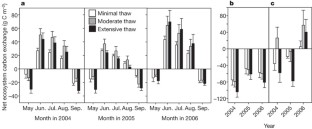
The alternative text for this image may have been generated using AI.
Figure 2: Radiocarbon values of ecosystem respiration and the proportional contribution from old carbon for three sites that differ in the extent of permafrost thaw.

The alternative text for this image may have been generated using AI.
Figure 3: Old carbon loss and its relationship to total ecosystem respiration for three sites that differ in the extent of permafrost thaw.
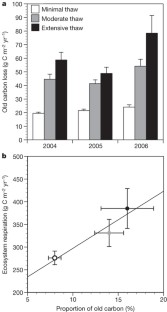
The alternative text for this image may have been generated using AI.
References
- Schuur, E. A. G. et al. Vulnerability of permafrost carbon to climate change: Implications for the global carbon cycle. Bioscience 58, 701–714 (2008)
Article Google Scholar - Zimov, S. A., Schuur, E. A. G. & Chapin, F. S. Permafrost and the global carbon budget. Science 312, 1612–1613 (2006)
Article CAS Google Scholar - Field, C. B., Sarmiento, J. & Hales, B. in The First State of the Carbon Cycle Report (SOCCR) — Synthesis and Assessment Product 2.2 (eds King, A.W. et al.) 21–28 (National Oceanic and Atmospheric Administration, National Climatic Data Center, 2007)
Google Scholar - Field, C. B., Lobell, D. B., Peters, H. A. & Chiariello, N. R. Feedbacks of terrestrial ecosystems to climate change. Annu. Rev. Environ. Resour. 32, 1–29 (2007)
Article Google Scholar - Davidson, E. A. & Janssens, I. A. Temperature sensitivity of soil carbon decomposition and feedbacks to climate change. Nature 440, 165–173 (2006)
Article CAS ADS Google Scholar - Heimann, M. & Reichstein, M. Terrestrial ecosystem carbon dynamics and climate feedbacks. Nature 451, 289–292 (2008)
Article CAS ADS Google Scholar - Oechel, W. C. et al. Recent change of Arctic tundra ecosystems from a net carbon dioxide sink to a source. Nature 361, 520–523 (1993)
Article ADS Google Scholar - Harden, J. W., Sundquist, E. T., Stallard, R. F. & Mark, R. K. Dynamics of soil carbon during deglaciation of the Laurentide ice sheet. Science 258, 1921–1924 (1992)
Article CAS ADS Google Scholar - Schirrmeister, L. et al. Paleoenvironmental and paleoclimatic records from permafrost deposits in the Arctic region of Northern Siberia. Quat. Int. 89, 97–118 (2002)
Article Google Scholar - Zimov, S. A. et al. Permafrost carbon: Stock and decomposability of a globally significant carbon pool. Geophys. Res. Lett. 33 10.1029/2006GL027484 (2006)
- Smith, L. C. et al. Siberian peatlands a net carbon sink and global methane source since the early Holocene. Science 303, 353–356 (2004)
Article CAS ADS Google Scholar - Osterkamp, T. E. Characteristics of the recent warming of permafrost in Alaska. J. Geophys. Res. 112 (F2). 10.1029/2006JF000578 (2007)
- Myneni, R. B., Tucker, C. J., Asrar, G. & Keeling, C. D. Interannual variations in satellite-sensed vegetation index data from 1981 to 1991. J. Geophys. Res. 103 (D6). 6145–6160 (1998)
Article ADS Google Scholar - Sturm, M., Racine, C. & Tape, K. Climate change – Increasing shrub abundance in the Arctic. Nature 411, 546–547 (2001)
Article CAS ADS Google Scholar - Chapin, F. S. et al. Role of land-surface changes in Arctic summer warming. Science 310, 657–660 (2005)
Article CAS ADS Google Scholar - Oechel, W. C. et al. Acclimation of ecosystem CO2 exchange in the Alaskan Arctic in response to decadal climate warming. Nature 406, 978–981 (2000)
Article CAS ADS Google Scholar - Vitt, D. H., Halsey, L. A. & Zoltai, S. C. The changing landscape of Canada's western boreal forest: The current dynamics of permafrost. Can. J. For. Res. 30, 283–287 (2000)
Article Google Scholar - Osterkamp, T. E. The recent warming of permafrost in Alaska. Glob. Planet. Change 49, 187–202 (2005)
Article ADS Google Scholar - Osterkamp, T. E. & Romanovsky, V. E. Evidence for warming and thawing of discontinuous permafrost in Alaska. Permafrost Periglac. Process. 10, 17–37 (1999)
Article Google Scholar - Schuur, E. A. G., Crummer, K. G., Vogel, J. G. & Mack, M. C. Plant species composition and productivity following permafrost thaw and thermokarst in Alaskan tundra. Ecosystems 10, 280–292 (2007)
Article Google Scholar - Trumbore, S. Age of soil organic matter and soil respiration: Radiocarbon constraints on belowground C dynamics. Ecol. Appl. 10, 399–411 (2000)
Article Google Scholar - Levin, I. & Hesshaimer, V. Radiocarbon – A unique tracer of global carbon cycle dynamics. Radiocarbon 42, 69–80 (2000)
Article CAS Google Scholar - Phillips, D. L. & Gregg, J. W. Source partitioning using stable isotopes: Coping with too many sources. Oecologia 136, 261–269 (2003)
Article ADS Google Scholar - Shaver, G. R. et al. Global change and the carbon balance of Arctic ecosystems. Bioscience 42, 433–441 (1992)
Article Google Scholar - Lawrence, D. M. & Slater, A. G. A projection of severe near-surface permafrost degradation during the 21st century. Geophys. Res. Lett. 32 L24401 10.1029/2005GL025080 (2005)
Article ADS Google Scholar - Delisle, G. Near-surface permafrost degradation: How severe during the 21st century? Geophys. Res. Lett. 34 (9) 10.1029/2007GL029323 (2007)
- Mack, M. C. et al. Ecosystem carbon storage in arctic tundra reduced by long-term nutrient fertilization. Nature 431, 440–443 (2004)
Article CAS ADS Google Scholar - Hobbie, S. E. Temperature and plant species control over litter decomposition in Alaskan tundra. Ecol. Monogr. 66, 503–522 (1996)
Article Google Scholar - Dutta, K., Schuur, E. A. G., Neff, J. C. & Zimov, S. A. Potential carbon release from permafrost soils of Northeastern Siberia. Glob. Change Biol. 12, 2336–2351 (2006)
Article ADS Google Scholar - Canadell, J. G. et al. Contributions to accelerating atmospheric CO2 growth from economic activity, carbon intensity, and efficiency of natural sinks. Proc. Natl Acad. Sci. USA 104, 18866–18870 (2007)
Article CAS ADS Google Scholar
Acknowledgements
This work was made possible by assistance from G. Adema, T. Chapin, S. DeBiasio, L. Gutierrez, M. Mack, M. Schieber, E. Tissier, C. Trucco, W. Vicars, E. Wilson, C. Wuthrich, L. Yocum, and the researchers and technicians of the Bonanza Creek LTER. This work relied on funds from the following sources: NASA New Investigator Program, NSF Bonanza Creek LTER Program, NSF DEB Ecosystems Program, and a cooperative agreement with the National Park Service.
Author Contributions E.A.G.S. conceived the experiment. E.A.G.S. and J.G.V. designed the experiment and wrote the paper. E.A.G.S., J.G.V., K.G.C. and H.L. performed research. All authors commented on the analysis and presentation of the data and were involved in the writing.
Author information
Author notes
- Edward A. G. Schuur and Jason G. Vogel: These authors contributed equally to this work.
Authors and Affiliations
- Department of Biology, University of Florida, Gainesville, Florida 32611, USA,
Edward A. G. Schuur, Jason G. Vogel, Kathryn G. Crummer & Hanna Lee - Department of Environmental Science, University of California, Riverside, California 92521, USA,
James O. Sickman - Geophysical Institute, University of Alaska, Fairbanks, Alaska 99775, USA ,
T. E. Osterkamp
Authors
- Edward A. G. Schuur
- Jason G. Vogel
- Kathryn G. Crummer
- Hanna Lee
- James O. Sickman
- T. E. Osterkamp
Corresponding author
Correspondence toEdward A. G. Schuur.
Supplementary information
PowerPoint slides
Rights and permissions
About this article
Cite this article
Schuur, E., Vogel, J., Crummer, K. et al. The effect of permafrost thaw on old carbon release and net carbon exchange from tundra.Nature 459, 556–559 (2009). https://doi.org/10.1038/nature08031
- Received: 24 August 2008
- Accepted: 25 March 2009
- Issue date: 28 May 2009
- DOI: https://doi.org/10.1038/nature08031
This article is cited by
Editorial Summary
Permafrost carbon release
The enormous amounts of carbon stored deep in permafrost soils — permafrost ecosystems contain almost twice as much carbon as is present in the atmosphere — have the potential to create a positive feedback to climate change if released into a warming world. The bulk of the permafrost carbon pool consists of 'old' carbon, accumulated over thousands of years, but the rate of carbon release from these soils is highly uncertain. Schuur et al. report data on net ecosystem carbon exchange and the radiocarbon age of ecosystem respiration from a long-term monitoring site in Alaska where permafrost temperatures have been directly measured since 1985, and observed to warm since then. They find significant losses of soil carbon with permafrost thaw that, over decadal timescales, overwhelms increased plant carbon uptake at rates that could make permafrost a large biospheric carbon source in a warmer world.