No sodium in the vapour plumes of Enceladus (original) (raw)
- Letter
- Published: 25 June 2009
- Matthew H. Burger2,
- Emily L. Schaller3,
- Michael E. Brown4,
- Robert E. Johnson5,
- Jeffrey S. Kargel6,
- Michele K. Dougherty7 &
- …
- Nicholas A. Achilleos8
Nature volume 459, pages 1102–1104 (2009)Cite this article
- 1010 Accesses
- 41 Citations
- 5 Altmetric
- Metrics details
Abstract
The discovery of water vapour and ice particles erupting from Saturn’s moon Enceladus fuelled speculation that an internal ocean was the source1,2,3. Alternatively, the source might be ice warmed, melted or crushed by tectonic motions4. Sodium chloride (that is, salt) is expected to be present in a long-lived ocean in contact with a rocky core. Here we report a ground-based spectroscopic search for atomic sodium near Enceladus that places an upper limit on the mixing ratio in the vapour plumes orders of magnitude below the expected ocean salinity5. The low sodium content of escaping vapour, together with the small fraction of salt-bearing particles6, argues against a situation in which a near-surface geyser is fuelled by a salty ocean through cracks in the crust1. The lack of observable sodium in the vapour is consistent with a wide variety of alternative eruption sources, including a deep ocean6, a freshwater reservoir, or ice. The existing data may be insufficient to distinguish between these hypotheses.
This is a preview of subscription content, access via your institution
Access options
Subscribe to this journal
Receive 51 print issues and online access
$199.00 per year
only $3.90 per issue
Buy this article
- Purchase on SpringerLink
- Instant access to the full article PDF.
USD 39.95
Prices may be subject to local taxes which are calculated during checkout
Additional access options:
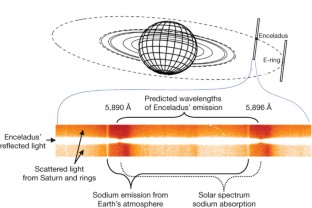
Figure 1: Observing geometry and corresponding sodium D-line spectrum of Enceladus and nearby E ring.
The alternative text for this image may have been generated using AI.
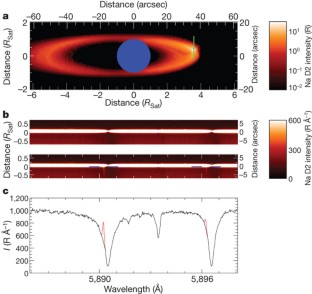
Figure 2: Determining the 4 × 10 -7 upper limit for direct sodium ejection into a south-directed plume.
The alternative text for this image may have been generated using AI.
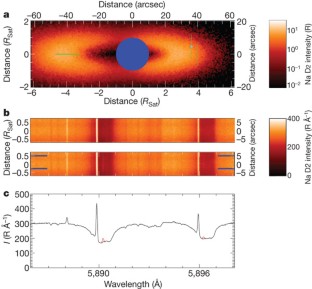
Figure 3: Determining the 7 × 10 -6 upper limit for a molecular source, with panels displaying the same information as in Fig. 2 .
The alternative text for this image may have been generated using AI.
References
- Porco, C. C. et al. Cassini observes the active south pole of Enceladus. Science 311, 1393–1401 (2006)
Article ADS CAS Google Scholar - Spencer, J. R. et al. Cassini encounters Enceladus: background and the discovery of a south polar hot spot. Science 311, 1401–1405 (2006)
Article ADS CAS Google Scholar - McKay, C. P., Porco, C. C., Altheide, T., Davis, W. L. & Kral, T. A. The possible origin and persistence of life on Enceladus and detection of biomarkers in the plume. Astrobiology 8, 909–919 (2008)
Article ADS CAS Google Scholar - Nimmo, F., Spencer, J. R., Pappalardo, R. T. & Mullen, M. E. Shear heating as the origin of the plumes and heat flux on Enceladus. Nature 447, 289–291 (2007)
Article ADS CAS Google Scholar - Zolotov, M. Y. An oceanic composition on early and today's Enceladus. Geophys. Res. Lett. 34 L23203 10.1029/2007GL031234 (2007)
Article ADS Google Scholar - Postberg, F. et al. Sodium salts in E-ring ice grains from an ocean below the surface of Enceladus. Nature 10.1038/nature08046 (this issue)
- Brown, R. A. in Exploration of the Planetary System (eds Woszczyk, A. & Iwaniszewska, C.) 527–531 (Proc. IAU Symp. No. 65, Reidel, 1974)
Book Google Scholar - Brown, M. E. & Hill, R. E. Discovery of an extended sodium atmosphere around Europa. Nature 380, 229–231 (1996)
Article ADS CAS Google Scholar - Potter, A. E. & Morgan, T. H. Discovery of sodium in the atmosphere of Mercury. Science 229, 651–653 (1985)
Article ADS CAS Google Scholar - Potter, A. E. & Morgan, T. H. Discovery of sodium and potassium vapor in the atmosphere of the Moon. Science 241, 675–680 (1988)
Article ADS CAS Google Scholar - Levin, B. J. On the reported Na tails of comets. Icarus 4, 497–499 (1964)
Article ADS Google Scholar - Lellouch, E., Paubert, G., Moses, J. I., Schneider, N. M. & Strobel, D. F. Volcanically emitted sodium chloride as a source for Io's neutral clouds and plasma torus. Nature 421, 45–47 (2003)
Article ADS CAS Google Scholar - Vogt, S. S. et al. HIRES: the high resolution echelle spectrometer on the Keck 10-m telescope. Proc. SPIE 2198, 362–375 (1994)
Article ADS CAS Google Scholar - Diego, F., Charalambous, A., Fish, A. C. & Walker, D. D. Final tests and commissioning of the UCL echelle spectrograph. Proc. SPIE 1235, 562–576 (1990)
Article ADS CAS Google Scholar - Osterbrock, D. E. et al. Night-sky high-resolution spectral atlas of OH and O2 emission lines for echelle spectrograph wavelength calibration. Publ. Astron. Soc. Pacif. 108, 277–308 (1996)
Article ADS Google Scholar - Hansen, C. J. et al. Enceladus' water vapor plume. Science 311, 1422–1425 (2006)
Article ADS CAS Google Scholar - Tian, F. et al. Monte Carlo simulations of the water vapor plumes on Enceladus. Icarus 188, 154–161 (2007)
Article ADS CAS Google Scholar - Jurac, S. et al. Saturn: search for a missing water source. Geophys. Res. Lett. 29 2172 10.1029/2002GL015855 (2002)
Article ADS CAS Google Scholar - Burger, M. H. Io's Neutral Clouds: From the Atmosphere to the Plasma Torus. Ph.D. thesis, Univ. Colorado (2003)
Google Scholar - Burger, M. H. & Johnson, R. E. Europa’s neutral cloud: morphology and comparisons to Io. Icarus 171, 557–560 (2004)
Article ADS CAS Google Scholar - Burger, M. H. et al. Understanding the escape of water from Enceladus. J. Geophys. Res. 112 A06219 10.1029/2002GL015855 (2007)
Article ADS CAS Google Scholar - Kieffer, S. W. et al. A clathrate reservoir hypothesis for Enceladus' south polar plume. Science 314, 1764–1766 (2006)
Article ADS CAS Google Scholar - Schmidt, J., Brillantov, N., Spahn, F. & Kempf, S. Slow dust in Enceladus' plume from condensation and wall collisions in tiger stripe fractures. Nature 451, 685–688 (2008)
Article ADS CAS Google Scholar - Hunter Waite, J. et al. Cassini ion and neutral mass spectrometer: Enceladus plume composition and structure. Science 311, 1419–1422 (2006)
Article ADS Google Scholar
Acknowledgements
Some of the data presented here were obtained at the W.M. Keck Observatory, which is operated as a scientific partnership among the California Institute of Technology, the University of California and the National Aeronautics and Space Administration. The Observatory was made possible by the financial support of the W.M. Keck Foundation. We also acknowledge the Anglo-Australian Telescope and its staff. This work was supported by the National Science Foundation’s Planetary Astronomy Program and the NASA Postdoctoral Program. This paper has benefited from discussions with M. Zolotov, J. Spencer, C. Porco, T. Johnson, A. Ingersoll, W. McKinnon, C. Mackay, F. Postberg, J. Schmidt, S. Kempf and R. Pappalardo.
Author information
Authors and Affiliations
- Laboratory for Atmospheric & Space Physics, University of Colorado, Boulder, Colorado 80309, USA ,
Nicholas M. Schneider - University of Maryland, Baltimore County, and NASA/Goddard Space Flight Center, Greenbelt, Maryland 20771, USA ,
Matthew H. Burger - Institute for Astronomy, University of Hawaii, Honolulu, Hawaii 96822, USA ,
Emily L. Schaller - Geological & Planetary Sciences, Caltech, Pasadena, California 91125, USA ,
Michael E. Brown - Engineering Physics, University of Virginia, Charlottesville, Virginia 22904, USA ,
Robert E. Johnson - Hydrology & Water Resources, University of Arizona, Tucson, Arizona 85721, USA ,
Jeffrey S. Kargel - Space & Atmospheric Physics, Imperial College, London SW7 2AZ, UK
Michele K. Dougherty - Physics & Astronomy, University College, London WC1E 6BT, UK
Nicholas A. Achilleos
Authors
- Nicholas M. Schneider
- Matthew H. Burger
- Emily L. Schaller
- Michael E. Brown
- Robert E. Johnson
- Jeffrey S. Kargel
- Michele K. Dougherty
- Nicholas A. Achilleos
Corresponding author
Correspondence toNicholas M. Schneider.
Supplementary information
PowerPoint slides
Rights and permissions
About this article
Cite this article
Schneider, N., Burger, M., Schaller, E. et al. No sodium in the vapour plumes of Enceladus.Nature 459, 1102–1104 (2009). https://doi.org/10.1038/nature08070
- Received: 24 October 2008
- Accepted: 08 April 2009
- Issue date: 25 June 2009
- DOI: https://doi.org/10.1038/nature08070
This article is cited by
Editorial Summary
An ocean on Enceladus ocean: the sodium test
Images from the Cassini spacecraft showed erupting plumes of water vapour and ice particles on Saturn's moon Enceladus, prompting speculation a subsurface ocean might be acting as a source of liquid water. Two groups this week report evidence relevant to the search for this subsurface ocean. The results, at first sight contradictory, leave the ocean a possibility, though still a hypothetical one. Postberg et al. used the Cassini Cosmic Dust Analyser to determine the chemical composition of ice grains in Saturn's E-ring, which consists largely of material from Enceladus. They find a population of E-ring grains rich in sodium salts, which should be possible only if the plumes originate from liquid water. Schneider et al. used Earth-based spectroscopic telescopes to search for sodium emission in the gas plumes erupting from Enceladus and found none. This is inconsistent with a direct supply from a salty ocean and suggests alternative eruption sources such as a deep ocean, a freshwater reservoir or ice. Or if there is a salty reservoir of water, some process not yet determined must be preventing the sodium from escaping into space.