Replacing underperforming protected areas achieves better conservation outcomes (original) (raw)
- Letter
- Published: 30 June 2010
- Eve McDonald-Madden1,2,
- Kerrie A. Wilson1,
- Josie Carwardine1,2,
- Hedley S. Grantham1,
- James E. M. Watson1,
- Carissa J. Klein1,
- David C. Green3 &
- …
- Hugh P. Possingham1
Nature volume 466, pages 365–367 (2010) Cite this article
- 6934 Accesses
- 212 Citations
- 17 Altmetric
- Metrics details
Subjects
Abstract
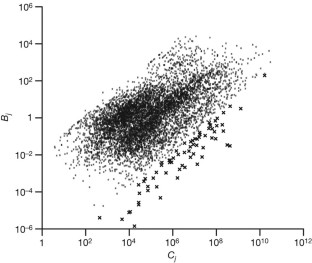
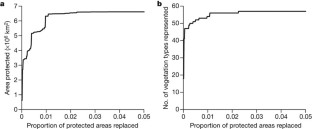
Protected areas vary enormously in their contribution to conserving biodiversity, and the inefficiency of protected area systems is widely acknowledged1,2,3. However, conservation plans focus overwhelmingly on adding new sites to current protected area estates4. Here we show that the conservation performance of a protected area system can be radically improved, without extra expenditure, by replacing a small number of protected areas with new ones that achieve more for conservation. Replacing the least cost-effective 1% of Australia’s 6,990 strictly protected areas could increase the number of vegetation types that have 15% or more of their original extent protected from 18 to 54, of a maximum possible of 58. Moreover, it increases markedly the area that can be protected, with no increase in overall spending. This new paradigm for protected area system expansion could yield huge improvements to global conservation at a time when competition for land is increasingly intense.
This is a preview of subscription content, access via your institution
Access options
Subscribe to this journal
Receive 51 print issues and online access
$199.00 per year
only $3.90 per issue
Buy this article
- Purchase on SpringerLink
- Instant access to the full article PDF.
USD 39.95
Prices may be subject to local taxes which are calculated during checkout
Additional access options:
Figure 1: Cost effectiveness in Australia’s protected areas.
The alternative text for this image may have been generated using AI.
Figure 2: Conservation outcomes delivered by protected area replacement.
The alternative text for this image may have been generated using AI.
References
- Rodrigues, A. S. L. et al. Effectiveness of the global protected area network in representing species diversity. Nature 428, 640–643 (2004)
Article CAS ADS Google Scholar - Wiersma, Y. F. & Nudds, T. D. Efficiency and effectiveness in representative reserve design in Canada: the contribution of existing protected areas. Biol. Conserv. 142, 1639–1646 (2009)
Article Google Scholar - Ceballos, G. Conservation priorities for mammals in megadiverse Mexico: the efficiency of reserve networks. Ecol. Appl. 17, 569–578 (2007)
Article Google Scholar - Scott, J. M. et al. Gap analysis: a geographic approach to protection of biological diversity. Wildl. Monogr. 123, 1–41 (1993)
Google Scholar - World Database on Protected Areas. 〈http://www.wdpa.org/〉 (2009)
- Ando, A., Camm, J., Polasky, S. & Solow, A. Species distributions, land values, and efficient conservation. Science 279, 2126–2128 (1998)
Article CAS ADS Google Scholar - Mora, C. et al. Coral reefs and the global network of marine protected areas. Science 312, 1750–1751 (2006)
Article CAS Google Scholar - Jaffre, T., Bouchet, P. & Veillon, J.-M. Threatened plants of New Caledonia: is the system of protected areas adequate? Biodivers. Conserv. 7, 109–135 (1998)
Article Google Scholar - Rodrigues, A. S. L. et al. Global gap analysis: priority regions for expanding the global protected-area network. Bioscience 54, 1092–1100 (2004)
Article Google Scholar - Carwardine, J. et al. Cost-effective priorities for global mammal conservation. Proc. Natl Acad. Sci. USA 105, 11446–11450 (2008)
Article CAS ADS Google Scholar - Underwood, E. C. et al. Expanding the global network of protected areas to save the imperiled Mediterranean biome. Conserv. Biol. 23, 43–52 (2009)
Article Google Scholar - Naidoo, R. et al. Integrating economic costs into conservation planning. Trends Ecol. Evol. 21, 681–687 (2006)
Article Google Scholar - Strange, N., Thorsen, B. J. & Bladt, J. Optimal reserve selection in a dynamic world. Biol. Conserv. 131, 33–41 (2006)
Article Google Scholar - Department of the Environment, Water, Heritage and the Arts; Australian Government. Australia’s Strategy for the National Reserve System 2009–2030 〈http://www.environment.gov.au/parks/publications/nrs/nrsstrat.html〉 (2009)
- Department of the Environment, Water, Heritage and the Arts; Australian Government. Collaborative Australia Protected Area Database 〈http://www.environment.gov.au/parks/nrs/science/capad/2006/index.html〉 (2009)
- Stein, J. in Linking Rivers to Landscapes (eds Rutherford, I., Wiszniewski, I., Askey-Doran, M. & Glazik, R.) 448–552 (Department of Primary Industries, Water and Environment, 2005)
Google Scholar - Roberts, C. M., Bohnsack, J. A., Gell, F., Hawkins, J. P. & Goodridge, R. Effects of marine reserves on adjacent fisheries. Science 294, 1920–1923 (2001)
Article CAS ADS Google Scholar - Vane-Wright, R. I., Humphries, C. J. & Williams, P. H. What to protect?—Systematics and the agony of choice. Biol. Conserv. 55, 235–254 (1991)
Article Google Scholar - Meir, E., Andelman, S. & Possingham, H. P. Does conservation planning matter in a dynamic and uncertain world? Ecol. Lett. 7, 615–622 (2004)
Article Google Scholar - Vandergeest, P. Property rights in protected areas: obstacles to community involvement as a solution in Thailand. Environ. Conserv. 23, 259–268 (1996)
Article Google Scholar - Dearden, P., Chettamart, S. & Emphandu, D. Protected areas and property rights in Thailand. Environ. Conserv. 25, 195–197 (1998)
Article Google Scholar - Vandergeest, P. Reply: Protected areas and property rights in Thailand. Environ. Conserv. 26, 7–9 (1999)
Article Google Scholar - Hardin, G. The tragedy of the commons. Science 162, 1243–1248 (1968)
Article CAS ADS Google Scholar - Veit, P. G., Nshala, R., Ochieng' Odhiambo, M. & Manyindo, J. Protected Areas and Property Rights: Democratizing Eminent Domain in East Africa (World Resources Institute, 2008)
Google Scholar - Child, K. Civil society in Uganda: the struggle to save the Mabira Forest Reserve. J. East. Afr. Stud. 3, 240–258 (2009)
Article Google Scholar - Sussman, R. W., Green, G. M. & Sussman, L. K. Satellite imagery, human ecology, anthropology, and deforestation in Madagascar. Hum. Ecol. 22, 333–354 (1994)
Article Google Scholar - Norton-Griffiths, M. & Southey, C. The opportunity costs of biodiversity conservation in Kenya. Ecol. Econ. 12, 125–139 (1995)
Article Google Scholar - Emerton, L., Bishop, J. & Thomas, L. Sustainable Financing of Protected Areas: A Global Review of Challenges and Options (IUCN, 2006)
Book Google Scholar
Acknowledgements
We thank J. Stein for providing subcatchment data, and L. Barr, C. Fuller, B. Kendall, T. Martin and H. Wilson for discussion. This work was funded by the Centre for Applied Environmental Decision Analysis, an Australian Commonwealth Environment Research Facility.
Author information
Authors and Affiliations
- The Ecology Centre, University of Queensland, St Lucia, Queensland 4072, Australia,
Richard A. Fuller, Eve McDonald-Madden, Kerrie A. Wilson, Josie Carwardine, Hedley S. Grantham, James E. M. Watson, Carissa J. Klein & Hugh P. Possingham - CSIRO Climate Adaptation Flagship and CSIRO Sustainable Ecosystems, St Lucia, Queensland 4072, Australia,
Richard A. Fuller, Eve McDonald-Madden & Josie Carwardine - Information Technology Services, University of Queensland, St Lucia, Queensland 4072, Australia,
David C. Green
Authors
- Richard A. Fuller
- Eve McDonald-Madden
- Kerrie A. Wilson
- Josie Carwardine
- Hedley S. Grantham
- James E. M. Watson
- Carissa J. Klein
- David C. Green
- Hugh P. Possingham
Contributions
All authors designed the research. E.M.-M., D.C.G. and R.A.F. performed the analysis, and R.A.F. wrote the manuscript. All authors discussed the results and commented on the manuscript.
Corresponding author
Correspondence toRichard A. Fuller.
Ethics declarations
Competing interests
The authors declare no competing financial interests.
Supplementary information
PowerPoint slides
Rights and permissions
About this article
Cite this article
Fuller, R., McDonald-Madden, E., Wilson, K. et al. Replacing underperforming protected areas achieves better conservation outcomes.Nature 466, 365–367 (2010). https://doi.org/10.1038/nature09180
- Received: 17 February 2010
- Accepted: 18 May 2010
- Published: 30 June 2010
- Issue date: 15 July 2010
- DOI: https://doi.org/10.1038/nature09180
This article is cited by
Comments
Commenting on this article is now closed.
- Dan Faith 9 July 2010, 00:28
False economy?
We applaud the fact that Fuller et al. address the issue of inefficiency of existing protected areas (PA) networks, suggesting that protected areas expansion could do well if it moved away from considering existing PAs as fixed. In our own conservation planning work in Papua New Guinea (Faith et al., 2001; Pacific Conservation Biology) we found that, when we did not regard existing PAs as fixed, we could achieve our biodiversity representation goals at nearly 25% less cost.
But we anticipate problems in selling the idea of de-gazetting PAs to achieve supposed greater efficiency. We all would probably agree that, unless all the relevant costs and constraints are on the table, these ?efficiency? analyses are largely academic exercises. That is a concern particularly with regard to measures of biodiversity (as in our PNG study). Fuller et al. use percent targets, which have some well-known weaknesses (most recently highlighted at a ?pre-COP meeting? :http://www.biodic.go.jp/gbm... ). Without good information on biodiversity, these approaches can only efficiently pursue an inefficient solution. Surely, this provides no strong case for de-gazetting.
But even if we had a good list of all species and good cost estimates, Fuller et al?s proposed method does _not _ provide a strong case for de-gazetting, because it is not an effective way to achieve efficiency. Their suggested ?radical approach? is to ?reverse the protection status of the least cost-effective sites?, and use that capital for new PAs. But that approach does not in general identify the set for de-gazetting that would result in greatest efficiency. The best set of PAs to remove depends on what is available for selection as new PA s. They ignore this.
Suppose we have the following 5 existing protected areas (perhaps part of a larger set), with species designated by letters, followed by cost of the area. Species a ? f are unique to these listed PAs.
1.	[ab] 10
2.	[cd] 10
3.	[ef] 10
4.	[lmno] 15
5.	[pqrs] 15
Outside the PAs, 7 species, t ? z, are not represented in any PAs, but are available in one or more other areas, for a total cost of 30 units. Many copies of species l ? s are available in these same areas. De-gazetting ?the least cost-effective sites´ implies removal of areas 1, 2, and 3. Each has a complementary benefit of 2 species and cost of 10 units. Spending the released capital of 30 units on new areas then picks up 7 new species, t ? z, for a total biodiversity score in the new PA set of 15 (species l ? z).
The alternative approach (in the planning tools used in PNG and elsewhere) would recognise areas 4 and 5 as the best to remove, so that spending the same 30 units now means that new areas can pick up 7 new species, t ? z, and replace l ? s cheaply. Plus, we have retained species a ? f, for a total of 21 (species a ? f; l ? z). Efficiency is greater.
The Fig 7a example in ?Faith (1995) Biodiversity and Regional Sustainability Analysis? :http://australianmuseum.net... illustrates this kind of problem, in a trade-offs space. A set of protected areas (hollow square) allocated without looking at what might be added to that protected set constrains all possible additions to the set to result in solutions falling along a curve with relatively poor efficiency.
Fuller et al.'s proposed strategy to ?reverse the protection status of the least cost-effective sites? perhaps could be modified to ?reverse the protection status of that set of sites that best takes advantage of properties of available new PAs ?. But, even with that improvement, de-gazetting will be a hard sell, given all the other factors that inevitably do not make it into these supposed ?efficiency? calculations.
Dan Faith, the Australian Museum
Kristen Williams, CSIRO
2. Wayne Thogmartin 14 July 2010, 17:11
This idea of 'degazetting' conserved areas in exchange for areas of greater biotic 'worth' is interesting. A concern I have is the means for determining worth. The authors have examined the current value of locations and posited an exchange, but in doing so devalue future worth from those relinquished sites. It may be prudent to include in our calculations potential future value of conserved lands in the face of a changing climate. If we are to build networks of conserved lands allowing adaptation to changing climate, currently undervalued lands may play a more prominent role in the future.
Editorial Summary
Conservation: where to save
Suggestions that poorly performing conservation areas should lose their protected status, and the money saved used to better effect elsewhere, tend not to go down well with conservationists or local lobby groups. But according to a study of the performance of the nearly 7,000 protected areas in Australia, that may well be the best policy in the long run. The sale of about 70 delisted sites, those yielding the lowest conservation value per assessed land value, could raise about Aus$21 billion (US$17.7 billion). If that money were then reinvested in sites where biodiversity conservation strategies are more likely to prosper, it should be possible to achieve a greater degree of conservation for the same expenditure. And with the rate of new investment in protected areas continuing to decline worldwide, the authors suggest, it is more important than ever that the most valuable and productive sites are retained in the face of rampant land clearances.