The evolution of the marine phosphate reservoir (original) (raw)
- Letter
- Published: 27 October 2010
- Olivier J. Rouxel2,3,
- Andrey Bekker4,
- Stefan V. Lalonde5,
- Kurt O. Konhauser5,
- Christopher T. Reinhard1 &
- …
- Timothy W. Lyons1
Nature volume 467, pages 1088–1090 (2010) Cite this article
- 9206 Accesses
- 471 Citations
- 81 Altmetric
- Metrics details
Subjects
Abstract
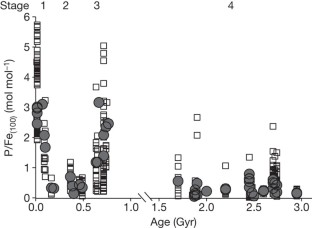
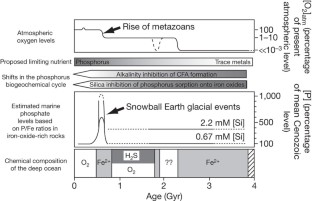
Phosphorus is a biolimiting nutrient that has an important role in regulating the burial of organic matter and the redox state of the ocean–atmosphere system1. The ratio of phosphorus to iron in iron-oxide-rich sedimentary rocks can be used to track dissolved phosphate concentrations if the dissolved silica concentration of sea water is estimated2,3,4,5. Here we present iron and phosphorus concentration ratios from distal hydrothermal sediments and iron formations through time to study the evolution of the marine phosphate reservoir. The data suggest that phosphate concentrations have been relatively constant over the Phanerozoic eon, the past 542 million years (Myr) of Earth’s history. In contrast, phosphate concentrations seem to have been elevated in Precambrian oceans. Specifically, there is a peak in phosphorus-to-iron ratios in Neoproterozoic iron formations dating from ∼750 to ∼635 Myr ago, indicating unusually high dissolved phosphate concentrations in the aftermath of widespread, low-latitude ‘snowball Earth’ glaciations. An enhanced postglacial phosphate flux would have caused high rates of primary productivity and organic carbon burial and a transition to more oxidizing conditions in the ocean and atmosphere. The snowball Earth glaciations and Neoproterozoic oxidation are both suggested as triggers for the evolution and radiation of metazoans6,7. We propose that these two factors are intimately linked; a glacially induced nutrient surplus could have led to an increase in atmospheric oxygen, paving the way for the rise of metazoan life.
This is a preview of subscription content, access via your institution
Access options
Subscribe to this journal
Receive 52 print issues and online access
$199.00 per year
only $3.83 per issue
Buy this article
- Purchase on SpringerLink
- Instant access to the full article PDF.
USD 39.95
Prices may be subject to local taxes which are calculated during checkout
Additional access options:
Figure 1: P/Fe molar ratios through time in iron-oxide-rich distal hydrothermal sediments and iron formations with low amounts of siliciclastic input.
The alternative text for this image may have been generated using AI.
Figure 2: Model for the coevolution of atmospheric and oceanic redox state and limiting nutrients for marine primary productivity.
The alternative text for this image may have been generated using AI.
References
- Holland, H. D. The Chemical Evolution of the Atmosphere and Oceans 598 (Princeton Univ. Press, 1984)
Google Scholar - Bjerrum, C. J. & Canfield, D. E. Ocean productivity before about 1.9 Gyr ago limited by phosphorus adsorption onto iron oxides. Nature 417, 159–162 (2002)
Article ADS CAS Google Scholar - Edmonds, H. N. & German, C. R. Particle geochemistry in the Rainbow hydrothermal plume, Mid-Atlantic Ridge. Geochim. Cosmochim. Acta 68, 759–772 (2004)
Article ADS CAS Google Scholar - Feely, R. A., Trefry, J. H., Lebon, G. T. & German, C. R. The relationship between P/Fe and V/Fe ratios in hydrothermal precipitates and dissolved phosphate in seawater. Geophys. Res. Lett. 25, 2253–2256 (1998)
Article ADS CAS Google Scholar - Poulton, S. W. & Canfield, D. E. Co-diagenesis of iron and phosphorus in hydrothermal sediments from the southern East Pacific Rise: implications for the evaluation of paleoseawater phosphate concentrations. Geochim. Cosmochim. Acta 70, 5883–5898 (2006)
Article ADS CAS Google Scholar - Hoffman, P. F. & Schrag, D. P. The snowball Earth hypothesis: testing the limits of global change. Terra Nova 14, 129–155 (2002)
Article ADS CAS Google Scholar - Knoll, A. H. & Carroll, S. B. Early animal evolution: emerging views from comparative biology and geology. Science 284, 2129–2137 (1999)
Article CAS Google Scholar - Howarth, R. W. Nutrient limitation of net primary production in marine ecosystems. Annu. Rev. Ecol. Syst. 19, 89–110 (1988)
Article Google Scholar - Tyrrell, T. The relative influences of nitrogen and phosphorus on oceanic primary production. Nature 400, 525–531 (1999)
Article ADS CAS Google Scholar - Holland, H. D. The oxygenation of the atmosphere and oceans. Phil. Trans. R. Soc. B 361, 903–915 (2006)
Article CAS Google Scholar - Konhauser, K. O., Lalonde, S. V., Amskold, L. & Holland, H. D. Was there really an Archean phosphate crisis? Science 315, 1234 (2007)
Article ADS CAS Google Scholar - Konhauser, K. O. et al. Oceanic nickel depletion and a methanogen famine before the Great Oxidation Event. Nature 458, 750–753 (2009)
Article ADS CAS Google Scholar - Racki, G. & Cordey, F. Radiolarian palaeoecology and radiolarites: is the present the key to the past? Earth Sci. Rev. 52, 83–120 (2000)
Article ADS CAS Google Scholar - Siever, R. The silica cycle in the Precambrian. Geochim. Cosmochim. Acta 56, 3265–3272 (1992)
Article ADS CAS Google Scholar - Arvidson, R. S., Mackenzie, F. T. & Guidry, M. W. MAGic: a Phanerozoic model for the geochemical cycling of major rock-forming components. Am. J. Sci. 306, 135–190 (2006)
Article ADS CAS Google Scholar - Maliva, R. G., Knoll, A. H. & Simonson, B. M. Secular change in the Precambrian silica cycle: insights from chert petrology. Geol. Soc. Am. Bull. 117, 835–845 (2005)
Article ADS Google Scholar - Wheat, C. G., Feely, R. A. & Mottl, M. J. Phosphate removal by oceanic hydrothermal processes: an update of the phosphorus budget in the oceans. Geochim. Cosmochim. Acta 60, 3593–3608 (1996)
Article ADS CAS Google Scholar - Canfield, D. E. et al. Ferruginous conditions dominated later Neoproterozoic deep-water chemistry. Science 321, 949–952 (2008)
Article ADS CAS Google Scholar - Ruttenberg, K. C. & Berner, R. A. Authigenic apatite formation and burial in sediments from non-upwelling, continental-margin environments. Geochim. Cosmochim. Acta 57, 991–1007 (1993)
Article ADS CAS Google Scholar - Jahnke, R. A. The synthesis and solubility of carbonate fluorapatite. Am. J. Sci. 284, 58–78 (1984)
Article ADS CAS Google Scholar - Ridgwell, A. & Zeebe, R. E. The role of the global carbonate cycle in the regulation and evolution of the Earth system. Earth Planet. Sci. Lett. 234, 299–315 (2005)
Article ADS CAS Google Scholar - Föllmi, K. B., Hosein, R., Arn, K. & Steinmann, P. Weathering and the mobility of phosphorus in the catchments and forefields of the Rhône and Oberaar glaciers, central Switzerland: implications for the global phosphorus cycle on glacial–interglacial timescales. Geochim. Cosmochim. Acta 73, 2252–2282 (2009)
Article ADS Google Scholar - Scott, C. et al. Tracing the stepwise oxygenation of the Proterozoic ocean. Nature 452, 457–460 (2008)
ADS Google Scholar - Martin, J. Glacial-interglacial CO2 change: the iron hypothesis. Paleoceanography 5, 1–13 (1990)
Article ADS Google Scholar - Wu, J. F., Sunda, W., Boyle, E. A. & Karl, D. M. Phosphate depletion in the western North Atlantic Ocean. Science 289, 759–762 (2000)
Article ADS CAS Google Scholar - Halverson, G. P., Hoffman, P. F., Schrag, D. P., Maloof, A. C. & Rice, H. N. Toward a Neoproterozoic composite carbon-isotope record. Geol. Soc. Am. Bull. 117, 1181–1207 (2005)
Article ADS Google Scholar - Jiang, G., Kennedy, M. J. & Christie-Blick, N. Stable isotope evidence for methane seeps in Neoproterozoic postglacial cap carbonates. Nature 426, 822–826 (2003)
Article ADS CAS Google Scholar - Cohen, P. A., Knoll, A. H. & Kodner, R. B. Large spinose microfossils in Ediacaran rocks as resting stages of early animals. Proc. Natl Acad. Sci. USA 106, 6519–6524 (2009)
Article ADS CAS Google Scholar - Love, G. D. et al. Fossil steroids record the appearance of Demospongiae during the Cryogenian period. Nature 457, 718–721 (2008)
Article ADS Google Scholar - Canfield, D. E. The early history of atmospheric oxygen: homage to Robert A. Garrels. Annu. Rev. Earth Planet. Sci. 33, 1–36 (2005)
Article ADS CAS Google Scholar
Acknowledgements
This work was supported by funding from the NSF-GSF program and the NASA Astrobiology Institute, to N.J.P.; from the NASA Exobiology Program and the NSF-EAR, to T.W.L.; from NSERC, to A.B., K.O.K. and S.V.L.; from NSF-OCE grants to O.J.R.; and from the NSF and the NASA Astrobiology Institute, to A.B.
Author information
Authors and Affiliations
- Department of Earth Sciences, University of California, Riverside, 92521, California, USA
Noah J. Planavsky, Christopher T. Reinhard & Timothy W. Lyons - Department of Marine Chemistry and Geochemistry, Woods Hole Oceanographic Institute, Woods Hole, 02543, Massachusetts, USA
Noah J. Planavsky & Olivier J. Rouxel - Université Européene de Bretagne, European Institute for Marine Studies, Technopôle Brest-Iroise, Place Nicolas Copernic, 29280 Plouzané, France,
Olivier J. Rouxel - Department of Geological Sciences, University of Manitoba, Winnipeg, Manitoba R3T 2N2, Canada,
Andrey Bekker - Department of Earth and Atmospheric Sciences, University of Alberta, Edmonton, Alberta T6G 2E3, Canada,
Stefan V. Lalonde & Kurt O. Konhauser
Authors
- Noah J. Planavsky
- Olivier J. Rouxel
- Andrey Bekker
- Stefan V. Lalonde
- Kurt O. Konhauser
- Christopher T. Reinhard
- Timothy W. Lyons
Contributions
All authors were involved in the writing and design of this study. A.B. and N.J.P. collected samples for this study, and N.J.P. and O.J.R. analysed them. N.J.P. and S.L. compiled literature data.
Corresponding author
Correspondence toTimothy W. Lyons.
Ethics declarations
Competing interests
The authors declare no competing financial interests.
Supplementary information
Supplementary Information (download PDF )
This file contains Supplementary Text comprising Sample Information and Methods and additional references. The file also includes Supplementary Figures 1-2 with legends and Supplementary Tables 1-2 with their appropriate references. (PDF 1756 kb)
PowerPoint slides
Rights and permissions
About this article
Cite this article
Planavsky, N., Rouxel, O., Bekker, A. et al. The evolution of the marine phosphate reservoir.Nature 467, 1088–1090 (2010). https://doi.org/10.1038/nature09485
- Received: 19 November 2009
- Accepted: 02 September 2010
- Published: 27 October 2010
- Issue date: 28 October 2010
- DOI: https://doi.org/10.1038/nature09485
This article is cited by
Editorial Summary
Geological history of marine phosphate
Phosphorus is generally thought to be a limiting nutrient of primary productivity in the oceans, and is important in regulating the redox state of the ocean–atmosphere system. Planavsky et al. use the ratio of phosphorus to iron in iron-oxide-rich sedimentary rocks through time to evaluate the evolution of the marine phosphate reservoir. They find relatively constant phosphate concentrations during the past 542 million years of Earth's history. The data are also indicative of high dissolved phosphate concentrations in the aftermath of the 'snowball Earth' glaciations around 700 million years ago, which could have led to high rates of primary productivity, organic carbon burial and an increase in atmospheric oxygen levels, paving the way for the rise of metazoan life.