Consequences of climate change on the tree of life in Europe (original) (raw)
- Letter
- Published: 16 February 2011
- Sébastien Lavergne1,
- Cristina Roquet1,
- Isabelle Boulangeat1,
- Bruno Lafourcade1 &
- …
- Miguel. B. Araujo2,3
Nature volume 470, pages 531–534 (2011) Cite this article
- 8921 Accesses
- 524 Citations
- 13 Altmetric
- Metrics details
Abstract
Many species are projected to become vulnerable to twenty-first-century climate changes1,2, with consequent effects on the tree of life. If losses were not randomly distributed across the tree of life, climate change could lead to a disproportionate loss of evolutionary history3,4,5. Here we estimate the consequences of climate change on the phylogenetic diversities of plant, bird and mammal assemblages across Europe. Using a consensus across ensembles of forecasts for 2020, 2050 and 2080 and high-resolution phylogenetic trees, we show that species vulnerability to climate change clusters weakly across phylogenies. Such phylogenetic signal in species vulnerabilities does not lead to higher loss of evolutionary history than expected with a model of random extinctions. This is because vulnerable species have neither fewer nor closer relatives than the remaining clades. Reductions in phylogenetic diversity will be greater in southern Europe, and gains are expected in regions of high latitude or altitude. However, losses will not be offset by gains and the tree of life faces a trend towards homogenization across the continent.
This is a preview of subscription content, access via your institution
Access options
Subscribe to this journal
Receive 52 print issues and online access
$199.00 per year
only $3.83 per issue
Buy this article
- Purchase on SpringerLink
- Instant access to the full article PDF.
USD 39.95
Prices may be subject to local taxes which are calculated during checkout
Additional access options:
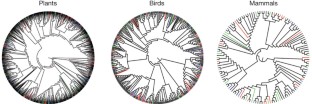
Figure 1: Changes in suitable climate (A1FI scenario for 2080) mapped onto the phylogeny of European plants, birds and mammals.
The alternative text for this image may have been generated using AI.
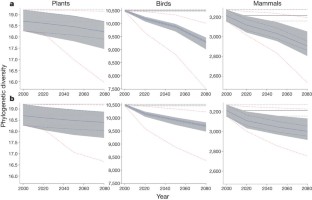
Figure 2: Changes in phylogenetic diversity versus scenarios of random extinction for plants, birds and mammals.
The alternative text for this image may have been generated using AI.
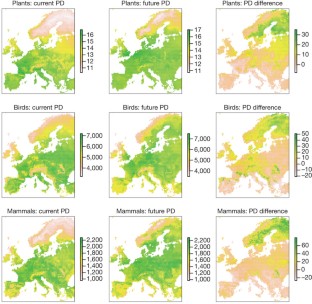
Figure 3: Map of current and future phylogenetic diversities (A1FI scenario for 2080) and their relative differences for the three species groups.
The alternative text for this image may have been generated using AI.
References
- Thomas, C. D. et al. Extinction risk from climate change. Nature 427, 145–148 (2004)
Article CAS ADS Google Scholar - Thuiller, W., Lavorel, S., Araújo, M. B., Sykes, M. T. & Prentice, I. C. Climate change threats to plant diversity in Europe. Proc. Natl Acad. Sci. USA 102, 8245–8250 (2005)
Article CAS ADS Google Scholar - Mace, G. M., Gittleman, J. L. & Purvis, A. Preserving the tree of life. Science 300, 1707–1709 (2003)
Article CAS ADS Google Scholar - Nee, S. & May, R. M. Extinction and the loss of evolutionary history. Science 288, 328–330 (1997)
Google Scholar - Heard, S. B. & Mooers, A. O. Phylogenetically patterned speciation rates and extinction risks change the loss of evolutionary history during extinctions. Proc. R. Soc. Lond. B 267, 613–620 (2000)
Article CAS Google Scholar - Parmesan, C. Ecological and evolutionary responses to recent climate change. Annu. Rev. Ecol. Evol. Syst. 37, 637–669 (2006)
Article Google Scholar - Meyers, L. A. & Bull, J. J. Fighting change with change: adaptive variation in an uncertain world. Trends Ecol. Evol. 17, 551–557 (2002)
Article Google Scholar - Thuiller, W. Climate change and the ecologist. Nature 448, 550–552 (2007)
Article CAS ADS Google Scholar - Purvis, A. Phylogenetic approaches to the study of extinction. Annu. Rev. Ecol. Evol. Syst. 39, 301–319 (2008)
Article Google Scholar - Thuiller, W., Lavorel, S. & Araújo, M. B. Niche properties and geographical extent as predictors of species sensitivity to climate change. Glob. Ecol. Biogeogr. 14, 347–357 (2005)
Article Google Scholar - Prinzing, A., Durka, W., Klotz, S. & Brandl, R. The niche of higher plants: evidence for phylogenetic conservatism. Proc. R. Soc. Lond. B 268, 2383–2389 (2001)
Article CAS Google Scholar - McKinney, M. L. Extinction vulnerability and selectivity: combining ecological and paleontological views. Annu. Rev. Ecol. Evol. Syst. 28, 495–516 (1997)
Article Google Scholar - Lande, R. Statistics and partitioning of species diversity, and similarity among multiple communities. Oikos 76, 5–13 (1996)
Article Google Scholar - Chown, S. L. & Gaston, K. J. Areas, cradles and museums: the latitudinal gradient in species richness. Trends Ecol. Evol. 15, 311–315 (2000)
Article CAS Google Scholar - Mitchell, T. D. & Jones, P. D. An improved method of constructing a database of monthly climate observations and associated high-resolution grids. Int. J. Climatol. 25, 693–712 (2005)
Article Google Scholar - Baillie, J. E. M., Hilton-Taylor, C., Stuart, S. N., eds. 2004 IUCN Red List of Threatened Species. A Global Species Assessment (International Union for Conservation of Nature, 2004)
Google Scholar - Bambach, R. K. Phanerozoic biodiversity mass extinctions. Annu. Rev. Earth Planet. Sci. 34, 127–155 (2006)
Article CAS ADS Google Scholar - Koch, P. L. & Barnosky, A. D. Late Quaternary extinctions: state of the debate. Annu. Rev. Ecol. Evol. Syst. 37, 215–250 (2006)
Article Google Scholar - Thuiller, W., Lafourcade, B., Engler, R. & Araujo, M. B. BIOMOD – a platform for ensemble forecasting of species distributions. Ecography 32, 369–373 (2009)
Article Google Scholar - Nakicenovic, N. & Swart, R. Emissions Scenarios: A Special Report of Working Group III of the Intergovernmental Panel on Climate Change 570 (Cambridge Univ. Press, 2000)
Google Scholar - Marmion, M., Parviainen, M., Luoto, M., Heikkinen, R. K. & Thuiller, W. Evaluation of consensus methods in predictive species distribution modelling. Divers. Distrib. 15, 59–69 (2009)
Article Google Scholar - Smith, S. A., Beaulieu, J. M. & Donoghue, M. J. Mega-phylogeny approach for comparative biology: an alternative to supertree and supermatrix approaches. BMC Evol. Biol. 9, 37–48 (2009)
Article Google Scholar - Fritz, S. A., Bininda-Emonds, O. R. P. & Purvis, A. Geographical variation in predictors of mammalian extinction risk: big is bad, but only in the tropics. Ecol. Lett. 12, 538–549 (2009)
Article Google Scholar - Pavoine, S., Ollier, S., Pontier, D. & Chessel, D. Testing for phylogenetic signal in phenotypic traits: new matrices of phylogenetic proximities. Theor. Popul. Biol. 73, 79–91 (2008)
Article Google Scholar - Blomberg, S. P., Garland, T. & Ives, A. R. Testing for phylogenetic signal in comparative data: behavioral traits are more labile. Evolution 57, 717–745 (2003)
Article Google Scholar - Pagel, M. Inferring the historical patterns of biological evolution. Nature 401, 877–884 (1999)
Article CAS ADS Google Scholar - Witting, L. & Loeschke, V. The optimization of biodiversity conservation. Biol. Conserv. 71, 205–207 (1995)
Article Google Scholar
Acknowledgements
This research was funded by the EU ECOCHANGE (GOCE-CT-2007-036866) and DIVERSITALP (ANR-2007-BDIV-014) projects. C.R. was supported by a grant from Fundación Ramón Areces. We thank P. Pearman and A. Mooers for comments on earlier drafts. Computations were performed using the CIMENT infrastructure (https://ciment.ujf-grenoble.fr), supported by the Rhône-Alpes region (GRANT CPER07-13 CIRA).
Author information
Authors and Affiliations
- Laboratoire d’Ecologie Alpine, UMR CNRS 5553, Université Joseph Fourier, BP 53, FR-38041 Grenoble Cedex 9, France,
Wilfried Thuiller, Sébastien Lavergne, Cristina Roquet, Isabelle Boulangeat & Bruno Lafourcade - Department of Biodiversity and Evolutionary Biology, National Museum of Natural Sciences, CSIC, Calle Gutierrez Abascal, 2, 28006, Madrid, Spain,
Miguel. B. Araujo - Rui Nabeiro Biodiversity Chair, CIBIO, University of Évora, Largo dos Colegiais, 7000 Évora, Portugal,
Miguel. B. Araujo
Authors
- Wilfried Thuiller
- Sébastien Lavergne
- Cristina Roquet
- Isabelle Boulangeat
- Bruno Lafourcade
- Miguel. B. Araujo
Contributions
W.T. and S.L. designed the study, C.R. built the plant and bird phylogenies, I.B. and B.L. helped with R code writing, and W.T. performed all the analyses. W.T., S.L. and M.B.A. wrote the manuscript with substantial contributions from all authors.
Corresponding author
Correspondence toWilfried Thuiller.
Ethics declarations
Competing interests
The authors declare no competing financial interests.
Supplementary information
Supplementary Information (download PDF )
The file contains Supplementary Figures 1-8 with legends, Supplementary References, Supplementary Table 1 and a Supplementary Methods section containing additional figures, tables and references. (PDF 1386 kb)
PowerPoint slides
Rights and permissions
About this article
Cite this article
Thuiller, W., Lavergne, S., Roquet, C. et al. Consequences of climate change on the tree of life in Europe.Nature 470, 531–534 (2011). https://doi.org/10.1038/nature09705
- Received: 07 June 2010
- Accepted: 29 November 2010
- Published: 16 February 2011
- Issue date: 24 February 2011
- DOI: https://doi.org/10.1038/nature09705
This article is cited by
Editorial Summary
European movements
Extinction episodes, such as the anthropogenic one widely thought to be under way right now, result in a pruned tree of life. The possibility that further non-random extinctions across the tree of life could arise as a consequence of climate change has been investigated quantitatively using a series of projections of the phylogenetic diversity of European plants, birds and mammals. The overall effect is a thinning of the tree, with little loss of diversity. However, there are differences in the responses of northern and southern European species. For instance, France and Spain are more exposed to losses of phylogenetic diversity than high-latitude and high-altitude regions, where phylogenetic diversity is projected to increase.