Species–area relationships always overestimate extinction rates from habitat loss (original) (raw)
- Letter
- Published: 18 May 2011
Nature volume 473, pages 368–371 (2011) Cite this article
- 17k Accesses
- 423 Citations
- 128 Altmetric
- Metrics details
Subjects
Abstract
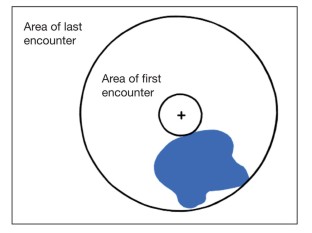
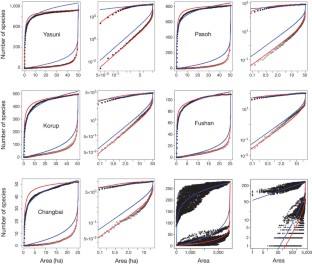
Extinction from habitat loss is the signature conservation problem of the twenty-first century1. Despite its importance, estimating extinction rates is still highly uncertain because no proven direct methods or reliable data exist for verifying extinctions. The most widely used indirect method is to estimate extinction rates by reversing the species–area accumulation curve, extrapolating backwards to smaller areas to calculate expected species loss. Estimates of extinction rates based on this method are almost always much higher than those actually observed2,3,4,5. This discrepancy gave rise to the concept of an ‘extinction debt’, referring to species ‘committed to extinction’ owing to habitat loss and reduced population size but not yet extinct during a non-equilibrium period6,7. Here we show that the extinction debt as currently defined is largely a sampling artefact due to an unrecognized difference between the underlying sampling problems when constructing a species–area relationship (SAR) and when extrapolating species extinction from habitat loss. The key mathematical result is that the area required to remove the last individual of a species (extinction) is larger, almost always much larger, than the sample area needed to encounter the first individual of a species, irrespective of species distribution and spatial scale. We illustrate these results with data from a global network of large, mapped forest plots and ranges of passerine bird species in the continental USA; and we show that overestimation can be greater than 160%. Although we conclude that extinctions caused by habitat loss require greater loss of habitat than previously thought, our results must not lead to complacency about extinction due to habitat loss, which is a real and growing threat.
This is a preview of subscription content, access via your institution
Access options
Subscribe to this journal
Receive 52 print issues and online access
$199.00 per year
only $3.83 per issue
Buy this article
- Purchase on SpringerLink
- Instant access to the full article PDF.
USD 39.95
Prices may be subject to local taxes which are calculated during checkout
Additional access options:
Figure 1: Sampling differences for SAR and EAR.
The alternative text for this image may have been generated using AI.
Figure 2: Species– and endemics–area curves for six of the nine data sets in Table 1 .
The alternative text for this image may have been generated using AI.
References
- Millennium Ecosystem Assessment. Ecosystems and Human Well-Being: Biodiversity Synthesis (World Resources Institute, 2005)
- Simberloff, D. in Tropical Deforestation and Species Extinction (eds Whitmore, T. C. & Sayer, J. A. ) 75–89 (Chapman & Hall, 1992)
Google Scholar - May, R. M., Lawton, J. H. & Stork, N. E. in Extinction Rates (eds Lawton, J. H. & May, R. M. ) 1–24 (Oxford Univ. Press, 1995)
Google Scholar - Pimm, S. L. & Askins, R. A. Forest losses predict bird extinctions in eastern North America. Proc. Natl Acad. Sci. USA 92, 9343–9347 (1995)
Article ADS CAS Google Scholar - Rosenzweig, M. L. Species Diversity in Space and Time (Cambridge Univ. Press, 1995)
Book Google Scholar - Tilman, D., May, R. M., Lehman, C. L. & Nowak, M. A. Habitat destruction and the extinction debt. Nature 371, 365–366 (1994)
Google Scholar - Pimm, S. L., Russell, G. J., Gittleman, J. L. & Brooks, T. M. The future of biodiversity. Science 269, 347–350 (1995)
Article ADS CAS Google Scholar - Myers, N. The Sinking Ark: A New Look at the Problem of Disappearing Species (Pergamon, 1979)
Google Scholar - Lovejoy, T. E. in The Global 2000 Report to the President: Entering the Twenty-First Century (study director Barney, G. O.) 328–331 (Council on Environmental Quality, U.S. Government Printing Office, 1980)
Google Scholar - National Research Council. Research Priorities in Tropical Biology (National Academy of Sciences, 1980)
- Ehrlich, P. R. & Ehrlich, A. H. Extinction: The Causes and Consequences of the Disappearance of Species (Random House, 1981)
MATH Google Scholar - Myers, N. in Tropical Rain Forest Ecosystems, Structure and Function (ed. Golley, F. B. ) 325–334 (Elsevier, 1983)
Google Scholar - Lugo, A. E. in Biodiversity (ed. Wilson, E. O. ) 58–70 (National Academy Press, 1988)
Google Scholar - WCMC. Global Biodiversity: Status of the Earth’s Living Resources (Chapman & Hall, 1992)
- Heywood, V. H. & Stuart, S. N. in Tropical Deforestation and Species Extinction (ed. Whitmore, T. C. & Sayer, J. A. ) 91–117 (Chapman & Hall, 1992)
Google Scholar - Dial, R. & Budiansky, S. Extinction or miscalculation? Nature 370, 104–105 (1994)
Article ADS Google Scholar - Heywood, V. H., Mace, G. M., May, R. M. & Stuart, S. N. Uncertainties in extinction rates. Nature 368, 105 (1994)
Article ADS Google Scholar - Brooks, T. & Balmford, A. Atlantic forest extinctions. Nature 380, 115 (1996)
Article ADS Google Scholar - Thomas, C. D. et al. Extinction risk from climate change. Nature 427, 145–148 (2004)
Article ADS CAS Google Scholar - Harte, J., Ostling, A., Green, J. & Kinzig, A. Biodiversity conservation: Climate change and extinction risk. Nature 430 10.1038/nature02718 (2004)
- Brooks, T. M., Pimm, S. L. & Oyugi, J. O. Time lag between deforestation and bird extinction in tropical forest fragments. Conserv. Biol. 13, 1140–1150 (1999)
Article Google Scholar - Arrhenius, O. Species and area. J. Ecol. 9, 95–99 (1921)
Article Google Scholar - Coleman, B. D. Random placement and species-area relations. Math. Biosci. 54, 191–215 (1981)
Article MathSciNet Google Scholar - He, F. & Legendre, P. Species diversity patterns derived from species–area models. Ecology 83, 1185–1198 (2002)
Google Scholar - Green, J. & Ostling, A. Endemics–area relationships: the influence of species dominance and spatial aggregation. Ecology 84, 3090–3097 (2003)
Article Google Scholar - Condit, R. et al. Spatial patterns in the distribution of tropical tree species. Science 288, 1414–1418 (2000)
Article ADS CAS Google Scholar - Kinzig, A. P. & Harte, J. Implications of endemics–area relationships for estimates of species extinctions. Ecology 81, 3305–3311 (2000)
Google Scholar - Pimm, S. L. & Raven, P. Extinction by numbers. Nature 403, 843–845 (2000)
Article ADS CAS Google Scholar - Achard, F. et al. Determination of deforestation rates of the world’s humid tropical forests. Science 297, 999–1002 (2002)
Article ADS CAS Google Scholar - Barnosky, A. D. et al. Has the Earth’s sixth mass extinction already arrived? Nature 471, 51–57 (2011)
Article ADS CAS Google Scholar
Acknowledgements
We acknowledge the work of the principal investigators and their field assistants for collecting the field data on the large plots of the Center for Tropical Forest Science network. We are grateful to P. Gowaty, K. Gaston and M. Rosenzweig for their comments on the paper. We thank R. Condit, R. Perez and S. Agular for Barro Colorado Island, R. Valencia for Yasuni, N. Supardi Noor and R. Kassim for Pasoh, D. Thomas, D. Kenfack and G. Chuyong for Korup, W.-H. Ye for Dinghushan, I.-F. Sun and C.-F. Hseih for Fushan, X.-H. Wang for Tiantong, Z.-Q. Hao for Changbaishan and X.-L. Wang for processing the passerine data. This work was supported by Sun Yat-sen University, the Natural Sciences and Engineering Research Council (Canada), NASA (National Aeronautics and Space Administration) and the US National Science Foundation.
Author information
Authors and Affiliations
- State Key Laboratory of Biocontrol and School of Life Sciences, Sun Yat-sen University, Guangzhou, 510275, China
Fangliang He - Department of Renewable Resources, University of Alberta, Edmonton, Alberta, T6G 2H1, Canada,
Fangliang He - Department of Ecology and Evolutionary Biology, University of California, Los Angeles, 90095, California, USA
Stephen P. Hubbell - Center for Tropical Forest Science, Smithsonian Tropical Research Institute, Unit 0948, APO AA 34002-0948, Republic of Panama ,
Stephen P. Hubbell
Authors
- Fangliang He
- Stephen P. Hubbell
Contributions
Both authors designed the study, analysed and interpreted data, and wrote the paper.
Corresponding authors
Correspondence toFangliang He or Stephen P. Hubbell.
Ethics declarations
Competing interests
The authors declare no competing financial interests.
Supplementary information
PowerPoint slides
Rights and permissions
About this article
Cite this article
He, F., Hubbell, S. Species–area relationships always overestimate extinction rates from habitat loss.Nature 473, 368–371 (2011). https://doi.org/10.1038/nature09985
- Received: 21 December 2010
- Accepted: 08 March 2011
- Published: 18 May 2011
- Issue date: 19 May 2011
- DOI: https://doi.org/10.1038/nature09985
This article is cited by
Comments
Commenting on this article is now closed.
- Suresh Babu 22 May 2011, 16:15
Although this article deals with a better way to measure extinction rates (of which a score of methods are already debated) than the reverse SAR, it has been made to sound as though it is a scientific breakthrough. The flaws with the classical approach has been known and debated. Serious concerns remain in their adopting 'the last individual' of a species as the object of conservation. It is now well understood that a breeding population of a minimum size is necessary for the survival of a species. When we take this minimum viable population in to consideration, the new extinction rates are likely to be 'gross under-estimates'. Besides, the new estimates would put the present extinction rates at 40-400 or 4000 times the background rates, without factoring in minimum viable populations that grossly vary across taxa, which is hardly a relief. If only we could devise a model to plug that model in to this one, we could come up with an even better model of how habitat destruction impacts species extinctions. We need to, at some point begin to question the relevance of these all pervasive, unifying macro-models and the manner in which they crumble at the sight of reality.
Editorial Summary
Getting a handle on extinction rates
There is broad agreement that Earth is facing a biodiversity crisis, but estimating extinction rates remains a daunting task, not least because it is almost impossible to determine when the very last individual of a species has died. Fangliang He and Stephen Hubbell demonstrate that a widely used indirect method of estimating extinction rates — based on backward extrapolation of species–area relationship data — tends to overestimate the problem. As an example, they cite data on passerine bird species in the United States. He and Hubbell stress that habitat loss remains a real and growing threat to biodiversity, although we need to develop more reliable means of monitoring the situation.