Rapid regulation of depression-related behaviours by control of midbrain dopamine neurons (original) (raw)
- Letter
- Published: 12 December 2012
- Jessica J. Walsh1,2 na1,
- Allyson K. Friedman1,
- Barbara Juarez1,2,
- Stacy M. Ku1,2,
- Ja Wook Koo2,
- Deveroux Ferguson2,
- Hsing-Chen Tsai3,
- Lisa Pomeranz4,
- Daniel J. Christoffel2,
- Alexander R. Nectow4,
- Mats Ekstrand4,
- Ana Domingos4,
- Michelle S. Mazei-Robison2,
- Ezekiell Mouzon2,
- Mary Kay Lobo2,
- Rachael L. Neve5,
- Jeffrey M. Friedman4,
- Scott J. Russo2,
- Karl Deisseroth3,
- Eric J. Nestler1,2 &
- …
- Ming-Hu Han1,2
Nature volume 493, pages 532–536 (2013) Cite this article
- 53k Accesses
- 1112 Citations
- 120 Altmetric
- Metrics details
Subjects
Abstract
Ventral tegmental area (VTA) dopamine neurons in the brain’s reward circuit have a crucial role in mediating stress responses1,2,3,4, including determining susceptibility versus resilience to social-stress-induced behavioural abnormalities5. VTA dopamine neurons show two in vivo patterns of firing: low frequency tonic firing and high frequency phasic firing6,7,8. Phasic firing of the neurons, which is well known to encode reward signals6,7,9, is upregulated by repeated social-defeat stress, a highly validated mouse model of depression5,8,10,11,12,13. Surprisingly, this pathophysiological effect is seen in susceptible mice only, with no apparent change in firing rate in resilient individuals5,8. However, direct evidence—in real time—linking dopamine neuron phasic firing in promoting the susceptible (depression-like) phenotype is lacking. Here we took advantage of the temporal precision and cell-type and projection-pathway specificity of optogenetics to show that enhanced phasic firing of these neurons mediates susceptibility to social-defeat stress in freely behaving mice. We show that optogenetic induction of phasic, but not tonic, firing in VTA dopamine neurons of mice undergoing a subthreshold social-defeat paradigm rapidly induced a susceptible phenotype as measured by social avoidance and decreased sucrose preference. Optogenetic phasic stimulation of these neurons also quickly induced a susceptible phenotype in previously resilient mice that had been subjected to repeated social-defeat stress. Furthermore, we show differences in projection-pathway specificity in promoting stress susceptibility: phasic activation of VTA neurons projecting to the nucleus accumbens (NAc), but not to the medial prefrontal cortex (mPFC), induced susceptibility to social-defeat stress. Conversely, optogenetic inhibition of the VTA–NAc projection induced resilience, whereas inhibition of the VTA–mPFC projection promoted susceptibility. Overall, these studies reveal novel firing-pattern- and neural-circuit-specific mechanisms of depression.
This is a preview of subscription content, access via your institution
Access options
Subscribe to this journal
Receive 52 print issues and online access
$199.00 per year
only $3.83 per issue
Buy this article
- Purchase on SpringerLink
- Instant access to the full article PDF.
USD 39.95
Prices may be subject to local taxes which are calculated during checkout
Additional access options:
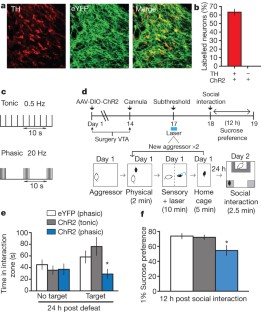
Figure 1: Phasic, but not tonic, optical stimulation of VTA dopamine neurons during a subthreshold social defeat induces a susceptible phenotype.
The alternative text for this image may have been generated using AI.
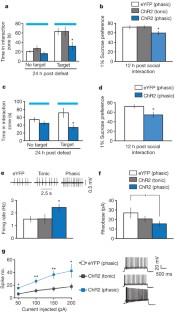
Figure 2: Phasic optical stimulation of VTA dopamine neurons during the social-interaction test instantly induces a susceptible phenotype in two social-defeat paradigms.
The alternative text for this image may have been generated using AI.
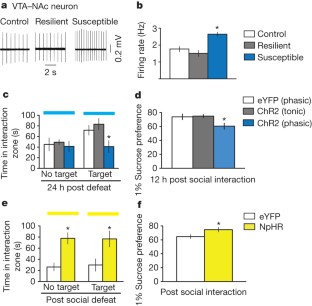
Figure 3: Bidirectional effect of modulating the VTA–NAc pathway on susceptibility to social defeat.
The alternative text for this image may have been generated using AI.
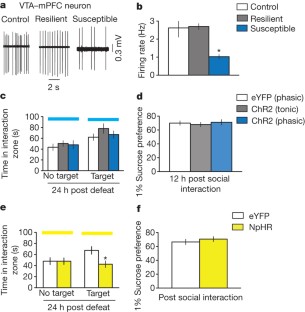
Figure 4: Effect of modulating the VTA–mPFC pathway on susceptibility to social defeat.
The alternative text for this image may have been generated using AI.
References
- Willner, P., Hale, A. S. & Argyropoulos, S. Dopaminergic mechanism of antidepressant action in depressed patients. J. Affect. Disord. 86, 37–45 (2005)
Article CAS Google Scholar - Nestler, E. J. & Carlezon, W. A., Jr The mesolimbic dopamine reward circuit in depression. Biol. Psychiatry 59, 1151–1159 (2006)
Article CAS Google Scholar - Berton, O. & Nestler, E. J. New approaches to antidepressant drug discovery: beyond monoamines. Nature Rev. Neurosci. 7, 137–151 (2006)
Article CAS Google Scholar - Yadid, G. & Friedman, A. Dynamics of the dopaminergic system as a key component to the understanding of depression. Prog. Brain Res. 172, 265–286 (2008)
Article CAS Google Scholar - Krishnan, V. et al. Molecular adaptations underlying susceptibility and resistance to social defeat in brain reward regions. Cell 131, 391–404 (2007)
Article CAS Google Scholar - Grace, A. A., Floresco, S. B., Goto, Y. & Lodge, D. J. Regulation of firing of dopaminergic neurons and control of goal-directed behaviors. Trends Neurosci. 30, 220–227 (2007)
Article CAS Google Scholar - Tsai, H. C. et al. Phasic firing in dopaminergic neurons is sufficient for behavioral conditioning. Science 324, 1080–1084 (2009)
Article ADS CAS Google Scholar - Cao, J. L. et al. Mesolimbic dopamine neurons in the brain reward circuit mediate susceptibility to social defeat and antidepressant action. J. Neurosci. 30, 16453–16458 (2010)
Article CAS Google Scholar - Schultz, W. Dopamine signals for reward value and risk: basic and recent data. Behav. Brain Funct. 6, 24 (2010)
Article ADS Google Scholar - Berton, O. et al. Essential role of BDNF in the mesolimbic dopamine pathway in social defeat stress. Science 311, 864–868 (2006)
Article ADS CAS Google Scholar - Anstrom, K. K., Miczek, K. A. & Budygin, E. A. Increased phasic dopamine signaling in the mesolimbic pathway during social defeat in rats. Neuroscience 161, 3–12 (2009)
Article CAS Google Scholar - Razzoli, M., Andreoli, M., Michielin, F., Quarta, D. & Sokal, D. M. Increased phasic activity of VTA dopamine neurons in mice 3 weeks after repeated social defeat. Behav. Brain Res. 218, 253–257 (2011)
Article CAS Google Scholar - Krishnan, V., Berton, O. & Nestler, E. The use of animal models in psychiatric research and treatment. Am. J. Psychiatry 165, 1109 (2008)
Article Google Scholar - Lobo, M. K. et al. Cell type-specific loss of BDNF signaling mimics optogenetic control of cocaine reward. Science 330, 385–390 (2010)
Article ADS CAS Google Scholar - Iñiguez, S. D. et al. Extracellular signal-regulated kinase-2 within the ventral tegmental area regulates responses to stress. J. Neurosci. 30, 7652–7663 (2010)
Article Google Scholar - Valenti, O., Gill, K. M. & Grace, A. A. Different stressors produce excitation or inhibition of mesolimbic dopamine neuron activity: response alteration by stress pre-exposure. Eur. J. Neurosci. 35, 1312–1321 (2012)
Article Google Scholar - Ungless, M. A., Magill, P. J. & Bolam, J. P. Uniform inhibition of dopamine neurons in the ventral tegmental area by aversive stimuli. Science 303, 2040–2042 (2004)
Article ADS CAS Google Scholar - Venzala, E., Garcia-Garcia, A. L., Elizalde, N. & Tordera, R. M. Social vs. environmental stress models of depression from a behavioural and neurochemical approach. Eur. Neuropsychopharmacol. advance online publication, http://dx.doi.org/10.1016/j.euroneuro.2012.05.010 (June 27, 2012)
Google Scholar - Lammel, S., Ion, D. I., Roeper, J. & Malenka, R. C. Projection-specific modulation of dopamine neuron synapses by aversive and rewarding stimuli. Neuron 70, 855–862 (2011)
Article CAS Google Scholar - Willner, P. The mesolimbic dopamine system as a target for rapid antidepressant action. Int. Clin. Psychopharmacol. 12 (Suppl. 3). S7–S14 (1997)
Article Google Scholar - Radulescu, A. R. Mechanisms explaining transitions between tonic and phasic firing in neuronal populations as predicted by a low dimensional firing rate model. PLoS ONE 5, e12695 (2010)
Article ADS Google Scholar - Inyushin, M. U., Arencibia-Albite, F., Vazquez-Torres, R., Velez-Hernandez, M. E. & Jimenez-Rivera, C. A. Alpha-2 noradrenergic receptor activation inhibits the hyperpolarization-activated cation current (Ih) in neurons of the ventral tegmental area. Neuroscience 167, 287–297 (2010)
Article CAS Google Scholar - Han, H. M. et al. Essential role of ventral tegmental area dopamine neurons in mediating the induction and rapid reversal of depression-like behaviours. Abstract, http://www.acnp.org/annualmeeting/programbooks.aspx (The 50th Anniversary Meeting of ACNP, 2011)
- Berman, R. M. et al. Antidepressant effects of ketamine in depressed patients. Biol. Psychiatry 47, 351–354 (2000)
CAS Google Scholar - Li, N. et al. mTOR-dependent synapse formation underlies the rapid antidepressant effects of NMDA antagonists. Science 329, 959–964 (2010)
Article ADS CAS Google Scholar - Autry, A. E. et al. NMDA receptor blockade at rest triggers rapid behavioural antidepressant responses. Nature 475, 91–95 (2011)
Article CAS Google Scholar - Hemmeter, U. M., Hemmeter-Spernal, J. & Krieg, J. C. Sleep deprivation in depression. Expert Rev. Neurother. 10, 1101–1115 (2010)
Article Google Scholar - Giacobbe, P., Mayberg, H. S. & Lozano, A. M. Treatment resistant depression as a failure of brain homeostatic mechanisms: implications for deep brain stimulation. Exp. Neurol. 219, 44–52 (2009)
Article Google Scholar - Sartorius, A. et al. Remission of major depression under deep brain stimulation of the lateral habenula in a therapy-refractory patient. Biol. Psychiatry 67, e9–e11 (2010)
Article Google Scholar - Li, B. et al. Synaptic potentiation onto habenula neurons in the learned helplessness model of depression. Nature 470, 535–539 (2011)
Article ADS CAS Google Scholar - Lindeberg, J. et al. Transgenic expression of Cre recombinase from the tyrosine hydroxylase locus. Genesis 40, 67–73 (2004)
Article CAS Google Scholar - Cardin, J. A. et al. Targeted optogenetic stimulation and recording of neurons in vivo using cell-type-specific expression of Channelrhodopsin-2. Nature Protocols 5, 247–254 (2010)
Article CAS Google Scholar - Hommel, J. D., Sears, R. M., Georgescu, D., Simmons, D. L. & DiLeone, R. J. Local gene knockdown in the brain using viral-mediated RNA interference. Nature Med. 9, 1539–1544 (2003)
Article CAS Google Scholar - Sparta, D. R. et al. Construction of implantable optical fibers for long-term optogenetic manipulation of neural circuits. Nature Protocols 7, 12–23 (2011)
Article Google Scholar - Gradinaru, V. et al. Targeting and readout strategies for fast optical neural control in vitro and in vivo. J. Neurosci. 27, 14231–14238 (2007)
Article CAS Google Scholar - Golden, S. A., Covington, H. E., III, Berton, O. & Russo, S. J. A standardized protocol for repeated social defeat stress in mice. Nature Protocols 6, 1183–1191 (2011)
Article CAS Google Scholar - Stuber, G. D. et al. Excitatory transmission from the amygdala to nucleus accumbens facilitates reward seeking. Nature 475, 377–380 (2011)
Article CAS Google Scholar
Acknowledgements
This work was supported by the National Institute of Mental Health (R01 MH092306 to D.C. and M.H.H.), Johnson & Johnson IMHRO Rising Star Translational Research Award (M.H.H.), the National Research Service Awards (F31 MH095425 to J.J.W. and F32 MH096464 to A.K.F) and the Mount Sinai PREP R25 GM064118 (B.J.). We would like to thank K. Roy for help with some of the schematics in the figures, and we thank R. Cachope and J. Cheer for help with chronic fibre implantation techniques.
Author information
Author notes
- Dipesh Chaudhury and Jessica J. Walsh: These authors contributed equally to this work.
Authors and Affiliations
- Department of Pharmacology and Systems Therapeutics, Friedman Brain Institute, Mount Sinai School of Medicine, New York, 10029, New York, USA
Dipesh Chaudhury, Jessica J. Walsh, Allyson K. Friedman, Barbara Juarez, Stacy M. Ku, Eric J. Nestler & Ming-Hu Han - Fishberg Department of Neuroscience, Friedman Brain Institute, Mount Sinai School of Medicine, New York, 10029, New York, USA
Jessica J. Walsh, Barbara Juarez, Stacy M. Ku, Ja Wook Koo, Deveroux Ferguson, Daniel J. Christoffel, Michelle S. Mazei-Robison, Ezekiell Mouzon, Mary Kay Lobo, Scott J. Russo, Eric J. Nestler & Ming-Hu Han - Departments of Bioengineering and Psychiatry and Behavioural Sciences, Stanford University, Stanford, 94305, California, USA
Hsing-Chen Tsai & Karl Deisseroth - Laboratory of Molecular Genetics, Howard Hughes Medical Institute, Rockefeller University, New York, 10056, New York, USA
Lisa Pomeranz, Alexander R. Nectow, Mats Ekstrand, Ana Domingos & Jeffrey M. Friedman - McGovern Institute for Brain Research, Massachusetts Institute of Technology, Cambridge, 02139, Massachusetts, USA
Rachael L. Neve
Authors
- Dipesh Chaudhury
- Jessica J. Walsh
- Allyson K. Friedman
- Barbara Juarez
- Stacy M. Ku
- Ja Wook Koo
- Deveroux Ferguson
- Hsing-Chen Tsai
- Lisa Pomeranz
- Daniel J. Christoffel
- Alexander R. Nectow
- Mats Ekstrand
- Ana Domingos
- Michelle S. Mazei-Robison
- Ezekiell Mouzon
- Mary Kay Lobo
- Rachael L. Neve
- Jeffrey M. Friedman
- Scott J. Russo
- Karl Deisseroth
- Eric J. Nestler
- Ming-Hu Han
Contributions
D.C., J.J.W., A.K.F., B.J., J.W.K., D.F., D.J.C., H.C.T., M.K.L., M.S.M.-R. and S.M.K. collected and analysed data. L.P., A.R.N. M.E., A.D., E.M., R.L.N., S.J.R., J.M.F., K.D. and E.J.N. generated and provided viral vectors and TH–Cre mice. D.C., J.J.W., E.J.N. and M.H.H. designed and wrote the paper.
Corresponding author
Correspondence toMing-Hu Han.
Ethics declarations
Competing interests
The authors declare no competing financial interests.
Supplementary information
PowerPoint slides
Rights and permissions
About this article
Cite this article
Chaudhury, D., Walsh, J., Friedman, A. et al. Rapid regulation of depression-related behaviours by control of midbrain dopamine neurons.Nature 493, 532–536 (2013). https://doi.org/10.1038/nature11713
- Received: 01 March 2012
- Accepted: 25 October 2012
- Published: 12 December 2012
- Issue date: 24 January 2013
- DOI: https://doi.org/10.1038/nature11713
This article is cited by
Editorial Summary
Role of VTA neurons in depression
Dopaminergic neurons in the ventral tegmental area (VTA) are involved in reward processing but also in mediating stress responses. Two papers from Ming-Hu Han and Karl Deisseroth's laboratories demonstrate the effects of specifically manipulating these neurons on stress-evoked behaviours. Han and colleagues probe the functional effects of different patterns of activity during social defeat, an acutely stressful experience. Manipulation of phasic, but not tonic, activity of certain populations of VTA neurons renders previously resilient mice susceptible to stress. Deisseroth and colleagues examine the effects of manipulating VTA neuron activity on behavioural effects and circuit alterations caused by exposure to long-term, chronic stress. These studies emphasize the behavioural importance of circuit-specific firing patterns and provide insights into developing novel therapeutics for the treatment of depression.