Increase in forest water-use efficiency as atmospheric carbon dioxide concentrations rise (original) (raw)
- Letter
- Published: 10 July 2013
- David Y. Hollinger2,
- Gil Bohrer3,
- Danilo Dragoni4,
- J. William Munger5,
- Hans Peter Schmid6 &
- …
- Andrew D. Richardson1
Nature volume 499, pages 324–327 (2013) Cite this article
- 36k Accesses
- 1237 Citations
- 232 Altmetric
- Metrics details
Subjects
Abstract
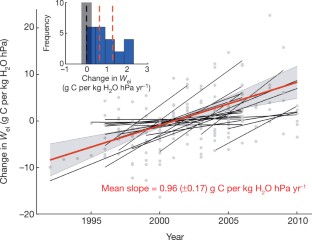
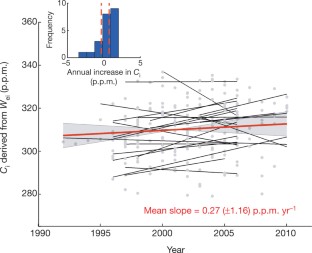
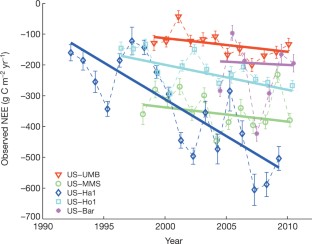
Terrestrial plants remove CO2 from the atmosphere through photosynthesis, a process that is accompanied by the loss of water vapour from leaves1. The ratio of water loss to carbon gain, or water-use efficiency, is a key characteristic of ecosystem function that is central to the global cycles of water, energy and carbon2. Here we analyse direct, long-term measurements of whole-ecosystem carbon and water exchange3. We find a substantial increase in water-use efficiency in temperate and boreal forests of the Northern Hemisphere over the past two decades. We systematically assess various competing hypotheses to explain this trend, and find that the observed increase is most consistent with a strong CO2 fertilization effect. The results suggest a partial closure of stomata1—small pores on the leaf surface that regulate gas exchange—to maintain a near-constant concentration of CO2 inside the leaf even under continually increasing atmospheric CO2 levels. The observed increase in forest water-use efficiency is larger than that predicted by existing theory and 13 terrestrial biosphere models. The increase is associated with trends of increasing ecosystem-level photosynthesis and net carbon uptake, and decreasing evapotranspiration. Our findings suggest a shift in the carbon- and water-based economics of terrestrial vegetation, which may require a reassessment of the role of stomatal control in regulating interactions between forests and climate change, and a re-evaluation of coupled vegetation–climate models.
This is a preview of subscription content, access via your institution
Access options
Subscribe to this journal
Receive 52 print issues and online access
$199.00 per year
only $3.83 per issue
Buy this article
- Purchase on SpringerLink
- Instant access to the full article PDF.
USD 39.95
Prices may be subject to local taxes which are calculated during checkout
Additional access options:
Figure 1: Long-term change in forest water-use efficiency.
The alternative text for this image may have been generated using AI.
Figure 2: Canopy-scale leaf intercellular CO2 concentrations.
The alternative text for this image may have been generated using AI.
Figure 3: Long-term increase in net ecosystem carbon uptake.
The alternative text for this image may have been generated using AI.
References
- Berry, J. A., Beerling, D. J. & Franks, P. J. Stomata: key players in the earth system, past and present. Curr. Opin. Plant Biol. 13, 232–239 (2010)
Article Google Scholar - Beer, C. et al. Temporal and among-site variability of inherent water use efficiency at the ecosystem level. Glob. Biogeochem. Cycles 23, 1–13 (2009)
Article ADS Google Scholar - Baldocchi, D. Breathing of the terrestrial biosphere: lessons learned from a global network of carbon dioxide flux measurement systems. Aust. J. Bot. 56, 1–26 (2008)
Article CAS Google Scholar - Field, C. B., Jackson, R. B. & Mooney, H. A. Stomatal responses to increased CO2: implications from the plant to the global scale. Plant Cell Environ. 18, 1214–1225 (1995)
Article Google Scholar - Katul, G. G., Palmroth, S. & Oren, R. Leaf stomatal responses to vapour pressure deficit under current and CO2-enriched atmosphere explained by the economics of gas exchange. Plant Cell Environ. 32, 968–979 (2009)
Article CAS Google Scholar - Lewis, S. L. et al. Increasing carbon storage in intact African tropical forests. Nature 457, 1003–1006 (2009)
Article ADS CAS Google Scholar - Salzer, M. W., Hughes, M. K., Bunn, A. G. & Kipfmueller, K. F. Recent unprecedented tree-ring growth in bristlecone pine at the highest elevations and possible causes. Proc. Natl Acad. Sci. USA 106, 20348–20353 (2009)
Article ADS CAS Google Scholar - McMahon, S. M., Parker, G. G. & Miller, D. R. Evidence for a recent increase in forest growth. Proc. Natl Acad. Sci. USA 107, 3611–3615 (2010)
Article ADS CAS Google Scholar - Ballantyne, A. P., Alden, C. B., Miller, J. B., Tans, P. P. & White, J. W. C. Increase in observed net carbon dioxide uptake by land and oceans during the past 50 years. Nature 488, 70–72 (2012)
Article ADS CAS Google Scholar - Norby, R. J. & Zak, D. R. Ecological lessons from free-air CO2 enrichment (FACE) experiments. Annu. Rev. Ecol. Evol. Syst. 42, 181–203 (2011)
Article Google Scholar - Peñuelas, J., Canadell, J. G. & Ogaya, R. Increased water-use efficiency during the 20th century did not translate into enhanced tree growth. Glob. Ecol. Biogeogr. 20, 597–608 (2011)
Article Google Scholar - Seibt, U., Rajabi, A., Griffiths, H. & Berry, J. A. Carbon isotopes and water use efficiency: sense and sensitivity. Oecologia 155, 441–454 (2008)
Article ADS Google Scholar - Schubert, B. A. & Jahren, A. H. The effect of atmospheric CO2 concentration on carbon isotope fractionation in C3 land plants. Geochim. Cosmochim. Acta 96, 29–43 (2012)
Article ADS CAS Google Scholar - Ainsworth, E. A. & Rogers, A. The response of photosynthesis and stomatal conductance to rising [CO2]: mechanisms and environmental interactions. Plant Cell Environ. 30, 258–270 (2007)
Article CAS Google Scholar - Saurer, M., Siegwolf, R. T. W. & Schweingruber, F. H. Carbon isotope discrimination indicates improving water-use efficiency of trees in northern Eurasia over the last 100 years. Glob. Change Biol. 10, 2109–2120 (2004)
Article ADS Google Scholar - Battipaglia, G. et al. Elevated CO2 increases tree-level intrinsic water use efficiency: insights from carbon and oxygen isotope analyses in tree rings across three forest FACE sites. New Phytol. 197, 544–554 (2013)
Article CAS Google Scholar - Drake, J. E. et al. Increases in the flux of carbon belowground stimulate nitrogen uptake and sustain the long-term enhancement of forest productivity under elevated CO2 . Ecol. Lett. 14, 349–357 (2011)
Article Google Scholar - Schmidt, A., Hanson, C., Chan, W. S. & Law, B. E. Empirical assessment of uncertainties of meteorological parameters and turbulent fluxes in the AmeriFlux network. J. Geophys. Res. 117, G04014 (2012)
ADS Google Scholar - Medlyn, B. E. et al. Reconciling the optimal and empirical approaches to modelling stomatal conductance. Glob. Change Biol. 17, 2134–2144 (2011)
Article ADS Google Scholar - Buckley, T. N. The role of stomatal acclimation in modelling tree adaptation to high CO2 . J. Exp. Bot. 59, 1951–1961 (2008)
Article CAS Google Scholar - Jones, J. A. et al. Ecosystem processes and human influences regulate streamflow response to climate change at long-term ecological research sites. Bioscience 62, 390–404 (2012)
Article Google Scholar - Dragoni, D. et al. Evidence of increased net ecosystem productivity associated with a longer vegetated season in a deciduous forest in south-central Indiana, USA. Glob. Change Biol. 17, 886–897 (2011)
Article ADS Google Scholar - Niinemets, U., Flexas, J. & Peñuelas, J. Evergreens favored by higher responsiveness to increased CO2 . Trends Ecol. Evol. 26, 136–142 (2011)
Article Google Scholar - Bernacchi, C. J., Kimball, B. A., Quarles, D. R., Long, S. P. & Ort, D. R. Decreases in stomatal conductance of soybean under open-air elevation of [CO2] are closely coupled with decreases in ecosystem evapotranspiration. Plant Physiol. 143, 134–144 (2007)
Article CAS Google Scholar - Lee, X. et al. Observed increase in local cooling effect of deforestation at higher latitudes. Nature 479, 384–387 (2011)
Article ADS CAS Google Scholar - Betts, R. A. et al. Projected increase in continental runoff due to plant responses to increasing carbon dioxide. Nature 448, 1037–1041 (2007)
Article ADS CAS Google Scholar - Keys, P. W. et al. Analyzing precipitationsheds to understand the vulnerability of rainfall dependent regions. Biogeosciences 9, 733–746 (2012)
Article ADS Google Scholar - Nemani, R. R. et al. Climate-driven increases in global terrestrial net primary production from 1982 to 1999. Science 300, 1560–1563 (2003)
Article ADS CAS Google Scholar - Reichstein, M. et al. On the separation of net ecosystem exchange into assimilation and ecosystem respiration: review and improved algorithm. Glob. Change Biol. 11, 1424–1439 (2005)
Article ADS Google Scholar - Desai, A. R. et al. Cross-site evaluation of eddy covariance GPP and RE decomposition techniques. Agric. For. Meteorol. 148, 821–838 (2008)
Article ADS Google Scholar - Papale, D. et al. Towards a standardized processing of net ecosystem exchange measured with eddy covariance technique: algorithms and uncertainty estimation. Biogeosciences 3, 571–583 (2006)
Article ADS CAS Google Scholar - Khairi, M. M. A. & Hall, A. E. Comparative studies of net photosynthesis and transpiration of some citrus species and relatives. Physiol. Plant. 36, 35–39 (1976)
Article Google Scholar - Grelle, A., Lundberg, A., Lindroth, A., Morén, A.-S. & Cienciala, E. Evaporation components of a boreal forest: variations during the growing season. J. Hydrol. 197, 70–87 (1997)
Article ADS Google Scholar
Acknowledgements
This research was supported by the NOAA Climate Program Office, Global Carbon Cycle Program (award NA11OAR4310054) and the Office of Science (Biological and Environmental Research), US Department of Energy. G.B. acknowledges a grant from the National Science Foundation (grant number DEB-0911461). This work used eddy covariance data acquired by the FLUXNET community and in particular by the AmeriFlux, CarboEuropeIP and Fluxnet-Canada networks. AmeriFlux was supported by the US Department of Energy, Biological and Environmental Research, Terrestrial Carbon Program (grant numbers DE-FG02-04ER63917 and DE-FG02-04ER63911, DE-SC0006708) and Fluxnet-Canada was supported by CFCAS, NSERC, BIOCAP, Environment Canada and NRCan. We acknowledge financial support of the eddy covariance data harmonization provided by CarboEuropeIP, FAO-GTOS-TCO, iLEAPS, the Max-Planck Institute for Biogeochemistry, National Science Foundation, University of Tuscia, Université Laval and Environment Canada and US Department of Energy and of the database development and technical support from Berkeley Water Center, Lawrence Berkeley National Laboratory, Microsoft Research eScience, Oak Ridge National Laboratory, University of California-Berkeley, University of Virginia. We thank all those involved in the NACP Site Synthesis, in particular the modelling teams who provided model output. Research at the Bartlett Experimental Forest tower is supported by the National Science Foundation (grant DEB-1114804), and the USDA Forest Service’s Northern Research Station. Research at Howland Forest is supported by the Office of Science (BER), US Department of Energy. Carbon flux and biometric measurements at Harvard Forest have been supported by the Office of Science (BER), US Department of Energy and the National Science Foundation Long-Term Ecological Research programmes. We thank S. Ollinger and S. Frey for maintaining the long-term leaf nitrogen measurements at Harvard Forest, and B. Yang for providing gap-filled meteorological data for the regional focus sites.
Author information
Authors and Affiliations
- Department of Organismic and Evolutionary Biology, Harvard University, Cambridge, Massachusetts, 02138, USA,
Trevor F. Keenan & Andrew D. Richardson - USDA Forest Service, Northern Research Station, Durham, 03824, New Hampshire, USA
David Y. Hollinger - Department of Civil, Environmental and Geodetic Engineering, The Ohio State University, Columbus, 43210, Ohio, USA
Gil Bohrer - Department of Geography, Indiana University, Bloomington, 47405, Indiana, USA
Danilo Dragoni - School of Engineering and Applied Sciences and Department of Earth and Planetary Sciences, Harvard University, Cambridge, 02138, Massachusetts, USA
J. William Munger - Institute of Meteorology and Climate Research, Karlsruhe Institute of Technology, IMK-IFU, 82467 Garmisch-Partenkirchen, Germany,
Hans Peter Schmid
Authors
- Trevor F. Keenan
- David Y. Hollinger
- Gil Bohrer
- Danilo Dragoni
- J. William Munger
- Hans Peter Schmid
- Andrew D. Richardson
Contributions
T.F.K. and A.D.R. designed the study and are responsible for the integrity of the manuscript. A.D.R. planned the regional analysis, with input from D.Y.H., J.W.M., G.B., H.P.S. and D.D. A.D.R., D.Y.H., J.W.M., G.B., H.P.S. and D.D. contributed data. T.F.K. compiled the data sets, detailed and performed the analysis. A.D.R. and D.Y.H. contributed ideas to the analysis. T.F.K. led the writing, with input from A.D.R. and D.Y.H. All authors discussed and commented on the results and the manuscript.
Corresponding authors
Correspondence toTrevor F. Keenan or Andrew D. Richardson.
Ethics declarations
Competing interests
The authors declare no competing financial interests.
Supplementary information
PowerPoint slides
Rights and permissions
About this article
Cite this article
Keenan, T., Hollinger, D., Bohrer, G. et al. Increase in forest water-use efficiency as atmospheric carbon dioxide concentrations rise.Nature 499, 324–327 (2013). https://doi.org/10.1038/nature12291
- Received: 13 September 2012
- Accepted: 13 May 2013
- Published: 10 July 2013
- Issue date: 18 July 2013
- DOI: https://doi.org/10.1038/nature12291
This article is cited by
Comments
Commenting on this article is now closed.
- Arno Arrak 15 July 2013, 09:55
Finally some quantitative data on carbon dioxide fertilization effect that should put to rest scare stories from the global warming movement that promise us lower yields, more pests, and faster-growing weeds. But being down on crops is just a sideline with them. Their main agenda is the belief that increase of atmospheric carbon dioxide will cause a dangerous increase of global temperature that must be prevented by any means available. Its scientific basis is said to be the greenhouse effect, but this is no longer tenable because of current observations of nature. First, atmospheric carbon dioxide now is higher than ever but sixteen years have gone by without any warming of any kind. A similar no-warming period happened also in the eighties and nineties. I discovered it by comparing satellite temperature curves with ground-based data for my book What Warming? 1 According to satellites there was no warming before the super El Nino of 1998 appeared. But ground-based temperature curves were showing a "late twentieth century warming" in that time slot. Until last fall, that is, when I discovered that GISTEMP, HadCRUT, and NCDC had suddenly retracted this warming and aligned their eighties and nineties data with satellites. It was done secretly and no explanation was given. With this warming now out of the way we can now construct a realistic temperature curve for the satellite era. Start it with an 18 year no-warming period from 1979. Add to this all of the twenty-first century as another no-warming period. The space left over is just wide enough to accommodate the super El Nino of 1998 and its step warming, leaving no opening for any greenhouse effect at all. This means that we have had 34 greenhouse-free years. Knowing this fact, how likely is it that earlier warming, when much less carbon dioxide was in the air, could have been greenhouse warming? I vote zero for that. But there are persistent attempts to explain away the current lack of warming, including a suggestion that the missing heat has disappeared into the ocean bottom 2. That sure is a good place to hide it because Trenberth and Fasullo 3 at one time managed to lose 80 percent of global energy in the ocean somewhere and no one has been able to find it since. Stuff like that I regard as last-ditch attempts to save global warming from the waste basket of history where it has a place right next to phlogiston, another failed theory of heat.
1 Arno Arrak, "What Warming? Satellite view of global temperature change" (CreateSpace 2010)
2 Gerald A. Meehl, Julie M. Arblaster, John T. Fasullo, Aixue Hu and Kevin E. Trenberth, "Model-based evidence of deep-ocean heat uptake during surface-temperature hiatus periods" Nature Climate Change 1:360-364 (18 September 2011)
3 Kevin E. Trenberth and John T. Fasullo, "Tracking Earth's Energy" Science 328:316-317 (2010)
Editorial Summary
Large increase in forest water-use efficiency
Theory suggests that rising atmospheric CO2 concentrations should increase the efficiency with which plants use water, but the actual magnitude of this effect in natural forest ecosystems remains unknown. An analysis of long-term measurements of carbon and water fluxes from forest research sites across the Northern Hemisphere has identified an unexpectedly large increase in water-use efficiency during the past two decades, coinciding with an increase of atmospheric CO2 from 350 to 400 parts per million. This trend is often accompanied by concurrent increases in rates of photosynthetic uptake and carbon sequestration. The authors suggest partial closure of stomata — to maintain constant CO2 concentrations in the plant leaves — as the most likely explanation for the observed trend in water-use efficiency. The results are inconsistent with current theory and terrestrial biosphere models.