Quantum error correction in a solid-state hybrid spin register (original) (raw)
- Letter
- Published: 12 February 2014
- Y. Wang1 na1,
- S. Zaiser1,
- M. Jamali1,
- T. Schulte-Herbrüggen2,
- H. Abe3,
- T. Ohshima3,
- J. Isoya4,
- J. F. Du5,
- P. Neumann1 &
- …
- J. Wrachtrup1,6
Nature volume 506, pages 204–207 (2014)Cite this article
- 23k Accesses
- 604 Citations
- 72 Altmetric
- Metrics details
Subjects
This article has been updated
Abstract
Error correction is important in classical and quantum computation. Decoherence caused by the inevitable interaction of quantum bits with their environment leads to dephasing or even relaxation. Correction of the concomitant errors is therefore a fundamental requirement for scalable quantum computation[1](/articles/nature12919#ref-CR1 "Shor, P. W. in Proc. 37th Symp. Foundations Comput. 56–65 (IEEE Comp. Soc. Press, 1996); available at http://ieeexplore.ieee.org/xpls/abs_all.jsp?arnumber=548464
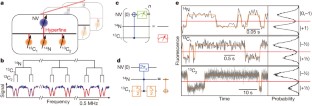
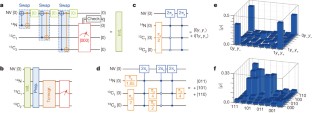
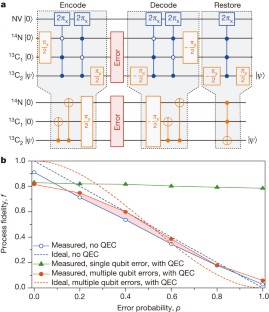
"),[2](/articles/nature12919#ref-CR2 "Cory, D. G. et al. Experimental quantum error correction. Phys. Rev. Lett. 81, 2152–2155 (1998)"),[3](/articles/nature12919#ref-CR3 "Knill, E., Laflamme, R., Martinez, R. & Negrevergne, C. Benchmarking quantum computers: the five-qubit error correcting code. Phys. Rev. Lett. 86, 5811–5814 (2001)"),[4](/articles/nature12919#ref-CR4 "Boulant, N., Viola, L., Fortunato, E. & Cory, D. Experimental implementation of a concatenated quantum error-correcting code. Phys. Rev. Lett. 94, 130501 (2005)"),[5](/articles/nature12919#ref-CR5 "Moussa, O., Baugh, J., Ryan, C. A. & Laflamme, R. Demonstration of sufficient control for two rounds of quantum error correction in a solid state ensemble quantum information processor. Phys. Rev. Lett. 107, 160501 (2011)"),[6](/articles/nature12919#ref-CR6 "Schindler, P. et al. Experimental repetitive quantum error correction. Science 332, 1059–1061 (2011)"),[7](/articles/nature12919#ref-CR7 "Reed, M. D. et al. Realization of three-qubit quantum error correction with superconducting circuits. Nature 482, 382–385 (2012)"). Although algorithms for error correction have been known for some time, experimental realizations are scarce[2](/articles/nature12919#ref-CR2 "Cory, D. G. et al. Experimental quantum error correction. Phys. Rev. Lett. 81, 2152–2155 (1998)"),[3](/articles/nature12919#ref-CR3 "Knill, E., Laflamme, R., Martinez, R. & Negrevergne, C. Benchmarking quantum computers: the five-qubit error correcting code. Phys. Rev. Lett. 86, 5811–5814 (2001)"),[4](/articles/nature12919#ref-CR4 "Boulant, N., Viola, L., Fortunato, E. & Cory, D. Experimental implementation of a concatenated quantum error-correcting code. Phys. Rev. Lett. 94, 130501 (2005)"),[5](/articles/nature12919#ref-CR5 "Moussa, O., Baugh, J., Ryan, C. A. & Laflamme, R. Demonstration of sufficient control for two rounds of quantum error correction in a solid state ensemble quantum information processor. Phys. Rev. Lett. 107, 160501 (2011)"),[6](/articles/nature12919#ref-CR6 "Schindler, P. et al. Experimental repetitive quantum error correction. Science 332, 1059–1061 (2011)"),[7](/articles/nature12919#ref-CR7 "Reed, M. D. et al. Realization of three-qubit quantum error correction with superconducting circuits. Nature 482, 382–385 (2012)"). Here we show quantum error correction in a heterogeneous, solid-state spin system[8](/articles/nature12919#ref-CR8 "Kane, B. E. A silicon-based nuclear spin quantum computer. Nature 393, 133–137 (1998)"),[9](/articles/nature12919#ref-CR9 "Morton, J. J. L. et al. Solid-state quantum memory using the 31P nuclear spin. Nature 455, 1085–1088 (2008)"),[10](/articles/nature12919#ref-CR10 "Neumann, P. et al. Single-shot readout of a single nuclear spin. Science 329, 542–544 (2010)"),[11](/articles/nature12919#ref-CR11 "Koehl, W. F., Buckley, B. B., Heremans, F. J., Calusine, G. & Awschalom, D. D. Room temperature coherent control of defect spin qubits in silicon carbide. Nature 479, 84–87 (2011)"),[12](/articles/nature12919#ref-CR12 "Pla, J. J. et al. A single-atom electron spin qubit in silicon. Nature 489, 541–545 (2012)"),[13](/articles/nature12919#ref-CR13 "Taminiau, T. et al. Detection and control of individual nuclear spins using a weakly coupled electron spin. Phys. Rev. Lett. 109, 137602 (2012)"),[14](/articles/nature12919#ref-CR14 "Pfaff, W. et al. Demonstration of entanglement-by-measurement of solid-state qubits. Nature Phys. 9, 29–33 (2012)"),[15](/articles/nature12919#ref-CR15 "Dolde, F. et al. Room-temperature entanglement between single defect spins in diamond. Nature Phys. 9, 139–143 (2013)"),[16](/articles/nature12919#ref-CR16 "Chekhovich, E. A. et al. Nuclear spin effects in semiconductor quantum dots. Nature Mater. 12, 494–504 (2013)"),[17](/articles/nature12919#ref-CR17 "Bernien, H. et al. Heralded entanglement between solid-state qubits separated by three metres. Nature 497, 86–90 (2013)"),[18](/articles/nature12919#ref-CR18 "Maurer, P. C. et al. Room-temperature quantum bit memory exceeding one second. Science 336, 1283–1286 (2012)"),[19](/articles/nature12919#ref-CR19 "Pla, J. J. et al. High-fidelity readout and control of a nuclear spin qubit in silicon. Nature 496, 334–338 (2013)"),[20](/articles/nature12919#ref-CR20 "Yin, C. et al. Optical addressing of an individual erbium ion in silicon. Nature 497, 91–94 (2013)"),[21](/articles/nature12919#ref-CR21 "Kolesov, R. et al. Optical detection of a single rare-earth ion in a crystal. Nature Commun. 3, 1029 (2012)"). We demonstrate that joint initialization, projective readout and fast local and non-local gate operations can all be achieved in diamond spin systems, even under ambient conditions. High-fidelity initialization of a whole spin register (99 per cent) and single-shot readout of multiple individual nuclear spins are achieved by using the ancillary electron spin of a nitrogen–vacancy defect. Implementation of a novel non-local gate generic to our electron–nuclear quantum register allows the preparation of entangled states of three nuclear spins, with fidelities exceeding 85 per cent. With these techniques, we demonstrate three-qubit phase-flip error correction. Using optimal control, all of the above operations achieve fidelities approaching those needed for fault-tolerant quantum operation, thus paving the way to large-scale quantum computation. Besides their use with diamond spin systems, our techniques can be used to improve scaling of quantum networks relying on phosphorus in silicon[19](/articles/nature12919#ref-CR19 "Pla, J. J. et al. High-fidelity readout and control of a nuclear spin qubit in silicon. Nature 496, 334–338 (2013)"), quantum dots[22](/articles/nature12919#ref-CR22 "Le Gall, C., Brunetti, A., Boukari, H. & Besombes, L. Optical Stark effect and dressed exciton states in a Mn-doped CdTe quantum dot. Phys. Rev. Lett. 107, 057401 (2011)"), silicon carbide[11](/articles/nature12919#ref-CR11 "Koehl, W. F., Buckley, B. B., Heremans, F. J., Calusine, G. & Awschalom, D. D. Room temperature coherent control of defect spin qubits in silicon carbide. Nature 479, 84–87 (2011)") or rare-earth ions in solids[20](/articles/nature12919#ref-CR20 "Yin, C. et al. Optical addressing of an individual erbium ion in silicon. Nature 497, 91–94 (2013)"),[21](/articles/nature12919#ref-CR21 "Kolesov, R. et al. Optical detection of a single rare-earth ion in a crystal. Nature Commun. 3, 1029 (2012)").This is a preview of subscription content, access via your institution
Access options
Subscribe to this journal
Receive 51 print issues and online access
$199.00 per year
only $3.90 per issue
Buy this article
- Purchase on SpringerLink
- Instant access to the full article PDF.
USD 39.95
Prices may be subject to local taxes which are calculated during checkout
Additional access options:
Figure 1: Single-shot readout and control of a nuclear spin register via the NV.
The alternative text for this image may have been generated using AI.
Figure 2: Three-qubit entangled states.
The alternative text for this image may have been generated using AI.
Figure 3: Quantum error correction.
The alternative text for this image may have been generated using AI.
Change history
12 February 2014
A new reference (31) has been added to the main-text reference list and all subsequent references have been renumbered.
References
- Shor, P. W. in Proc. 37th Symp. Foundations Comput. 56–65 (IEEE Comp. Soc. Press, 1996); available at http://ieeexplore.ieee.org/xpls/abs_all.jsp?arnumber=548464
- Cory, D. G. et al. Experimental quantum error correction. Phys. Rev. Lett. 81, 2152–2155 (1998)
Article ADS CAS Google Scholar - Knill, E., Laflamme, R., Martinez, R. & Negrevergne, C. Benchmarking quantum computers: the five-qubit error correcting code. Phys. Rev. Lett. 86, 5811–5814 (2001)
Article ADS CAS Google Scholar - Boulant, N., Viola, L., Fortunato, E. & Cory, D. Experimental implementation of a concatenated quantum error-correcting code. Phys. Rev. Lett. 94, 130501 (2005)
Article ADS Google Scholar - Moussa, O., Baugh, J., Ryan, C. A. & Laflamme, R. Demonstration of sufficient control for two rounds of quantum error correction in a solid state ensemble quantum information processor. Phys. Rev. Lett. 107, 160501 (2011)
Article ADS Google Scholar - Schindler, P. et al. Experimental repetitive quantum error correction. Science 332, 1059–1061 (2011)
Article ADS CAS Google Scholar - Reed, M. D. et al. Realization of three-qubit quantum error correction with superconducting circuits. Nature 482, 382–385 (2012)
Article ADS CAS Google Scholar - Kane, B. E. A silicon-based nuclear spin quantum computer. Nature 393, 133–137 (1998)
Article ADS CAS Google Scholar - Morton, J. J. L. et al. Solid-state quantum memory using the 31P nuclear spin. Nature 455, 1085–1088 (2008)
Article ADS CAS Google Scholar - Neumann, P. et al. Single-shot readout of a single nuclear spin. Science 329, 542–544 (2010)
Article ADS CAS Google Scholar - Koehl, W. F., Buckley, B. B., Heremans, F. J., Calusine, G. & Awschalom, D. D. Room temperature coherent control of defect spin qubits in silicon carbide. Nature 479, 84–87 (2011)
Article ADS CAS Google Scholar - Pla, J. J. et al. A single-atom electron spin qubit in silicon. Nature 489, 541–545 (2012)
Article ADS CAS Google Scholar - Taminiau, T. et al. Detection and control of individual nuclear spins using a weakly coupled electron spin. Phys. Rev. Lett. 109, 137602 (2012)
Article ADS CAS Google Scholar - Pfaff, W. et al. Demonstration of entanglement-by-measurement of solid-state qubits. Nature Phys. 9, 29–33 (2012)
Article ADS Google Scholar - Dolde, F. et al. Room-temperature entanglement between single defect spins in diamond. Nature Phys. 9, 139–143 (2013)
Article ADS CAS Google Scholar - Chekhovich, E. A. et al. Nuclear spin effects in semiconductor quantum dots. Nature Mater. 12, 494–504 (2013)
Article ADS CAS Google Scholar - Bernien, H. et al. Heralded entanglement between solid-state qubits separated by three metres. Nature 497, 86–90 (2013)
Article ADS CAS Google Scholar - Maurer, P. C. et al. Room-temperature quantum bit memory exceeding one second. Science 336, 1283–1286 (2012)
Article ADS CAS Google Scholar - Pla, J. J. et al. High-fidelity readout and control of a nuclear spin qubit in silicon. Nature 496, 334–338 (2013)
Article ADS CAS Google Scholar - Yin, C. et al. Optical addressing of an individual erbium ion in silicon. Nature 497, 91–94 (2013)
Article ADS CAS Google Scholar - Kolesov, R. et al. Optical detection of a single rare-earth ion in a crystal. Nature Commun. 3, 1029 (2012)
Article ADS CAS Google Scholar - Le Gall, C., Brunetti, A., Boukari, H. & Besombes, L. Optical Stark effect and dressed exciton states in a Mn-doped CdTe quantum dot. Phys. Rev. Lett. 107, 057401 (2011)
Article ADS CAS Google Scholar - Dutt, M. et al. Quantum register based on individual electronic and nuclear spin qubits in diamond. Science 316, 1312–1316 (2007)
Article Google Scholar - Neumann, P. et al. Multipartite entanglement among single spins in diamond. Science 320, 1326–1329 (2008)
Article ADS CAS Google Scholar - Robledo, L. et al. High-fidelity projective read-out of a solid-state spin quantum register. Nature 477, 574–578 (2011)
Article ADS CAS Google Scholar - Taminiau, T. H., Cramer, J., van der Sar, T., Dobrovitski, V. V. & Hanson, R. Universal control and error correction in multi-qubit spin registers in diamond. Preprint at http://arxiv.org/abs/1309.5452 (2013)
- Dréau, A., Spinicelli, P., Maze, J. R., Roch, J.-F. & Jacques, V. Single-shot readout of multiple nuclear spin qubits in diamond under ambient conditions. Phys. Rev. Lett. 110, 060502 (2013)
Article ADS Google Scholar - Machnes, S. et al. Comparing, optimizing, and benchmarking quantum-control algorithms in a unifying programming framework. Phys. Rev. A 84, 022305 (2011)
Article ADS Google Scholar - Dür, W., Vidal, G. & Cirac, J. I. Three qubits can be entangled in two inequivalent ways. Phys. Rev. A 62, 062314 (2000)
Article ADS MathSciNet Google Scholar - Mermin, N. D. Extreme quantum entanglement in a superposition of macroscopically distinct states. Phys. Rev. Lett. 65, 1838–1840 (1990)
Article ADS MathSciNet CAS Google Scholar - Filidou, V. et al. Ultrafast entangling gates between nuclear spins using photo-excited triplet states. Nature Phys. 8, 596–600 (2012)
Article ADS CAS Google Scholar - Mizuochi, N. et al. Coherence of single spins coupled to a nuclear spin bath of varying density. Phys. Rev. B 80, 041201 (2009)
Article ADS Google Scholar - Marseglia, L. et al. Nanofabricated solid immersion lenses registered to single emitters in diamond. Appl. Phys. Lett. 98, 133107 (2011)
Article ADS Google Scholar - Waldherr, G. et al. Dark states of single nitrogen-vacancy centers in diamond unraveled by single shot NMR. Phys. Rev. Lett. 106, 157601 (2011)
Article ADS CAS Google Scholar - Aslam, N., Waldherr, G., Neumann, P., Jelezko, F. & Wrachtrup, J. Photo-induced ionization dynamics of the nitrogen vacancy defect in diamond investigated by single-shot charge state detection. New J. Phys. 15, 013064 (2013)
Article ADS CAS Google Scholar - Waldherr, G. et al. High dynamic range magnetometry with a single nuclear spin in diamond. Nature Nanotechnol. 7, 105–108 (2011)
Article ADS MathSciNet CAS Google Scholar - Khaneja, N., Reiss, T., Kehlet, C., Schulte-Herbrggen, T. & Glaser, S. J. Optimal control of coupled spin dynamics: design of NMR pulse sequences by gradient ascent algorithms. J. Magn. Reson. 172, 296–305 (2005)
Article ADS CAS Google Scholar - Bell, J. S. On the Einstein Podolsky Rosen paradox. Physics 1, 195–200 (1964)
Article MathSciNet Google Scholar - Waldherr, G., Neumann, P., Huelga, S., Jelezko, F. & Wrachtrup, J. Violation of a temporal Bell inequality for single spins in a diamond defect center. Phys. Rev. Lett. 107, 090401 (2011)
Article ADS CAS Google Scholar
Acknowledgements
We thank F. Dolde, I. Jakobi, M. Kleinmann, F. Jelezko, J. Honert, A. Brunner and C. Walter for experimental help and discussions. We acknowledge financial support from the Max Planck Society, the ERC project SQUTEC, the DFG SFB/TR21, the EU projects DIAMANT, SIQS, QESSENCE and QINVC, the JST-DFG (FOR1482 and FOR1493), and the Volkswagenstiftung.
Author information
Author notes
- G. Waldherr and Y. Wang: These authors contributed equally to this work.
Authors and Affiliations
- 3. Physikalisches Institut and Research Center SCOPE, University of Stuttgart, Pfaffenwaldring 57, 70569 Stuttgart, Germany ,
G. Waldherr, Y. Wang, S. Zaiser, M. Jamali, P. Neumann & J. Wrachtrup - Department of Chemistry, Technical University of Munich, 85747 Garching, Germany,
T. Schulte-Herbrüggen - Japan Atomic Energy Agency, Takasaki, Gunma 370-1292, Japan ,
H. Abe & T. Ohshima - Research Center for Knowledge Communities, University of Tsukuba, Tsukuba, Ibaraki 305-8550, Japan ,
J. Isoya - Hefei National Laboratory for Physical Sciences at the Microscale and Department of Modern Physics, University of Science and Technology of China, Hefei 230026, China,
J. F. Du - Max Planck Institute for Solid State Research, Heisenbergstraße 1, 70569 Stuttgart, Germany ,
J. Wrachtrup
Authors
- G. Waldherr
- Y. Wang
- S. Zaiser
- M. Jamali
- T. Schulte-Herbrüggen
- H. Abe
- T. Ohshima
- J. Isoya
- J. F. Du
- P. Neumann
- J. Wrachtrup
Contributions
Y.W., G.W., P.N. and J.W. conceived the experiments; G.W. and S.Z. prepared the sample and performed the experiments; Y.W. calculated the robust pulses; Y.W., G.W. and S.Z. analysed the data; J.I., H.A., T.O. and P.N. performed the electron irradiation; M.J. fabricated the SIL; G.W., J.W., P.N., Y.W., T.S.-H. and J.F.D. wrote the manuscript; and P.N. and J.W. supervised the project.
Corresponding author
Correspondence toG. Waldherr.
Ethics declarations
Competing interests
The authors declare no competing financial interests.
Extended data figures and tables
Extended Data Figure 1 Hyperfine spectrum as explained in the main text.
Only hyperfine values with an error of less than 4% were used, such that hyperfine values which are close to each other can be resolved.
Extended Data Figure 2 Estimation of number of usable 13C spins.
a, Average number of suitable 13C spins per NV for different 13C concentrations c and different minimum hyperfine (min. h.f.) interactions. Red dots, strongly coupled nuclei; blue triangles, effect of including weakly coupled nuclei with at least 20 kHz hyperfine splitting. b, Spectral density of suitable lattice positions per NV for different magnetic fields B. Note that for these simulations, actual lattice positions are not taken into account. The fluctuations at higher hyperfine interaction are due to numerical grain, that is, due to discretization of the integration volume.
Extended Data Figure 3 Solid immersion lens (SIL).
a, Image of the SIL in diamond. b, Saturation curves of the NV with and without the SIL (measurements were performed with a oil-immersion objective).
Extended Data Figure 4 Full sequence for initialization and readout of the nuclear register.
The ‘main sequence’ part is the actual quantum algorithm, including final local rotations for setting the measurement basis. Note that the charge state post-selection can be substituted by charge state pre-selection34,39.
Extended Data Figure 6 Optimal control.
a, The two microwave frequencies _f_1 and _f_2, relative to the electron spin transition frequencies, applied in the experiment. b, The pulse sequence on the left side shows the piecewise-constant control amplitudes (Rabi frequency) for the real and imaginary parts of _f_1 and _f_2, where each piece (bar) has a duration of 1.46 µs. It realizes the controlled gate on the electron spin given on the right side.
Extended Data Table 1 Measurement procedure for the Mermin inequality
Extended Data Table 2 Measurement procedure and theoretical results for the process fidelity
PowerPoint slides
Rights and permissions
About this article
Cite this article
Waldherr, G., Wang, Y., Zaiser, S. et al. Quantum error correction in a solid-state hybrid spin register.Nature 506, 204–207 (2014). https://doi.org/10.1038/nature12919
- Received: 02 September 2013
- Accepted: 27 November 2013
- Published: 12 February 2014
- Issue date: 13 February 2014
- DOI: https://doi.org/10.1038/nature12919
This article is cited by
Editorial Summary
Practical quantum error correction
Quantum information processing has the potential to be very powerful, solving problems that classical computing cannot even address. One drawback is its reliance on fragile resources — quantum superposition and entanglement — that are easily perturbed. Error correction is therefore central to fault-tolerant quantum computation and although various schemes have been proposed, there are few experimental realizations. Gerald Waldherr et al. successfully demonstrate a quantum error correction process on a system of electron and nuclear spins residing in a diamond crystal. Three nearby nuclear spins form the three entangled quantum bits (qubits) that are necessary for a quantum error correction protocol and the interaction with an electron spin enables readout. This new approach is applicable to other solid-state hybrid quantum spin systems such as those based on dopants in silicon.