The evolving landscape of plant varietal rights in the United States, 1930–2008 (original) (raw)
- Patents
- Published: 09 January 2013
Nature Biotechnology volume 31, pages 25–29 (2013) Cite this article
- 3166 Accesses
- 40 Citations
- 9 Altmetric
- Metrics details
Subjects
The types of plants being protected, by whom and by what form of varietal right, has changed markedly since the United States first enabled intellectual property protection for plant varieties in 1930.
This is a preview of subscription content, access via your institution
Access options
Subscribe to this journal
Receive 12 print issues and online access
$259.00 per year
only $21.58 per issue
Buy this article
- Purchase on SpringerLink
- Instant access to the full article PDF.
USD 39.95
Prices may be subject to local taxes which are calculated during checkout
Additional access options:
Figure 1: US varietal rights, 1930–2008.

The alternative text for this image may have been generated using AI.
Figure 2: Changing distribution of varietal rights by crop.
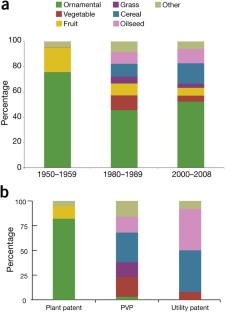
The alternative text for this image may have been generated using AI.
Figure 3: Changing composition of applicant pool, 1930–2008.

The alternative text for this image may have been generated using AI.
Figure 4: Increasing concentration of varietal rights applications, 1930–2008.
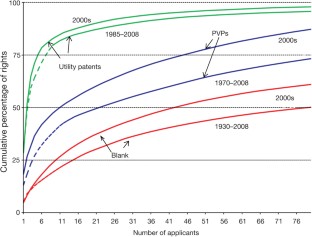
The alternative text for this image may have been generated using AI.
References
- Newman, M.R. USDA Agr. Lib. Notes 6, 35–42 (1931).
Google Scholar - (7 U.S.C. 2543 (d–e)).
- (7 U.S.C. 2541).
- Diamond v. Chakrabarty, 447 U.S. 303,309 (1980).
- J.E.M. Ag Supply v. Pioneer Hi-Bred Int'l. 534 U.S. 124 (2001).
- Monsanto Canada Inc. v. Schmeiser [2004] 1 S.C.R. 902, 2004 SCC 34.
- Louwaars, N.P. et al. Impacts of strengthened intellectual property rights regimes on the plant breeding industry in developing countries: a synthesis of five case studies (Wageningen, UR, 2005).
- Kimbrell, A. Fatal Harvest: The Tragedy of Industrial Agriculture (Island Press, 2002).
Google Scholar - ETC Group. Communiqué 100 (2008).
- Tansey, G. Food security, biotechnology and intellectual property: unpacking some issues around TRIPS (Quaker United Nations Office, 2002).
- Alston, J.M. & Venner, R.J. Res. Pol. 31, 527–542 (2002).
Article Google Scholar - Heald, P.J. & Chapman, S. Veggie tales: Pernicious myths about patents, innovation, and crop diversity in the twentieth century. Illinois Program in Law, Behavior and Social Science Paper No. LBSS11-34; Illinois Public Law Research Paper No. 11-03. (2011). http://ssrn.com/abstract=1928920
- Marco, A.C. & Rausser, G.C. Amer. J. Agr. Econ. 90, 133–151 (2008).
Article Google Scholar - Jerardo, A. Floriculture and nursery crops yearbook (USDA, ERS, 2007).
- Fernandez-Cornejo, J. Bulletin 786 (USDA, ERS, 2004)
Google Scholar - Jones, C.A., El-Osta, H. & Green, R. Econ. Brief 7 (USDA, ERS, 2006).
Google Scholar
Acknowledgements
The authors are especially appreciative of research assistance from C. Pratt, S. Pardey, M. Hallaway and C. Chan-Kang, and for the excellent assistance with data queries from personnel at the US Patent and Trademark Office and USDA's Plant Variety Protection Office. The research for this paper was supported by the International Science and Technology Policy (InSTePP) center at the University of Minnesota, the University of Waterloo, the US National Institutes of Health and the Bill and Melinda Gates Foundation, by way of the HarvestChoice project.
Author information
Authors and Affiliations
- Philip Pardey and Jennifer Drew are in the Department of Applied Economics, University of Minnesota, Minneapolis, Minnesota, USA.,
Philip Pardey & Jennifer Drew - Bonwoo Koo is in the Department of Management Sciences, University of Waterloo, Ontario, Canada.,
Bonwoo Koo - Jeffrey Horwich is a host of Marketplace from American Public Media, Los Angeles, California, USA.,
Jeffrey Horwich - Carol Nottenburg is at Cougar Patent Law, Renton, Washington, USA.,
Carol Nottenburg
Authors
- Philip Pardey
- Bonwoo Koo
- Jennifer Drew
- Jeffrey Horwich
- Carol Nottenburg
Corresponding author
Correspondence toPhilip Pardey.
Ethics declarations
Competing interests
The authors declare no competing financial interests.
Supplementary information
Rights and permissions
About this article
Cite this article
Pardey, P., Koo, B., Drew, J. et al. The evolving landscape of plant varietal rights in the United States, 1930–2008.Nat Biotechnol 31, 25–29 (2013). https://doi.org/10.1038/nbt.2467
- Published: 09 January 2013
- Issue date: January 2013
- DOI: https://doi.org/10.1038/nbt.2467