Targeting leukemia on the DOT (original) (raw)
- News & Views
- Published: 28 August 2011
Epigenetics
Nature Chemical Biology volume 7, pages 663–665 (2011)Cite this article
- 961 Accesses
- 5 Citations
- 6 Altmetric
- Metrics details
Subjects
A combination of chemical and genetic approaches has established a proof of concept in mouse models—with strong mechanistic underpinning—indicating that targeting the aberrantly recruited histone methyltransferase activity of DOT1L has therapeutic potential in aggressive leukemias driven by MLL fusion genes.
This is a preview of subscription content, access via your institution
Relevant articles
Open Access articles citing this article.
Childhood B-acute lymphoblastic leukemia: a genetic update
- Jennifer S Woo
- , Michael O Alberti
- & Carlos A Tirado
Experimental Hematology & Oncology Open Access 13 June 2014
Access options
Subscribe to this journal
Receive 12 print issues and online access
$259.00 per year
only $21.58 per issue
Buy this article
- Purchase on SpringerLink
- Instant access to the full article PDF.
USD 39.95
Prices may be subject to local taxes which are calculated during checkout
Additional access options:
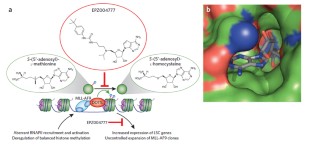
Figure 1: The first-in-class SAM-competitive and selective histone methyl transferase inhibitor EPZ004777 targets DOT1L-mediated H3K79 methylation at key MLL fusion target genes, leading to therapeutic effects in mixed-lineage leukemia.
References
- Krivtsov, A.V. & Armstrong, S.A. Nat. Rev. Cancer 7, 823–833 (2007).
Article CAS PubMed Google Scholar - Rodríguez-Paredes, M. & Esteller, M. Nat. Med. 17, 330–339 (2011).
Article PubMed Google Scholar - Ley, T.J. et al. N. Engl. J. Med. 363, 2424–2433 (2010).
Article CAS PubMed PubMed Central Google Scholar - Quivoron, C. et al. Cancer Cell 20, 25–38 (2011).
Article CAS PubMed Google Scholar - van Haaften, G. et al. Nat. Genet. 41, 521–523 (2009).
Article CAS PubMed PubMed Central Google Scholar - Morin, R.D. et al. Nat. Genet. 42, 181–185 (2010).
Article CAS PubMed PubMed Central Google Scholar - Guenther, M.G. et al. Genes Dev. 22, 3403–3408 (2008).
Article CAS PubMed PubMed Central Google Scholar - Workman, P. & Collins, I. Chem. Biol. 17, 561–577 (2010).
Article CAS PubMed PubMed Central Google Scholar - Copeland, R.A., Solomon, M.E. & Richon, V.M. Nat. Rev. Drug Discov. 8, 724–732 (2009).
Article CAS PubMed Google Scholar - Min, J., Feng, Q., Li, Z., Zhang, Y. & Xu, R.M. Cell 112, 711–723 (2003).
Article CAS PubMed Google Scholar - Daigle, S.R. et al. Cancer Cell 20, 53–65 (2011).
Article CAS PubMed PubMed Central Google Scholar - Bernt, K.M. et al. Cancer Cell 20, 66–78 (2011).
Article CAS PubMed PubMed Central Google Scholar - Vedadi, M. et al. Nat. Chem. Biol. 7, 566–574 (2011).
Article CAS PubMed PubMed Central Google Scholar
Acknowledgements
The authors wish to acknowledge B. Matijssen for assistance with Figure 1b.
Author information
Authors and Affiliations
- Division of Cancer Therapeutics, Jon Travers and Paul Workman are in the Signal Transduction and Molecular Pharmacology Team, Cancer Research UK Cancer Therapeutics Unit, The Institute of Cancer Research, Sutton, UK.,
Jon Travers & Paul Workman - Division of Cancer Therapeutics, Julian Blagg is in the Medicinal Chemistry Team, Cancer Research UK Cancer Therapeutics Unit, The Institute of Cancer Research, Sutton, UK.,
Julian Blagg
Authors
- Jon Travers
- Julian Blagg
- Paul Workman
Corresponding author
Correspondence toPaul Workman.
Ethics declarations
Competing interests
P.W. and J.B. are employees of and J.T. is a student of the Institute of Cancer Research. P.W. is also associated with Chroma Therapeutics and Nextech Invest Ltd.
Rights and permissions
About this article
Cite this article
Travers, J., Blagg, J. & Workman, P. Targeting leukemia on the DOT.Nat Chem Biol 7, 663–665 (2011). https://doi.org/10.1038/nchembio.661
- Published: 28 August 2011
- Issue date: October 2011
- DOI: https://doi.org/10.1038/nchembio.661