Implementation and opportunity costs of reducing deforestation and forest degradation in Tanzania (original) (raw)
- Letter
- Published: 29 May 2011
- Simon L. Lewis3,
- Neil D. Burgess4,5,
- Rogers E. Malimbwi6,
- Panteleo K. Munishi6,
- Ruth D. Swetnam4,
- R. Kerry Turner2,
- Simon Willcock3 &
- …
- Andrew Balmford4
Nature Climate Change volume 1, pages 161–164 (2011) Cite this article
- 2074 Accesses
- 107 Citations
- 27 Altmetric
- Metrics details
Subjects
An Erratum to this article was published on 31 May 2011
This article has been updated
Abstract
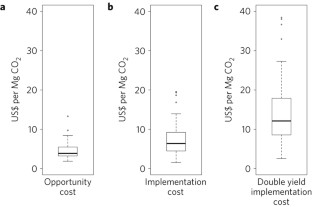
The Cancún Agreements provide strong backing for a REDD+ (Reducing Emissions from Deforestation and Forest Degradation) mechanism whereby developed countries pay developing ones for forest conservation1. REDD+ has potential to simultaneously deliver cost-effective climate change mitigation and human development2,3,4,5. However, most REDD+ analysis has used coarse-scale data, overlooked important opportunity costs to tropical forest users4,5 and failed to consider how to best invest funds to limit leakage, that is, merely displacing deforestation6. Here we examine these issues for Tanzania, a REDD+ country, by comparing district-scale carbon losses from deforestation with the opportunity costs of carbon conservation. Opportunity costs are estimated as rents from both agriculture and charcoal production (the most important proximate causes of regional forest conversion7,8,9). As an alternative we also calculate the implementation costs of alleviating the demand for forest conversion—thereby addressing the problem of leakage—by raising agricultural yields on existing cropland and increasing charcoal fuel-use efficiency. The implementation costs exceed the opportunity costs of carbon conservation (medians of US$6.50 versus US$3.90 per Mg CO2), so effective REDD+ policies may cost more than simpler estimates suggest. However, even if agricultural yields are doubled, implementation is possible at the competitive price of ∼US$12 per Mg CO2.
This is a preview of subscription content, access via your institution
Access options
Subscribe to this journal
Receive 12 print issues and online access
$259.00 per year
only $21.58 per issue
Buy this article
- Purchase on SpringerLink
- Instant access to the full article PDF.
USD 39.95
Prices may be subject to local taxes which are calculated during checkout
Additional access options:
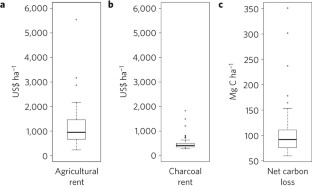
Figure 1: District-level results for agricultural rent, charcoal rent and carbon lost under forest conversion.
The alternative text for this image may have been generated using AI.
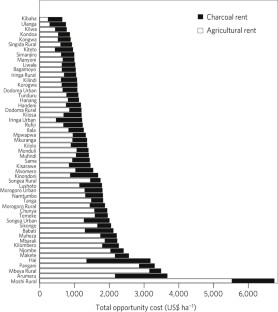
Figure 2: Opportunity cost of forest conservation.
The alternative text for this image may have been generated using AI.
Figure 3: Opportunity and implementation cost estimates for REDD+.
The alternative text for this image may have been generated using AI.
Change history
31 May 2011
In the abstract of the version of this Letter previously published, the third sentence from the end should have referred to '...alleviating the demand for forest conversion...'. This has now been corrected in the HTML and PDF versions of this Letter.
References
- UNFCCC Draft Decision -/CP.16 (United Nations Framework Convention on Climate Change, 2010).
- Miles, L. & Kapos, V. Reducing greenhouse gas emissions from deforestation and forest degradation: Global land-use implications. Science 320, 1454–1455 (2008).
Article CAS Google Scholar - Campbell, B. M. Beyond Copenhagen: REDD+, agriculture, adaptation strategies and poverty. Glob. Environ. Change 19, 397–399 (2009).
Article Google Scholar - Strassburg, B., Turner, R. K., Fisher, B., Schaeffer, R. & Lovett, A. Reducing emissions from deforestation—the ‘combined incentives’ mechanism and empirical simulations. Glob. Environ. Change 19, 265–278 (2009).
Article Google Scholar - Kindermann, G. et al. Global cost estimates of reducing carbon emissions through avoided deforestation. Proc. Natl Acad. Sci. USA 105, 10302–10307 (2008).
Article CAS Google Scholar - Phelps, J., Webb, E. L. & Agrawal, A. Does REDD+ threaten to recentralize forest governance? Science 328, 312–313 (2010).
Article CAS Google Scholar - Geist, H. J. & Lambin, E. F. Proximate causes and underlying driving forces of tropical deforestation. Bioscience 52, 143–150 (2002).
Article Google Scholar - Rindfuss, R. R. et al. Frontier land use change: Synthesis, challenges, and next steps. Annu. Assoc. Am. Geograph. 97, 739–754 (2007).
Article Google Scholar - Fisher, B. African exception to drivers of deforestation. Nature Geosci. 3, 375–376 (2010).
Article CAS Google Scholar - Alcamo, J. et al. Millennium Ecosystem Assessment: Scenarios Assessment (Island Press, 2005).
Google Scholar - Lewis, S. L. et al. Increasing carbon storage in intact African tropical forests. Nature 457, 1003–1006 (2009).
Article CAS Google Scholar - Ahrends, A. et al. Predictable waves of sequential forest degradation and biodiversity loss spreading from an African city. Proc. Natl Acad. Sci. USA 107, 14556–14561 (2010).
Article Google Scholar - National Sample Census of Agriculture 2002–2003. (National Bureau of Statistics, Ministry of Agriculture and Food Security, Ministry of Water and Livestock Development, Ministry of Cooperatives and Marketing, Presidents Office, Regional Administration and Local Government, Ministry of Finance and Economic Affairs, Dar es Salaam, Tanzania, 2007).
- Mwampamba, T. H. Has the woodfuel crisis returned? Urban charcoal consumption in Tanzania and its implications to present and future forest availability. Energ. Policy 35, 4221–4234 (2007).
Article Google Scholar - Hyden, G. Governance and poverty reduction in Africa. Proc. Natl Acad. Sci. USA 104, 16751–16756 (2007).
Article CAS Google Scholar - Rockstrom, J. et al. Conservation farming strategies in East and Southern Africa: Yields and rain water productivity from on-farm action research. Soil. Till. Res. 103, 23–32 (2009).
Article Google Scholar - Sanchez, P. et al. The African Millennium Villages. Proc. Natl Acad. Sci. USA 104, 16775–16780 (2007).
Article CAS Google Scholar - Sanchez, P. A. Tripling crop yields in tropical Africa. Nature Geosci. 3, 299–300 (2010).
Article CAS Google Scholar - Ewers, R. M., Scharlemann, J. P. W., Balmford, A. & Green, R. E. Do increases in agricultural yield spare land for nature? Glob. Change Biol. 15, 1716–1726 (2009).
Article Google Scholar - Rudel, T. K. et al. Agricultural intensification and changes in cultivated areas, 1970–2005. Proc. Natl Acad. Sci. USA 106, 20675–20680 (2009).
Article CAS Google Scholar - Angelsen, A. & Kaimowitz, D. Rethinking the causes of deforestation: Lessons from economic models. World Bank Res. Obser. 14, 73–98 (1999).
Article CAS Google Scholar - Bailis, R., Ezzati, M. & Kammen, D. Mortality and greenhouse gas impacts of biomass and petroleum energy futures in Africa. Science 308, 98–103 (2005).
Article CAS Google Scholar - Kammen, D. M. Cookstoves for the developing world. Sci. Am. 273, 72–75 (1995).
Article Google Scholar - Zein-Elabdin, E.O. Improved stoves in Sub-Saharan Africa: The case of the Sudan. Energ. Econom. 19, 465–475 (1997).
Article Google Scholar - DeFries, R. & Rosenzweig, C. Toward a whole-landscape approach for sustainable land use in the tropics. Proc. Natl Acad. Sci. USA 107, 19627–19632 (2010).
Article CAS Google Scholar - West, P.C. et al. Trading carbon for food: Global comparison of carbon stocks vs. crop yields on agricultural land. Proc. Natl Acad. Sci. USA 107, 19645–19648 (2010).
Article CAS Google Scholar - Palm, C. A. et al. Identifying potential synergies and trade-offs for meeting food security and climate change objectives in sub-Saharan Africa. Proc. Natl Acad. Sci. USA 107, 19661–19666 (2010).
Article CAS Google Scholar - Ferraro, P. J. & Pattanayak, S. K. Money for nothing? A call for empirical evaluation of biodiversity conservation investments. PLoS Biol. 4, 482–488 (2006).
Article CAS Google Scholar - Danielsen, F. et al. At the heart of REDD+: a role for local people in monitoring forests? Conserv. Lett. 4, 158–167 (2011).
Article Google Scholar
Acknowledgements
Funding was provided by The Leverhulme Trust (UK) under the ‘Valuing the Arc’ programme. B.F. was partially funded by a Program in Science, Technology and Environmental Policy (STEP) fellowship at Princeton University. We thank L. Estes, K. Kulindwa, B. Mbilinyi, S. Mwakalila, S. Morse-Jones, R. Naidoo, N. Olwero, B. Phalan, T. Ricketts, P. Sanchez, B. Strassburg and D. Wilcove for helpful discussions and comments.
Author information
Authors and Affiliations
- Program in Science, Technology and Environmental Policy (STEP), Woodrow Wilson School of Public and International Affairs, Princeton University, Princeton, New Jersey 08544, USA
Brendan Fisher - Centre for Social and Economic Research on the Global Environment, University of East Anglia, Norwich NR4 7TJ, UK
Brendan Fisher & R. Kerry Turner - School of Geography, University of Leeds, Leeds, LS2 9JT, UK
Simon L. Lewis & Simon Willcock - Department of Zoology, Conservation Science Group, University of Cambridge, Cambridge CB2 3EJ, UK
Neil D. Burgess, Ruth D. Swetnam & Andrew Balmford - WWF-US Conservation Science Program, 1250 24th Street, Washington DC, USA
Neil D. Burgess - Faculty of Forestry & Nature Conservation, Sokoine University of Agriculture, Chuo Kikuu, Morogoro, Tanzania
Rogers E. Malimbwi & Panteleo K. Munishi
Authors
- Brendan Fisher
- Simon L. Lewis
- Neil D. Burgess
- Rogers E. Malimbwi
- Panteleo K. Munishi
- Ruth D. Swetnam
- R. Kerry Turner
- Simon Willcock
- Andrew Balmford
Contributions
B.F. and A.B. conceived the study. B.F., A.B., S.L.L., N.D.B. and R.K.T. designed the study. B.F., S.L.L., R.E.M., P.K.M. and S.W. collected data. B.F., A.B., S.L.L., R.D.S., R.E.M., P.K.M. and S.W. analysed the data. B.F., A.B. and S.L.L. wrote the paper.
Corresponding author
Correspondence toBrendan Fisher.
Ethics declarations
Competing interests
The authors declare no competing financial interests.
Supplementary information
Rights and permissions
About this article
Cite this article
Fisher, B., Lewis, S., Burgess, N. et al. Implementation and opportunity costs of reducing deforestation and forest degradation in Tanzania.Nature Clim Change 1, 161–164 (2011). https://doi.org/10.1038/nclimate1119
- Received: 06 January 2011
- Accepted: 27 February 2011
- Published: 29 May 2011
- Issue date: June 2011
- DOI: https://doi.org/10.1038/nclimate1119