Land use alters the resistance and resilience of soil food webs to drought (original) (raw)
- Letter
- Published: 29 January 2012
- Mira E. Liiri2,
- Lisa Bjørnlund3,
- Matthew A. Bowker4,
- Søren Christensen3,
- Heikki M. Setälä2 &
- …
- Richard D. Bardgett1
Nature Climate Change volume 2, pages 276–280 (2012) Cite this article
- 9690 Accesses
- 599 Citations
- 31 Altmetric
- Metrics details
Subjects
Abstract
Soils deliver several ecosystem services including carbon sequestration and nutrient cycling, which are of central importance to climate mitigation and sustainable food production1,2,3. Soil biota play an important role in carbon and nitrogen cycling, and, although the effects of land use on soil food webs are well documented4,5,6, the consequences for their resistance and resilience to climate change are not known. We compared the resistance and resilience to drought—which is predicted to increase under climate change2,7—of soil food webs of two common land-use systems: intensively managed wheat with a bacterial-based soil food web and extensively managed grassland with a fungal-based soil food web. We found that the fungal-based food web, and the processes of C and N loss it governs, of grassland soil was more resistant, although not resilient, and better able to adapt to drought than the bacterial-based food web of wheat soil. Structural equation modelling revealed that fungal-based soil food webs and greater microbial evenness mitigated C and N loss. Our findings show that land use strongly affects the resistance and resilience of soil food webs to climate change, and that extensively managed grassland promotes more resistant, and adaptable, fungal-based soil food webs.
This is a preview of subscription content, access via your institution
Access options
Subscribe to this journal
Receive 12 print issues and online access
$259.00 per year
only $21.58 per issue
Buy this article
- Purchase on SpringerLink
- Instant access to the full article PDF.
USD 39.95
Prices may be subject to local taxes which are calculated during checkout
Additional access options:
Figure 1: Resistance and resilience of soil food webs to a laboratory drought as affected by a previous field drought.
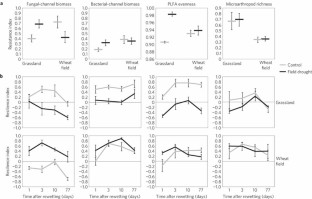
The alternative text for this image may have been generated using AI.
Figure 2: Resistance and resilience of C and N losses to a laboratory drought as affected by a previous field drought.
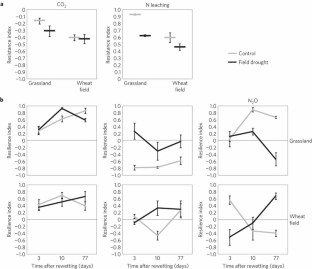
The alternative text for this image may have been generated using AI.
Figure 3: Relationships between remaining variance in soil-food-web characteristics and C and N fluxes, after variance accounted for by experimental treatments has been removed, 1, 3, 10 and 77 days after rewetting.
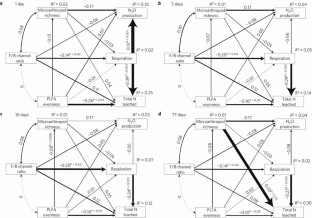
The alternative text for this image may have been generated using AI.
References
- Godfray, H. C. J. et al. Food security: The challenge of feeding 9 billion people. Science 327, 812–818 (2010).
Article CAS Google Scholar - Gornall, J. et al. Implications of climate change for agricultural productivity in the early twenty-first century. Phil. Trans. R. Soc. B 365, 2973–2989 (2010).
Article Google Scholar - Power, A.G. Ecosystem services and agriculture: Tradeoffs and synergies. Phil. Trans. R. Soc. B 365, 2959–2971 (2010).
Article Google Scholar - Bardgett, R. D. & Cook, R. Functional aspects of soil animal diversity in agricultural grasslands. Appl. Soil Ecol. 10, 263–276 (1998).
Article Google Scholar - De Vries, F. T., Hoffland, E., van Eekeren, N., Brussaard, L. & Bloem, J. Fungal/bacterial ratios in grasslands with contrasting nitrogen management. Soil Biol. Biochem. 38, 2092–2103 (2006).
Article CAS Google Scholar - Postma-Blaauw, M. B., de Goede, R. G. M., Bloem, J., Faber, J. H. & Brussaard, L. Soil biota community structure and abundance under agricultural intensification and extensification. Ecology 91, 460–473 (2010).
Article Google Scholar - IPCC Climate Change 2007: The Physical Science Basis (eds Solomon, S., et al.) (Cambridge Univ. Press, 2007).
- Bardgett, R. D., Freeman, C. & Ostle, N. J. Microbial contributions to climate change through carbon cycle feedbacks. ISME J. 2, 805–814 (2008).
Article CAS Google Scholar - Bardgett, R. D. The Biology of Soil: A Community and Ecosystem Approach (Oxford Univ. Press, 2005).
Book Google Scholar - Bardgett, R. D. & McAlister, E. The measurement of soil fungal:bacterial biomass ratios as an indicator of ecosystem self-regulation in temperate meadow grasslands. Biol. Fertil. Soils 29, 282–290 (1999).
Article Google Scholar - Hedlund, K. et al. Trophic interactions in changing landscapes: Responses of soil food webs. Basic Appl. Ecol. 5, 495–503 (2004).
Article Google Scholar - Wardle, D. A. Controls of temporal variability of the soil microbial biomass: A global-scale synthesis. Soil Biol. Biochem. 30, 1627–1637 (1998).
Article CAS Google Scholar - De Vries, F. T., Van Groenigen, J. W., Hoffland, E. & Bloem, J. Nitrogen losses from two grassland soils with different fungal biomass. Soil Biol. Biochem. 43, 997–1005 (2011).
Article CAS Google Scholar - Gordon, H., Haygarth, P. M. & Bardgett, R. D. Drying and rewetting effects on soil microbial community composition and nutrient leaching. Soil Biol. Biochem. 40, 302–311 (2008).
Article CAS Google Scholar - Six, J., Frey, S. D., Thiet, R. K. & Batten, K. M. Bacterial and fungal contributions to carbon sequestration in agroecosystems. Soil Sci. Soc. Am. J. 70, 555–569 (2006).
Article CAS Google Scholar - Wilson, G. W. T., Rice, C. W., Rillig, M. C., Springer, A. & Hartnett, D. C. Soil aggregation and carbon sequestration are tightly correlated with the abundance of arbuscular mycorrhizal fungi: Results from long-term field experiments. Ecol. Lett. 12, 452–461 (2009).
Article Google Scholar - Vauramo, S. & Setälä, H. Urban belowground food-web responses to plant community manipulation—impacts on nutrient dynamics. Landsc. Urban Plan. 97, 1–10 (2010).
Article Google Scholar - Pimm, S. L. The complexity and stability of ecosystems. Nature 307, 321–326 (1984).
Article Google Scholar - Grime, J. P. Plant Strategies, Vegetation Processes, and Ecosystem Properties (Wiley, 2001).
Google Scholar - Orwin, K. H., Wardle, D. A. & Greenfield, L. G. Context-dependent changes in the resistance and resilience of soil microbes to an experimental disturbance for three primary plant chronosequences. Oikos 112, 196–208 (2006).
Article Google Scholar - Holtkamp, R. et al. Soil food web structure during ecosystem development after land abandonment. Appl. Soil Ecol. 39, 23–34 (2008).
Article Google Scholar - Orwin, K. H. & Wardle, D. A. New indices for quantifying the resistance and resilience of soil biota to exogenous disturbances. Soil Biol. Biochem. 36, 1907–1912 (2004).
Article CAS Google Scholar - Cole, L., Buckland, S. M. & Bardgett, R. D. Relating microarthropod community structure and diversity to soil fertility manipulations in temperate grassland. Soil Biol. Biochem. 37, 1707–1717 (2005).
Article CAS Google Scholar - Chapuis-Lardy, L., Wrage, N., Metay, A., Chotte, J. L. & Bernoux, M. Soils, a sink for N2O? A review. Glob. Change Biol. 13, 1–17 (2007).
Article Google Scholar - Cavigelli, M. A. & Robertson, G. P. The functional significance of denitrifier community composition in a terrestrial ecosystem. Ecology 81, 1402–1414 (2000).
Article Google Scholar - Liiri, M., Setälä, H., Haimi, J., Pennanen, T. & Fritze, H. Relationship between soil microarthropod species diversity and plant growth does not change when the system is disturbed. Oikos 96, 137–149 (2002).
Article Google Scholar
Acknowledgements
This project was part of the EU Seventh Framework funded SOILSERVICE project, led by K. Hedlund. We thank all project partners for contributing to this manuscript through discussions. We thank S. Mortimer and D. Carpenter for setting up the field experiment, and G. Hildred for allowing us into his fields. H. Quirk, L. Trimnell, V. van Velzen, A. Spangenberg, L. F. Petersen, I. Dodd, G. Mies, F. Willeboordse, B. v/d Waterbeemd, C. Siderius, E. Wilson and K. Wilson helped with field and laboratory work. We thank K. Orwin and W. van der Putten for commenting on the manuscript.
Author information
Authors and Affiliations
- Soil and Ecosystem Ecology, Lancaster Environment Centre, Lancaster University, Lancaster LA1 3EX, UK
Franciska T. de Vries & Richard D. Bardgett - Department of Environmental Sciences, University of Helsinki, Niemenkatu 73, Lahti, FIN-15140, Finland
Mira E. Liiri & Heikki M. Setälä - Biologisk Institut, Terrestrisk Økologi, Øster Farimagsgade 2D, 1353 København K, Denmark
Lisa Bjørnlund & Søren Christensen - Southwest Biological Science Center, US Geological Survey, PO Box 5614, Building 56 No 150, Flagstaff, Arizona 86011, USA
Matthew A. Bowker
Authors
- Franciska T. de Vries
- Mira E. Liiri
- Lisa Bjørnlund
- Matthew A. Bowker
- Søren Christensen
- Heikki M. Setälä
- Richard D. Bardgett
Contributions
R.D.B., H.M.S., S.C., F.T.d.V., M.E.L. and L.B. had the original idea for the experiment. F.T.d.V. set up the experiment, and laboratory work was conducted by F.T.d.V., M.E.L. and L.B. M.A.B. carried out the structural equation modelling. The manuscript was written principally by F.T.d.V. and R.D.B., with extensive input from H.M.S., S.C., M.E.L., L.B. and M.A.B.
Corresponding author
Correspondence toFranciska T. de Vries.
Ethics declarations
Competing interests
The authors declare no competing financial interests.
Supplementary information
Rights and permissions
About this article
Cite this article
de Vries, F., Liiri, M., Bjørnlund, L. et al. Land use alters the resistance and resilience of soil food webs to drought.Nature Clim Change 2, 276–280 (2012). https://doi.org/10.1038/nclimate1368
- Received: 28 February 2011
- Accepted: 06 December 2011
- Published: 29 January 2012
- Issue date: April 2012
- DOI: https://doi.org/10.1038/nclimate1368