Pathways of human development and carbon emissions embodied in trade (original) (raw)
- Letter
- Published: 22 January 2012
Nature Climate Change volume 2, pages 81–85 (2012) Cite this article
- 4223 Accesses
- 212 Citations
- 66 Altmetric
- Metrics details
Subjects
Abstract
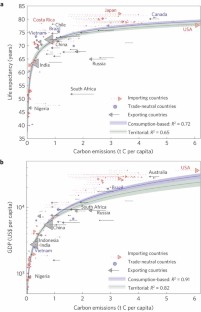
It has long been assumed that human development depends on economic growth, that national economic expansion in turn requires greater energy use and, therefore, increased greenhouse-gas emissions. These interdependences are the topic of current research. Scarcely explored, however, is the impact of international trade: although some nations develop socio-economically and import high-embodied-carbon products, it is likely that carbon-exporting countries gain significantly fewer benefits. Here, we use new consumption-based measures of national carbon emissions1 to explore how the relationship between human development and carbon changes when we adjust national emission rates for trade. Without such adjustment of emissions, some nations seem to be getting far better development ‘bang’ for the carbon ‘buck’ than others, who are showing scant gains for disproportionate shares of global emissions. Adjusting for the transfer of emissions through trade explains many of these outliers, but shows that further socio-economic benefits are accruing to carbon-importing rather than carbon-exporting countries. We also find that high life expectancies are compatible with low carbon emissions but high incomes are not. Finally, we see that, despite strong international trends, there is no deterministic industrial development trajectory: there is great diversity in pathways, and national histories do not necessarily follow the global trends.
This is a preview of subscription content, access via your institution
Access options
Subscribe to this journal
Receive 12 print issues and online access
$259.00 per year
only $21.58 per issue
Buy this article
- Purchase on SpringerLink
- Instant access to the full article PDF.
USD 39.95
Prices may be subject to local taxes which are calculated during checkout
Additional access options:
Figure 1: Correcting for trade: how moving from territorial to consumption-based emissions changes the relation between carbon and human development.
The alternative text for this image may have been generated using AI.
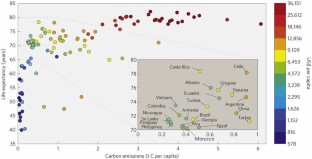
Figure 2: Simultaneous visualization of international life expectancy, income and consumption-based carbon emissions in 2004.
The alternative text for this image may have been generated using AI.
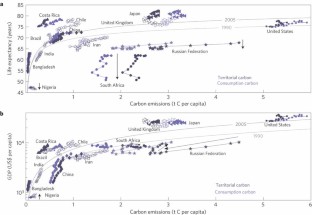
Figure 3: National development trajectories 1990–2005 for life expectancy, income and territorial and consumption-based emissions.
The alternative text for this image may have been generated using AI.
References
- Peters, G. P., Minx, J. C., Weber, C. L. & Edenhofer, O. Growth in emission transfers via international trade from 1990 to 2008. Proc. Natl Acad. Sci. USA 108, 8903–8908 (2011).
Article CAS Google Scholar - UNFCCC United Nations Framework Convention on Climate Change (United Nations, 1992); available at http://unfccc.int/resource/docs/convkp/conveng.pdf.
- Boden, T. A., Marland, G. & Andres, R. J. Global, Regional, and National Fossil-Fuel CO 2 Emissions (Carbon Dioxide Information Analysis Center (CDIAC), Oak Ridge National Laboratory, US Department of Energy, 2009).
- Meinshausen, M. et al. The RCP greenhouse gas concentrations and their extensions from 1765 to 2300. Climatic Change 109, 213–241 (2011).
Article CAS Google Scholar - Baer, P., Athanasiou, T. & Kartha, S. in The Right to Development in a Climate Constrained World: The Greenhouse Development Rights Framework 1–95 (Heinrich Böll Foundation, Christian Aid, EcoEquity and the Stockholm Environment Institute, 2007); available at http://ecoequity.org/docs/TheGDRsFramework-first.pdf.
Google Scholar - Cottrell, F. Energy and Society. The Relation between Energy, Social Change, and Economic Development (McGraw-Hill Book Company, 1955).
Google Scholar - Mazur, A. & Rosa, E. Energy and life-style. Science 186, 607–610 (1974).
Article CAS Google Scholar - UNDP Energy as an Instrument for Socio-Economic Development (United Nations Development Programme, 1995).
- Goldemberg, J. & Johansson, T. B. in World Energy Assessment. Overview 2004 Update 1–85 (United Nations Development Programme, United Nations Department of Economic and Social Affairs and the World Energy Council, 2004); available at http://www.undp.org/energy/weaover2004.htm.
Google Scholar - Wilkinson, P., Smith, K. R., Joffe, M. & Haines, A. A global perspective on energy: Health effects and injustices. Lancet 370, 965–978 (2007).
Article Google Scholar - Preston, S. H. The changing relation between mortality and level of economic development. Int. J. Epidemiol. 36, 484–490 (2007).
Article Google Scholar - UNDP Human Development Report 2010. The Real Wealth of Nations: Pathways to Human Development (United Nations Development Programme, 2010).
- Steinberger, J. K. & Roberts, J. T. From constraint to sufficiency: The decoupling of energy and carbon from human needs, 1975–2005. Ecol. Econ. 70, 425–433 (2010).
Article Google Scholar - Peters, G. P. & Hertwich, E. G. CO2 embodied in international trade with implications for global climate policy. Environ. Sci. Technol. 42, 1401–1407 (2008).
Article CAS Google Scholar - Davis, S. J. & Caldeira, K. Consumption-based accounting of CO2 emissions. Proc. Natl Acad. Sci. USA 107, 5687–5692 (2010).
Article CAS Google Scholar - Hertwich, E. G. & Peters, G. P. Carbon footprint of nations: A global, trade-linked analysis. Environ. Sci. Technol. 43, 6414–6420 (2009).
Article CAS Google Scholar - Levinson, A. Offshoring pollution: Is the United States increasingly importing polluted goods? Rev. Environ. Econ. Policy 4, 63–83 (2010).
Article Google Scholar - Peters, G. P. Policy update: Managing carbon leakage. Carbon Manage. 1, 35–37 (2010).
Article Google Scholar - Caldeira, K. & Davis, S. J. Accounting for carbon dioxide emissions: A matter of time. Proc. Natl Acad. Sci. USA 108, 8533–8534 (2011).
Article CAS Google Scholar - Roberts, J. T. & Parks, B. C. A Climate of Injustice. Global Inequality, North–South Politics, and Climate Policy (MIT Press, 2007).
Google Scholar - Dicken, P. Global Shift: Mapping the Changing Contours of the World Economy Sixth Edition (Sage, 2010).
Google Scholar - Bunker, S. G. Modes of extraction, unequal exchange, and the progressive underdevelopment of an extreme periphery: The Brazilian Amazon, 1600–1980. Am. J. Sociol. 89, 1017–1064 (1984).
Article Google Scholar - Unruh, G. C. & Carrillo-Hermosilla, J. Globalizing carbon lock-in. Energ. Policy 34, 1185–1197 (2006).
Article Google Scholar - Stern, D. Between estimates of the emissions-income elasticity. Ecol. Econ. 69, 2173–2182 (2010).
Article Google Scholar - Rothman, D. S. Environmental Kuznets curves—real progress or passing the buck? A case for consumption-based approaches. Ecol. Econ. 25, 177–194 (1998).
Article Google Scholar - Suri, V. & Chapman, D. Economic growth, trade and energy: Implications for the environmental Kuznets curve. Ecol. Econ. 25, 195–208 (1998).
Article Google Scholar - Wiedmann, T. et al. A carbon footprint time series of the UK—results from a Multi-Region Input–Output model. Econ. Syst. Res. 22, 19–42 (2010).
Article Google Scholar - Baiocchi, G. & Minx, J. C. Understanding changes in the UK’s CO2 emissions: A global perspective. Environ. Sci. Technol. 44, 1177–1184 (2010).
Article CAS Google Scholar - UN World Urbanization Prospects: The 2007 Revision (United Nations, Department of Economic and Social Affairs, Population Division, 2008).
- The World Bank World Development Indicators (World Bank, 2010); available at http://data.worldbank.org/data-catalog.
Acknowledgements
J.T.R.’s start-up research fund from Brown University was critical in the completion of this work. We thank J. Karstensen of CICERO for help with Fig. 1.
Author information
Authors and Affiliations
- Sustainability Research Institute and Centre for Climate Change Economics and Policy, School of Earth and Environment, University of Leeds, Maths/Earth and Environment Building, Leeds LS2 9JT, UK
Julia K. Steinberger - Institute of Social Ecology Vienna, Alpen-Adria University, 29 Schottenfeldgasse, A-1070, Austria
Julia K. Steinberger - Center for Environmental Studies, Brown University, Providence, Rhode Island 02912, Box 1943, 135 Angell Street, USA
J. Timmons Roberts - Center for International Climate and Environmental Research—Oslo (CICERO), PB 1129 Blindern, 0318 Oslo, Norway
Glen P. Peters - Norwich Business School, University of East Anglia, Norwich Research Park, Norwich NR4 7TJ, UK
Giovanni Baiocchi
Authors
- Julia K. Steinberger
- J. Timmons Roberts
- Glen P. Peters
- Giovanni Baiocchi
Contributions
J.K.S. and J.T.R. designed the research; J.K.S. and G.B. conducted the analysis; G.P.P. provided the consumption-based carbon data and feedback on its analysis; J.K.S., J.T.R. and G.P.P. wrote the paper.
Corresponding author
Correspondence toJulia K. Steinberger.
Ethics declarations
Competing interests
The authors declare no competing financial interests.
Supplementary information
Rights and permissions
About this article
Cite this article
Steinberger, J., Roberts, J., Peters, G. et al. Pathways of human development and carbon emissions embodied in trade.Nature Clim Change 2, 81–85 (2012). https://doi.org/10.1038/nclimate1371
- Received: 07 July 2011
- Accepted: 06 December 2011
- Published: 22 January 2012
- Issue date: February 2012
- DOI: https://doi.org/10.1038/nclimate1371