Detecting regional anthropogenic trends in ocean acidification against natural variability (original) (raw)
- Letter
- Published: 22 January 2012
- A. Timmermann1,
- A. Abe-Ouchi2,
- N. R. Bates3,
- M. O. Chikamoto2,
- M. J. Church4,
- J. E. Dore5,
- D. K. Gledhill6,
- M. González-Dávila7,
- M. Heinemann1,
- T. Ilyina8,
- J. H. Jungclaus8,
- E. McLeod9,
- A. Mouchet10 &
- …
- J. M. Santana-Casiano7
Nature Climate Change volume 2, pages 167–171 (2012) Cite this article
- 2693 Accesses
- 92 Citations
- 88 Altmetric
- Metrics details
Subjects
Abstract
Since the beginning of the Industrial Revolution humans have released ∼500 billion metric tons of carbon to the atmosphere through fossil-fuel burning, cement production and land-use changes1,[2](/articles/nclimate1372#ref-CR2 "Boden, T., Marland, G. & Andres, R. Global, Regional, and National Fossil-Fuel CO 2 Emissions Tech. Rep. http://dx.doi.org/10.3334/CDIAC/00001V2010
(Carbon Dioxide Information Analysis Center, Oak Ridge National Laboratory, US Department of Energy, 2010)."). About 30% has been taken up by the oceans[3](/articles/nclimate1372#ref-CR3 "Canadell, J. et al. Contributions to accelerating atmospheric CO2 growth from economic activity, carbon intensity, and efficiency of natural sinks. Proc. Natl Acad. Sci. USA 104, 18866–18870 (2007)."). The oceanic uptake of carbon dioxide leads to changes in marine carbonate chemistry resulting in a decrease of seawater pH and carbonate ion concentration, commonly referred to as ocean acidification. Ocean acidification is considered a major threat to calcifying organisms[4](/articles/nclimate1372#ref-CR4 "Raven, J. et al. Ocean Acidification Due to Increasing Atmospheric Carbon Dioxide 60, Tech. Rep. (The Royal Society, 2005)."),[5](/articles/nclimate1372#ref-CR5 "Kleypas, J. A. et al. Impacts of Ocean Acidification on Coral Reefs and Other Marine Calcifiers: A Guide for Future Research. Tech. Rep. (NSF, NOAA, and the US Geological Survey, 2006)."),[6](/articles/nclimate1372#ref-CR6 "National Research Council Report Ocean Acidification: A National Strategy to Meet the Challenges of a Changing Ocean 152 (National Academy of Science, 2010)."). Detecting its magnitude and impacts on regional scales requires accurate knowledge of the level of natural variability of surface ocean carbonate ion concentrations on seasonal to annual timescales and beyond. Ocean observations are severely limited with respect to providing reliable estimates of the signal-to-noise ratio of human-induced trends in carbonate chemistry against natural factors. Using three Earth system models we show that the current anthropogenic trend in ocean acidification already exceeds the level of natural variability by up to 30 times on regional scales. Furthermore, it is demonstrated that the current rates of ocean acidification at monitoring sites in the Atlantic and Pacific oceans exceed those experienced during the last glacial termination by two orders of magnitude.This is a preview of subscription content, access via your institution
Access options
Subscribe to this journal
Receive 12 print issues and online access
$259.00 per year
only $21.58 per issue
Buy this article
- Purchase on SpringerLink
- Instant access to the full article PDF.
USD 39.95
Prices may be subject to local taxes which are calculated during checkout
Additional access options:
Figure 1: Regional signal-to-noise ratio of  .
.

The alternative text for this image may have been generated using AI.
Figure 2: First year of detectability of anthropogenic trend.
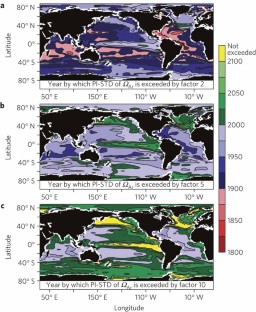
The alternative text for this image may have been generated using AI.
Figure 3: Current trends in the context of the Last Glacial Termination.

The alternative text for this image may have been generated using AI.
References
- Houghton, R. Revised estimates of the annual net flux of carbon to the atmosphere from changes in land use and land management 1850–2000. Tellus B 55, 378390 (2003).
Google Scholar - Boden, T., Marland, G. & Andres, R. Global, Regional, and National Fossil-Fuel CO 2 Emissions Tech. Rep. http://dx.doi.org/10.3334/CDIAC/00001V2010 (Carbon Dioxide Information Analysis Center, Oak Ridge National Laboratory, US Department of Energy, 2010).
- Canadell, J. et al. Contributions to accelerating atmospheric CO2 growth from economic activity, carbon intensity, and efficiency of natural sinks. Proc. Natl Acad. Sci. USA 104, 18866–18870 (2007).
Article CAS Google Scholar - Raven, J. et al. Ocean Acidification Due to Increasing Atmospheric Carbon Dioxide 60, Tech. Rep. (The Royal Society, 2005).
- Kleypas, J. A. et al. Impacts of Ocean Acidification on Coral Reefs and Other Marine Calcifiers: A Guide for Future Research. Tech. Rep. (NSF, NOAA, and the US Geological Survey, 2006).
- National Research Council Report Ocean Acidification: A National Strategy to Meet the Challenges of a Changing Ocean 152 (National Academy of Science, 2010).
- Riebesell, U. et al. Reduced calcification of marine plankton in response to increased atmospheric CO2 . Nature 407, 364–367 (2000).
Article CAS Google Scholar - Langdon, C. & Atkinson, M. J. Effect of elevated _p_CO2 on photosynthesis and calcification of corals and interactions with seasonal change in temperature/irradiance and nutrient enrichment. J. Geophys. Res. 110, C09S07 (2005).
Article Google Scholar - Jungclaus, J. H. et al. Climate and carbon-cycle variability over the last millennium. Clim. Past 6, 723–737 (2010).
Article Google Scholar - Cooley, S. R., Lucey, N., Kite-Powell, H. & Doney, S. C. Nutrition and income from molluscs today imply vulnerability to ocean acidification tomorrow. Fish Fish.http://dx.doi.org/10.1111/j.1467-2979.2011.00424.x (2011).
- Manzello, D. P. Coral growth with thermal stress and ocean acidification: lessons from the eastern tropical Pacific. Coral Reefs 29, 749–758 (2010).
Article Google Scholar - McNeil, B. & Matear, R. Southern Ocean acidification: A tipping point at 450-ppm atmospheric CO2 . Proc. Natl Acad. Sci. USA 105, 18860–18864 (2008).
Article CAS Google Scholar - Feely, R. A., Sabine, C., Hernandez-Ayon, J. M., Ianson, D. & Hales, B. Evidence for upwelling of corrosive acidified water onto the continental shelf. Science 320, 1490–1492 (2008).
Article CAS Google Scholar - Moy, A. D., Howard, W. R., Bray, S. G. & Trull, T. W. Reduced calcification in modern Southern Ocean planktonic foraminifera. Nature Geosci. 2, 276–280 (2009).
Article CAS Google Scholar - Yamamoto-Kawai, M., McLaughlin, F. A., Carmack, E. C., Nishino, S. & Shimada, K. Aragonite undersaturation in the Arctic Ocean: Effects of ocean acidification and sea ice melt. Science 326, 1098–1100 (2009).
Article CAS Google Scholar - Ilyina, T. et al. Early detection of ocean acidification effects on marine calcification. Glob. Biogeochem. Cycles 23, GB1008 (2009).
Article Google Scholar - Atzesu-Scott, K. et al. Calcium carbonate saturation states in the waters of the Canadian Arctic Archipelago and the Labrador Sea. J. Geophys. Res. 115, C11021 (2010).
Article Google Scholar - Beaufort, L. et al. Sensitivity of coccolithophores to carbonate chemistry and ocean acidification. Nature 476, 80–83 (2011).
Article CAS Google Scholar - Byrne, R. H., Mecking, S., Feely, R. A. & Liu, X. Direct observations of basin-wide acidification of the North Pacific Ocean. Geophys. Res. Lett. 37, L02601 (2010).
Article Google Scholar - Gledhill, D. K., Wanninkhof, R., Millero, F. J. & Eakin, M. Ocean acidification of the Greater Caribbean Region 1996–2006. J. Geophys. Res. 113, C10031 (2008).
Article Google Scholar - Lüthi, D. et al. High-resolution carbon dioxide concentration record 650,000–800,000 years before present. Nature 453, 379–382 (2008).
Article Google Scholar - Dore, J. E., Lukas, R., Sadler, D. W., Church, M. J. & Karl, D. M. Physical and biogeochemical modulation of ocean acidification in the central North Pacific. Proc. Natl Acad. Sci. USA 106, 12235–12240 (2009).
Article CAS Google Scholar - Bates, N. R. Interannual variability of the oceanic CO2 sink in the subtropical gyre of the North Atlantic Ocean over the last two decades. J. Geophys. Res. 112, C09013 (2007).
Article Google Scholar - Santana-Casiano, J. M., González-Dávila, M., Rueda, M.-J., Llinás, O. & González-Dávila, E. F. The interannual variability of oceanic CO2 parameters in the northeast Atlantic subtropical gyre at the ESTOC site. Glob. Biogeochem. Cycles 21, GB1015 (2007).
Article Google Scholar - Hoegh-Guldberg, O. Coral bleaching, Climate Change and the future of the worlds coral reefs. Rev. Mar. Freshwat. Res. 50, 839–866 (1999).
Article Google Scholar - Doney, S. C. The growing human footprint on coastal and open-ocean biogeochemistry. Science 328, 1512–1516 (2010).
Article CAS Google Scholar - Fabricius, K. et al. Losers and winners in coral reefs acclimatized to elevated carbon dioxide concentrations. Nature Clim. Change 1, 165–169 (2011).
Article CAS Google Scholar - McLeod, E. et al. Warming seas in the coral triangle: Coral reef vulnerability and management implications. Coast. Manag. 38, 518–539 (2010).
Article Google Scholar
Acknowledgements
This study was funded by The Nature Conservancy (www.nature.org) and National Science Foundation (NSF) grant #0902133. AT is supported by the Japan Agency for Marine-Earth Science and Technology (JAMSTEC) through its sponsorship of the International Pacific Research Center and NSF grant #0902551. We thank S. Lorenz for conducting the MPI-ESM experiments. This is International Pacific Research Center contribution number 829.
Author information
Authors and Affiliations
- International Pacific Research Center (IPRC), SOEST, University of Hawai’i, Honolulu, Hawaii 96822, USA
T. Friedrich, A. Timmermann & M. Heinemann - Research Institute for Global Change, Japan Agency for Marine Science and Technology, Yokohama 236-0001, Japan
A. Abe-Ouchi & M. O. Chikamoto - Bermuda Institute of Ocean Sciences, St George’s, GE 01, Bermuda
N. R. Bates - Department of Oceanography, University of Hawai’i, Honolulu, Hawaii 96822, USA
M. J. Church - Department of Land Resources and Environmental Sciences, Montana State University, Bozeman, Montana 59717, USA
J. E. Dore - NOAA AOML, Cooperative Institute of Marine and Atmospheric Studies, Rosenstiel School of Marine and Atmospheric Science, University of Miami, Miami, Florida 33149, USA
D. K. Gledhill - Departamento de Química, Facultad de Ciencias del Mar, Universidad de Las Palmas de Gran Canaria, Las Palmas de Gran Canaria 35.017, Spain
M. González-Dávila & J. M. Santana-Casiano - Max Planck Institute for Meteorology, Hamburg 20146, Germany
T. Ilyina & J. H. Jungclaus - The Nature Conservancy, Hawai’i Field Office, Honolulu, Hawaii 96817, USA
E. McLeod - Département Astrophysique, Géophysique et Océanographie, Université de Liège, Liège B-4000, Belgium
A. Mouchet
Authors
- T. Friedrich
- A. Timmermann
- A. Abe-Ouchi
- N. R. Bates
- M. O. Chikamoto
- M. J. Church
- J. E. Dore
- D. K. Gledhill
- M. González-Dávila
- M. Heinemann
- T. Ilyina
- J. H. Jungclaus
- E. McLeod
- A. Mouchet
- J. M. Santana-Casiano
Contributions
The paper was written by T.F. and A.T. Data analysis and interpretation were carried out by T.F., A.T., M.H., D.K.G., N.R.B., M.J.C., J.E.D., M.G-D., J.M.S-C., T.I., J.H.J., M.O.C., E.M. and A.M. Observational data were provided by N.R.B., M.J.C., J.E.D., M.G-D. and J.M.S-C. Data for the Caribbean region were calculated by D.K.G. Last Glacial Maximum modelling data were provided by T.F., M.O.C., A.A-O. and A.M.
Corresponding authors
Correspondence toT. Friedrich or A. Timmermann.
Ethics declarations
Competing interests
The authors declare no competing financial interests.
Supplementary information
Rights and permissions
About this article
Cite this article
Friedrich, T., Timmermann, A., Abe-Ouchi, A. et al. Detecting regional anthropogenic trends in ocean acidification against natural variability.Nature Clim Change 2, 167–171 (2012). https://doi.org/10.1038/nclimate1372
- Received: 29 September 2011
- Accepted: 08 December 2011
- Published: 22 January 2012
- Issue date: March 2012
- DOI: https://doi.org/10.1038/nclimate1372