Multistability and critical thresholds of the Greenland ice sheet (original) (raw)
- Letter
- Published: 11 March 2012
Nature Climate Change volume 2, pages 429–432 (2012) Cite this article
- 6140 Accesses
- 301 Citations
- 609 Altmetric
- Metrics details
Subjects
Abstract
Recent studies have focused on the short-term contribution of the Greenland ice sheet to sea-level rise, yet little is known about its long-term stability. The present best estimate of the threshold in global temperature rise leading to complete melting of the ice sheet is 3.1 °C (1.9–5.1 °C, 95% confidence interval) above the preindustrial climate1, determined as the temperature for which the modelled surface mass balance of the present-day ice sheet turns negative. Here, using a fully coupled model, we show that this criterion systematically overestimates the temperature threshold and that the Greenland ice sheet is more sensitive to long-term climate change than previously thought. We estimate that the warming threshold leading to a monostable, essentially ice-free state is in the range of 0.8–3.2 °C, with a best estimate of 1.6 °C. By testing the ice sheet’s ability to regrow after partial mass loss, we find that at least one intermediate equilibrium state is possible, though for sufficiently high initial temperature anomalies, total loss of the ice sheet becomes irreversible. Crossing the threshold alone does not imply rapid melting (for temperatures near the threshold, complete melting takes tens of millennia). However, the timescale of melt depends strongly on the magnitude and duration of the temperature overshoot above this critical threshold.
This is a preview of subscription content, access via your institution
Access options
Subscribe to this journal
Receive 12 print issues and online access
$259.00 per year
only $21.58 per issue
Buy this article
- Purchase on SpringerLink
- Instant access to the full article PDF.
USD 39.95
Prices may be subject to local taxes which are calculated during checkout
Additional access options:
Figure 1: Stability analysis.
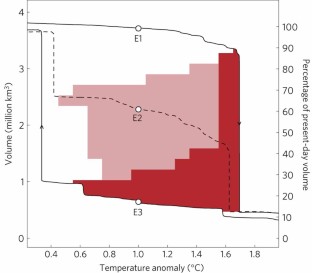
The alternative text for this image may have been generated using AI.
Figure 2: Threshold estimates.

The alternative text for this image may have been generated using AI.
Figure 3: Transient GIS evolution.
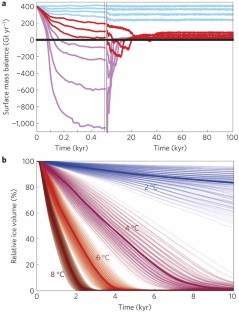
The alternative text for this image may have been generated using AI.
Figure 4: Equilibrium states of the GIS.
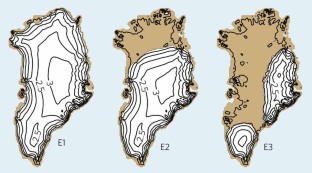
The alternative text for this image may have been generated using AI.
References
- Gregory, J. M. & Huybrechts, P. Ice-sheet contributions to future sea-level change. Phil. Tran. R. Soc. A 364, 1709–1732 (2006).
Article CAS Google Scholar - Oerlemans, J. & Van Den Dool, H. M. Energy balance climate models: Stability experiments with a refined albedo and updated coefficients for infrared emission. J. Atmos. Sci. 35, 371–381 (1978).
Article Google Scholar - Letréguilly, A., Huybrechts, P. & Reeh, N. Steady-state characteristics of the Greenland ice sheet under different climates. J. Glaciol. 37, 149–157 (1991).
Article Google Scholar - Crowley, T. J. & Baum, S. K. Is the greenland ice sheet bistable? Paleoceanography 10, 357–363 (1995).
Article Google Scholar - Lenton, T. M. et al. Tipping elements in the Earth’s climate system. Proc. Natl Acad. Sci. USA 105, 1786–1793 (2008).
Article CAS Google Scholar - Archer, D. et al. Atmospheric lifetime of fossil fuel carbon dioxide. Annu. Rev. Earth Planet. Sci. 37, 117–134 (2009).
Article CAS Google Scholar - Pollard, D. & DeConto, R. M. Hysteresis in Cenozoic Antarctic ice-sheet variations. Glob. Planet. Change 45, 9–21 (2005).
Article Google Scholar - Calov, R. & Ganopolski, A. Multistability and hysteresis in the climate-cryosphere system under orbital forcing. Geophys. Res. Lett. 32, L21717 (2005).
Article Google Scholar - Toniazzo, T., Gregory, J. M. & Huybrechts, P. Climatic impact of a Greenland deglaciation and its possible irreversibility. J. Clim. 17, 21–33 (2004).
Article Google Scholar - Charbit, S., Paillard, D. & Ramstein, G. Amount of CO2 emissions irreversibly leading to the total melting of Greenland. Geophys. Res. Lett. 35, L12503 (2008).
Article Google Scholar - Ridley, J., Gregory, J. M., Huybrechts, P. & Lowe, J. Thresholds for irreversible decline of the Greenland ice sheet. Clim. Dynam. 35, 1049–1057 (2009).
Article Google Scholar - Meehl, G. A. et al. in IPCC Climate Change 2007: The Physical Science Basis (eds Solomon, S. et al.) 747–846 (Cambridge Univ. Press, 2007).
Google Scholar - Bougamont, M. et al. Impact of model physics on estimating the surface mass balance of the Greenland ice sheet. Geophys. Res. Lett. 34, L17501 (2007).
Article Google Scholar - Robinson, A., Calov, R. & Ganopolski, A. An efficient regional energy-moisture balance model for simulation of the Greenland ice sheet response to climate change. The Cryosphere 4, 129–144 (2010).
Article Google Scholar - Greve, R. Application of a polythermal three-dimensional ice sheet model to the Greenland ice sheet: Response to steady-state and transient climate scenarios. J. Clim. 10, 901–918 (1997).
Article Google Scholar - Robinson, A., Calov, R. & Ganopolski, A. Greenland ice sheet model parameters constrained using simulations of the Eemian Interglacial. Clim. Past 7, 381–396 (2011).
Article Google Scholar - Frieler, K., Meinshausen, M., Mengel, M., Braun, N. & Hare, W. A scaling approach to probabilistic assessment of regional climate change. J. Clim. http://dx.doi.org/110927043956000 (in the press, 2011).
- Meehl, G. A. et al. The WCRP CMIP3 multimodel dataset: A new era in climate change research. Bull. Am. Meteorol. Soc. 88, 1383–1394 (2007).
Article Google Scholar - Franco, B., Fettweis, X., Erpicum, M. & Nicolay, S. Present and future climates of the Greenland ice sheet according to the IPCC AR4 models. Clim. Dynam. 36, 1897–1918 (2010).
Article Google Scholar - Christensen, J. H. et al. in IPCC Climate Change 2007: The Physical Science Basis (eds Solomon, S. et al.) 847–940 (Cambridge Univ. Press, 2007).
Google Scholar - Box, J. E., Yang, L., Bromwich, D. H. & Bai, L-S. Greenland ice sheet surface air temperature variability: 1840–2007. J. Clim. 22, 4029–4049 (2009).
Article Google Scholar - Ridley, J. K., Huybrechts, P., Gregory, J. M. & Lowe, J. A. Elimination of the Greenland ice sheet in a high CO2 climate. J. Clim. 18, 3409–3427 (2005).
Article Google Scholar - Rahmstorf, S. Bifurcations of the Atlantic thermohaline circulation in response to changes in the hydrological cycle. Nature 378, 145–149 (1995).
Article CAS Google Scholar - Hardy, R. J., Bamber, J. L. & Orford, S. The delineation of drainage basins on the Greenland ice sheet for mass-balance analyses using a combined modelling and geographical information system approach. Hydrol. Process. 14, 1931–1941 (2000).
Article Google Scholar - Lewis, S. M. & Smith, L. C. Hydrologic drainage of the Greenland ice sheet. Hydrol. Process. 23, 2004–2011 (2009).
Article Google Scholar - Uppala, S. M. et al. The ERA-40 re-analysis. Q. J. R. Meteorol. Soc. 131, 2961–3012 (2005).
Article Google Scholar
Acknowledgements
We would like to thank R. Greve for providing us with the ice-sheet model SICOPOLIS. We are also grateful to K. Frieler for providing the AOGCM scaling coefficients and to M. Perrette and J. Rougier for support concerning statistics. We acknowledge the modelling groups, the Program for Climate Model Diagnosis and Intercomparison and the World Climate Research Programme’s Working Group on Coupled Modelling for their roles in making available the World Climate Research Programme CMIP3 multimodel data set. Support of this data set is provided by the Office of Science, US Department of Energy. A.R. was financially supported by the European Commission’s Marie Curie 6th Framework Programme and by the Spanish Ministry of the Environment under project 200800050084028. R.C. was financially supported by the Deutsche Forschungsgemeinschaft grant RA 977/6-1.
Author information
Authors and Affiliations
- Potsdam Institute for Climate Impact Research, Potsdam D-14412, Germany
Alexander Robinson, Reinhard Calov & Andrey Ganopolski - Universidad Complutense de Madrid, Madrid 28040, Spain
Alexander Robinson - Instituto de Geociencias (IGEO), CSIC-UCM, Madrid 28040, Spain
Alexander Robinson
Authors
- Alexander Robinson
- Reinhard Calov
- Andrey Ganopolski
Contributions
All authors contributed equally to this work.
Corresponding author
Correspondence toAlexander Robinson.
Ethics declarations
Competing interests
The authors declare no competing financial interests.
Supplementary information
Rights and permissions
About this article
Cite this article
Robinson, A., Calov, R. & Ganopolski, A. Multistability and critical thresholds of the Greenland ice sheet.Nature Clim Change 2, 429–432 (2012). https://doi.org/10.1038/nclimate1449
- Received: 16 February 2011
- Accepted: 13 February 2012
- Published: 11 March 2012
- Issue date: June 2012
- DOI: https://doi.org/10.1038/nclimate1449